
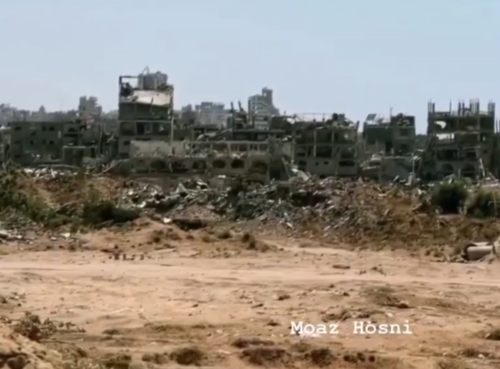
Israeli occupation forces launched new strikes and opened fire across several areas of the Gaza Strip on Saturday, injuring Palestinians in the north, center, and south of the enclave as ceasefire violations continued to escalate.
In Khan Younis, medical teams reported that a Palestinian man was shot in the city center, while additional civilians were wounded in an Israeli strike on Old Gaza Street in Jabalia in the northern Gaza Strip. Israeli military vehicles also opened sustained fire east of Khan Younis, an area repeatedly subjected to direct targeting.
Gunfire was also reported in Rafah, where Israeli warplanes fired toward the city, and Israeli artillery shelled the Zeitoun neighborhood southeast of Gaza City. Helicopters opened fire over areas east of Gaza City, including the vicinity of Shuja’iyya, which lies within zones Israel is required to vacate under the ceasefire agreement. Artillery fire also struck areas around the Zeitoun and Shuja’iyya neighborhoods inside Gaza City.
Emergency services reported additional injuries from Israeli fire outside designated deployment zones in Beit Lahia and central Khan Younis, where Nasser Medical Complex treated a Palestinian shot by Israeli forces. Earlier in the day, field reporters documented intensified Israeli gunfire inside areas where troops remain stationed east of the city.
A medical source said an Israeli quad‑copter drone shot Moayad Abu Muamar, 47, in the head near the Jasser Building junction in central Khan Younis, an area from which Israeli forces had previously withdrawn under the ceasefire terms.
🚨Israel is not only killing Palestinians with bombs and bullets.
Australian doctor Nada Abu Alrub, who volunteered in Gaza for an extended period during the war treating the wounded, explains that the catastrophic living conditions ,lack of clean water, collapsing sanitation… pic.twitter.com/oyGmJdSFLF
— Gaza Notifications (@gazanotice) January 22, 2026
Israeli fighter jets also struck locations southeast of Khan Younis, coinciding with heavy machine‑gun fire from military vehicles in the same area. Israeli naval forces simultaneously opened random fire toward the Khan Younis coastline.
In the eastern parts of the central governorate, particularly Deir al‑Balah and al‑Bureij refugee camp, Israeli armored units opened intense fire throughout the morning.
In Rafah, at Gaza’s southern edge, Israeli navy ships fired shells and live rounds at areas near the shore.
On his part, Ajith Sunghay, head of the UN office in Gaza, urged the international community to increase pressure to halt the bloodshed and support a rights‑based approach to recovery and reconstruction.
Meanwhile, uncertainty continues over the status of the Rafah crossing. Some sources cite U.S. efforts to reopen the crossing, while others point to Israeli decisions to keep it closed. U.S. envoy Steve Witkoff and the so-called “Gaza Administration Council” member Jared Kushner are expected in Israel for talks with Prime Minister Benjamin Netanyahu, Al-Jazeera reported.
Israeli Yedioth Ahronoth reported that discussions will focus on reopening Rafah and initiating Gaza’s reconstruction.
Jodie Ginsberg, CEO of the Committee to Protect Journalists (CPJ), said that Israel has killed more than 200 Palestinian journalists since October 7, making Gaza the most dangerous place for journalists in modern history. pic.twitter.com/eiMJ1F03Ba
— Ramy Abdu| رامي عبده (@RamAbdu) January 24, 2026
The paper said U.S. officials are pressing Israel to open the crossing before the recovery of the body of Israeli soldier Ran Gvili, with Washington pledging to assist in locating his remains.
U.S. State Department spokesperson Carissa Gonzalez said reopening Rafah is a core component of what it called “the Gaza peace plan,” adding that the crossing is expected to operate in both directions and that President Trump is closely monitoring developments.
While “Gaza administrator” Ali Shaath announced Thursday that Rafah would reopen next week, Israeli media reports dispute this, asserting that the crossing will not open until Israel’s conditions are fully met.
Yedioth Ahronoth confirmed that Israel’s security cabinet recently decided not to reopen Rafah at this stage.
On the ground, and amidst the ongoing Israeli violations, Israeli occupation forces continue to shift the so‑called “yellow line” deeper into Gaza City, expanding the areas under their control, the spokesperson for Gaza Municipality said on Saturday.
New satellite imagery shows that Israel has moved the concrete blocks marking the line eastward into the historic Tuffah neighborhood, demolishing dozens of buildings in the process, a move that constitutes a violation of the ceasefire agreement.
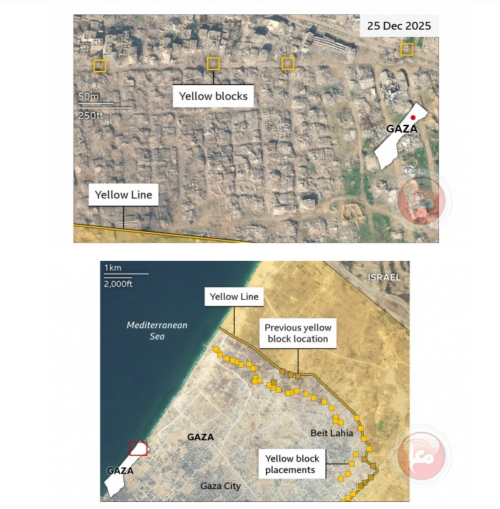 Satellite images taken on December 2nd and 13th 2025 reveal that the blocks were pushed roughly 200 meters into territory previously under Hamas control.
At least 40 buildings were subsequently demolished, leaving the neighborhood empty of residents.
In other parts of Gaza, Israel has shifted the blocks tens or even hundreds of meters further into Palestinian land and constructed at least six new military fortifications.
The Tuffah neighborhood, where thousands of Palestinians sought refuge after the October 2025 ceasefire, has now been reduced to a devastated landscape of rubble, with considerable damage to historic infrastructure.
Field reports also document repeated Israeli gunfire around the repositioned line, alongside Israeli claims of attempted crossings, despite the agreement requiring Israeli forces to withdraw to the original line rather than advance beyond it.
Palestinian sources report that Israeli violations of the ceasefire alone have resulted in 477 Palestinians killed and 1,301 injured since the agreement took effect in October of last year, forming part of a broader pattern of ongoing violations.
Since October 7, 2023, Israeli attacks have killed at least 71,562 Palestinians and injured more than 171,379 others — most of them children, women, and the elderly — across the Gaza Strip.
