
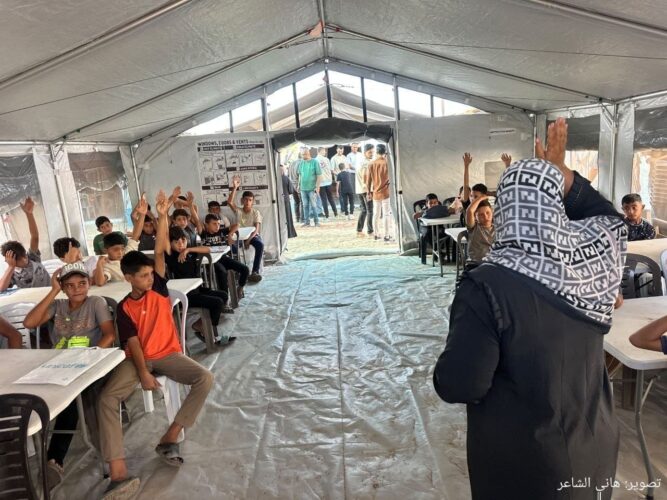
About 700,000 children are expected to return to lessons across Gaza—but most have no school to return to. With education buildings damaged, destroyed or sheltering displaced families, classes are beginning in temporary centers, tents and, where electricity and internet access allow, online.
The 2026–2027 school year began on Saturday after three years of war. Gaza’s Education Ministry aims to reach roughly 350,000 students, up from about 270,000 last year, while UNRWA is combining classroom and remote instruction for hundreds of thousands more.
Making Education Possible with Limited Resources
Teachers and administrators returned on September 16, followed by students on September 19. The plan reflects the harsh limits facing Gaza’s education system.
Classes are being held wherever space is available—in usable buildings, temporary centers and tents. Schools are also using digital platforms when students have electricity, devices and reliable internet, allowing teaching to resume before damaged schools are rebuilt.
Officials expect about 320 schools and learning points to operate this year, up from roughly 270 last year. Even so, many children will remain far from a conventional classroom.
In-Person and Remote Instruction
UNRWA opened 86 learning spaces at the start of the school year and plans to expand in-person classes as safe locations, teachers and basic services become available.
The program covers grades one through nine. About 280,000 children are expected to study remotely, while 72,051 will join the first phase of in-person classes. If conditions improve, face-to-face enrollment could reach about 100,000.
In-person students will have four lessons a day, three days a week, while remote teaching and follow-up continue through Moodle and other approved channels.
Tents as an Emergency Measure
For many students, however, the classroom is a tent. These makeshift spaces are stifling in warm weather, bitterly cold in winter and often too worn to offer a safe, healthy place to study.
Education Ministry figures cited in the original report indicate that about 97% of Gaza’s educational buildings are out of service—damaged, destroyed or sheltering displaced families. Tents and other temporary spaces remain emergency measures, not substitutes for reconstruction.
Years of Lost Learning
Space is only part of the challenge. After years of disrupted schooling, many students have fallen far behind. Teachers must assess what each child knows, then rebuild lost skills.
In-person lessons prioritize Arabic, English, mathematics and general science. Supplementary materials cover Islamic education and social studies, with online resources used where possible.
For students in grades two through nine, the ministry is also running an Accelerated Learning Program. Rather than rushing through the curriculum, it focuses on restoring the basic knowledge and skills students need to progress.
UNICEF is helping train principals and teachers to assess students’ needs and deliver the program.
A Generation Marked by War
According to figures cited by Gaza’s Education Ministry in the original report, about 17,000 students and 770 education workers have been killed during the war. The scale of that loss hangs over every effort to restart schooling.
Survivors face repeated displacement, insecurity and acute shortages of safe classrooms, supplies, electricity and internet access. Many also carry deep learning gaps and growing psychosocial needs.
Remote learning has also been uneven. Because many families lack devices or reliable internet, educators are using printed materials and other low-tech alternatives while developing an offline version of Moodle.
The ministry itself has been crippled. Its headquarters was destroyed, along with much of its furniture and equipment, while offices and transport vehicles were also lost.
Rebuilding the Education System
The recovery plan has three priorities: restore access to education, help students regain lost skills and gradually rebuild Gaza’s schools and wider education system.
For now, hundreds of thousands of children are studying wherever they can—in surviving schools, temporary centers, tents or online. Learning has resumed, but normal schooling remains distant.
Reopening classes offers children a measure of continuity amid displacement and destruction. It also keeps education within reach while Gaza’s schools and wider system await reconstruction.
