
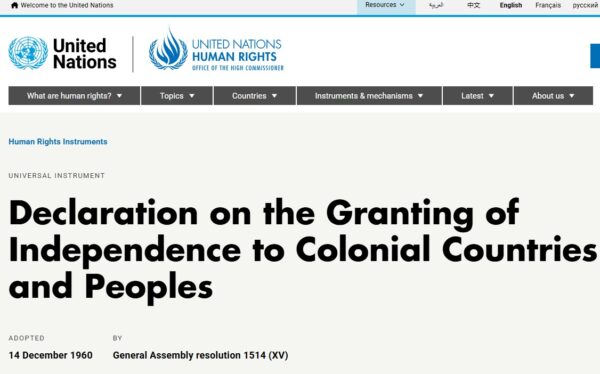
The United Nations General Assembly on Thursday held a high‑level plenary session to mark the 65th anniversary of the Declaration on the Granting of Independence to Colonial Countries and Peoples (adopted on 14 December 1960), with broad participation from member states.
The opening session featured addresses by the President of the General Assembly, the President of the Economic and Social Council, and the Assistant Secretary‑General for Peacebuilding Support, followed by statements from several countries, including Palestine, represented by its Permanent Observer to the UN, Ambassador Riyad Mansour.
In his remarks, Mansour stressed that the declaration was not merely a historic document but a binding affirmation of a natural law: that all human beings are born free and equal in dignity and rights.
He emphasized that the right to self‑determination stands at the core of the UN Charter and remains the most decisive principle in international order.
Mansour noted that while the declaration marked a turning point for many nations that achieved freedom and independence, for the Palestinian people it has remained an unfulfilled promise, delayed for decades and leaving behind unbearable humanitarian consequences.
He added that the words of the declaration still resonate across the occupied Palestinian territory and among millions of Palestinians in exile, serving both as a reminder of ongoing injustice and as a testament to the enduring belief that freedom will ultimately prevail.
The ambassador underscored that the declaration affirms the right of all peoples to self‑determination and deems the subjugation of nations to foreign domination and exploitation a violation of fundamental human rights, incompatible with the UN Charter and destructive to peace and international cooperation.
In this context, Mansour pointed to the advisory opinion issued by the International Court of Justice in 2024, which affirmed that the right to self‑determination under foreign occupation constitutes a peremptory norm of international law. The opinion further concluded that Israel’s practices of annexation and permanent control over the occupied Palestinian territory render its presence there unlawful.
Mansour called for the immediate end of this illegal colonial occupation, stressing that the Palestinian people continue to stand at the doors of the United Nations, awaiting the freedom and independence long denied to them.
He concluded by declaring that the time for Palestine’s freedom is long overdue, and that the Palestinian people must take their rightful place among the nations of the world as a free people exercising their inalienable right to self‑determination.
