
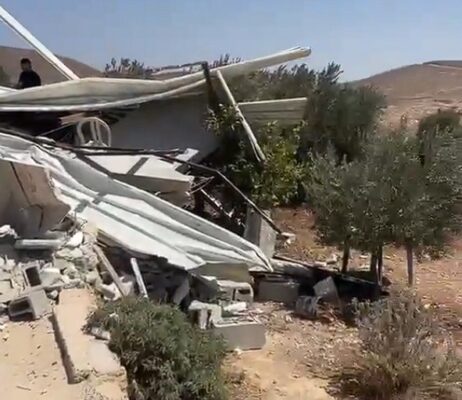
Israeli occupation forces carried out coordinated demolitions across three West Bank districts on Monday, destroying agricultural structures, a home under construction, a horse farm, and multiple commercial facilities, while simultaneously expanding bulldozing operations that threaten thousands of dunams of privately owned Palestinian farmland.
The soldiers invaded the town of Beit Dajan, east of Nablus in the northern West Bank, before dawn and demolished two agricultural structures.
Local sources said several military vehicles stormed the town at daybreak and destroyed two agricultural barracks, one belonging to Ghassan Hanini and the other to a member of the Tamam family. The demolition caused a power outage affecting the western plain area of the town and also destroyed the main waterline supplying residents with essential water services.
Later in the morning, occupation forces invaded Kafr Malek, east of Ramallah, and demolished a home under construction along with a horse farm.
Activist Jihad al‑Qaq stated that soldiers invaded the Jabal al‑‘Asur area and demolished a 140‑square‑meter home and a 460‑square‑meter horse farm owned by Khair B’eirat, under the pretext that the structures were located in Area “C.”
He added that the owner had received a stop‑work order nearly two years ago, and that soldiers forced him to remove the horses before the demolition but prevented him from salvaging any equipment or belongings.
In Jenin, in the northern West Bank, occupation forces distributed demolition notices targeting numerous commercial structures around Duwwar al‑Badia (Marj Ibn ‘Amer), while maintaining a heavy military presence in the area.
The notices were issued as Israeli bulldozers continued, for the tenth consecutive day, to level farmland in the nearby village of ‘Arbouna, threatening more than 1,000 dunams of cultivated land planted with olive, almond, and carob trees—part of an effort to establish a new illegal colony.
Shop owner Fayez Rawajba said that occupation forces handed demolition orders to owners of several commercial structures and barracks, demanding their removal within seven days under orders issued by the Israeli military commander.
The targeted facilities include shops under construction, vegetable and agricultural‑supply kiosks, restaurants, garages, and workshops belonging to Ishaq Mahamid, Ahmad ‘Eleyat, Fayez Rawajba, Muhammad ‘Eleyat, Mer’ey Sa’adi, Mahmoud Sa’adi, Talal Yasin, Mustafa Turkman, ‘Amer ‘Azmouti, and Osama ‘Azmouti.
Rawajba warned that the demolitions threaten the livelihoods of dozens of families who depend on these businesses.
The demolition orders cover two shops, a kiosk, carpentry workshops, car‑repair facilities, and other commercial structures.
Meanwhile, Hashim Abu Hasan, head of the ‘Arbouna village council, reported that Israeli bulldozers began leveling land in Basin 3, roughly 400 meters from the apartheid wall, extending toward the main road between ‘Arbouna and Faqqu’a.
He said soldiers uprooted olive and almond trees, destroyed fencing, and bulldozed his own 10‑dunam plot without issuing any prior confiscation order, despite the land being registered as private property.
Abu Hasan added that illegal paramilitary Israeli colonizers have already placed a caravan in the area and begun grazing around 15 sheep on Palestinian land, while soldiers repeatedly prevent residents from accessing their farms and invade the area whenever locals attempt to reach their property.
He warned that more than 1,000 dunams in ‘Arbouna and 1,500 dunams in neighboring Faqqu’a—rich with ancient olive trees, almonds, and cactus—are now under direct threat, jeopardizing the primary source of income for dozens of families.
The Wall & Colonization Resistance Commission documented 2,256 colonial attacks by Israeli forces and illegal paramilitary colonizers during July, targeting Palestinians, their land, and their property.
According to the Commission’s monthly report, Israeli authorities carried out 80 demolitions affecting 165 Palestinian structures, including 80 inhabited homes, 8 uninhabited homes, 63 agricultural facilities, and 11 sources of livelihood.
The highest concentration of demolitions occurred in Qalqilia (34 structures), followed by Hebron (26), Ramallah and al‑Bireh (22), and Bethlehem (16).
