
Israeli occupation forces and illegal paramilitary colonizers carried out a wide‑ranging escalation across the occupied West Bank overnight and into Monday, invading towns and refugee camps, breaking into homes, abducting residents, demolishing property, and launching coordinated colonizer assaults that included arson, land seizures, and violent attacks on civilians.
Israeli Army Invasions and Attacks
Israeli occupation forces conducted widespread invasions across the occupied West Bank, breaking into homes, abducting residents, destroying property, and assaulting civilians in multiple districts.
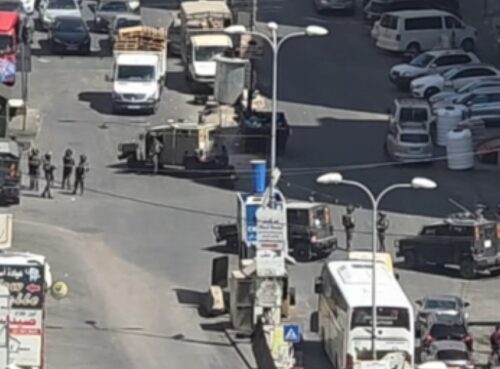
In occupied Jerusalem, soldiers invaded the town of Kafr ‘Aqab north of the city, deployed snipers on rooftops, closed a main street, and fired dozens of gas bombs at residents and homes.
Troops also broke into several buildings and forced a resident to accompany them as a human shield during searches. Soldiers continued to deploy throughout the town without reported injuries or abductions.
In Bethlehem, soldiers invaded Beit Fajjar and Tuqu’, firing concussion grenades at residents during ensuing protests. In al‑Khader south of Bethlehem, troops broke into a family celebration in the Um Rokba area and held residents for extended periods.
In Tulkarem, in the northwestern West Bank, soldiers invaded the ‘Ektaba suburb, broke into a residential building, and abducted former detainee Mohannad Abu Talal and Noor Shehada.
Troops also invaded Bal’a, northeast of Tulkarem, broke into the home of former political prisoner Ra’fat Murad Mur’i, ransacked the property, and abducted him.
Soldiers later forced residents of Jabal al‑Salihin east of Nur Shams refugee camp to evacuate their homes, claiming ongoing military operations and possible explosions.
The army sent additional armored vehicles and bulldozers into Nur Shams refugee camp, which has been under assault and siege for 541 consecutive days, causing extensive destruction of homes, roads, and infrastructure.
In Nablus, in the northern West Bank, soldiers invaded the eastern area near the Beit Furik military roadblock and the village of Beit Dajan, accompanied by bulldozers that demolished an agricultural structure, a caravan, and a water line.
The soldiers also invaded the village of Tell southwest of Nablus and broke into a residential building near the Arab Specialized Hospital and Faisal Street.
In eastern area of Beit Furik town, soldiers demolished an agricultural room belonging to resident ‘Ayed Nassar and bulldozed cultivated land.
In Jenin, in the northern West Bank, soldiers invaded Jalbun on foot, detained several young men, and assaulted them.
In addition, the army set up a military position at the entrance of Deir Ghazala, detained dozens of residents, forced them to lie on the ground, and assaulted them before breaking into homes and shops.
Soldiers also fired live rounds at a Palestinian vehicle near the American University roundabout. In Zababda and ‘Aqqaba, soldiers broke into homes, destroyed property, and abducted Basel Sharqawi and his son Baha’.
In Hebron, in the southern West Bank, soldiers invaded al‑Fawwar refugee camp, deploying heavily throughout its neighborhoods.
In Ramallah, in the central West Bank, soldiers invaded Birzeit and Deir Jarir. In Kafr Malek east of Ramallah, troops demolished a horse stable and an under‑construction home after forcing the owners to remove the horses. Bulldozers then began demolishing the structures.
In the same area, Israeli forces abducted two brothers, Zaid and Mohammad Salim Turki from Abu Falah, while they were working in their farmland in the Marj Si‘a plain.
In Qalqilia, in the northwestern West Bank, soldiers invaded Kufur Qaddum and broke into a home during their military operation.
In the northern Jordan Valley, soldiers invaded Bardala Secondary School and removed the Palestinian flag from its flagpole before withdrawing.
The director of education in Tubas, Azmi Bilawna, said the invasion is part of ongoing Israeli violations targeting educational institutions, including invasions, harassment of students, and restrictions on teachers and staff.
Illegal Paramilitary Colonizer Violations
 Paramilitary colonizers carried out many attacks across the occupied West Bank, including assaults on civilians, arson, land seizures, vandalism, and harassment of farmers and shepherds, often under direct Israeli military protection.
In Bethlehem, in the southern West Bank, an elderly Palestinian man was injured on Monday Israeli colonizers assaulted him in the Abu Njei area southeast of the city.
Local sources said the colonizers attacked Yahya ‘Elian while he was working on his land, beating him severely and spraying pepper gas at his face, causing bruises, cuts, and breathing difficulties. He received field treatment at the scene.
In a related incident, Israeli occupation forces invaded the Burak Suleiman archaeological and tourist area between al‑Khader and Artas, deploying around the second pool without conducting home invasions or arrests.
Residents noted that attacks by Israeli soldiers and colonizers have escalated recently in the Bethlehem district, particularly in Abu Njeim, where colonizers have repeatedly assaulted residents, attacked homes, fired at Palestinian vehicles, and vandalized property.
In Salfit, in the central West Bank, colonizers invaded Kifl Hares north of the city to perform religious rituals under heavy military protection.
In Tulkarem, colonizers conducted repeated provocative tours in the village of Ramin east of the city, where residents confronted them and forced them to withdraw.
In Nablus, colonizers set fire to olive trees in the Khanq area of Jabal ‘Ein ‘Eina, belonging to the town of Talfit, raising fears the blaze would spread to wider agricultural lands.
Colonizers also attacked a home in Beita, dumping piles of garbage at its entrance, and violently assaulted a young man from ‘Awarta while he was present in the al‑‘Arma area of Beita.
Also in Nablus, Israeli colonizers attacked a Palestinian commercial vehicle on Askar al‑Balad Street east of the city, causing extensive damage before attempting to seize the vehicle. Local sources said the colonizers blocked the road, assaulted the driver, and tried to force him out of the vehicle.
In addition, many colonizers seized the al‑Fakht area between the lands of ‘Urif, ‘Asira al‑Qibliya, and Jamma’in south of Nablus to establish a new illegal colonial outpost.
In Sebastia town, northwest of Nablus, Israeli occupation forces accompanied groups of colonizers into the archaeological area, before the soldiers forced all Palestinian shops to close and removed residents from the site.
In another attack, Israeli colonizers set fire to Palestinian lands in the town of Burqa northwest of the Nablus.
Local sources said several colonizers, accompanied by Israeli occupation soldiers, attacked the area and ignited fires near the northern cemetery, burning a number of trees.
Residents noted that Burqa, like other towns and villages northwest of Nablus, is subjected to repeated colonizer assaults that include attacking civilians and their property, and setting agricultural lands and trees ablaze, all under Israeli military protection.
Furthermore, a group of illegal paramilitary colonizers invaded Palestinian agricultural lands in the villages of Odala and Awarta, south of Nablus, where they began preparing the ground for a new road intended to connect the area to a recently established illegal colonial outpost in an effort to expand it.
Local sources said the soldiers deployed heavily throughout the area, blocked roads leading to the historic site, and prevented Palestinians from accessing nearby markets and public spaces while the colonizers roamed the archaeological area.
Residents reported that the army has been increasingly restricting access to Sebastia’s archaeological area in recent weeks, allowing colonizer groups to enter while barring Palestinians, in what local officials describe as part of ongoing efforts to impose control over the historic site and undermine Palestinian presence in the town.
In Ramallah, colonizers carried out provocative tours around the illegal outpost near Umm Safa northwest of the city and erected a new tent on Palestinian land.
Furthermore, Israeli colonizers attacked Palestinians between the villages of al‑Mughayyir and Abu Falah northeast of Ramallah.
Local sources said colonizers assaulted a Palestinian vehicle on the Marj Si‘a meadow road, beating two residents who were traveling with their children.
In Salfit, dozens of colonizers invaded the town of Kifl Hares north of the district at dawn, entering the historic Islamic shrines under heavy Israeli military protection.
Local sources said large groups of colonizers performed rituals inside the shrines of Dhul-Kifl, Dhul‑Nun, and Prophet Yusha’, three of the most significant religious and archaeological landmarks in the area.
Residents reported that these invasions occur repeatedly and are often accompanied by attacks on Palestinian property, including the smashing of windows, desecration of the adjacent Islamic cemetery, vandalism of gravestones, and the spray‑painting of incitement slogans, all under the protection of Israeli occupation forces.
In occupied Jerusalem, surveillance cameras documented colonizers spitting at and throwing stones toward the entrance of the historic Monastery of Saint James in the Armenian Quarter.
In addition, more than 181 colonizers, accompanied by soldiers and police officers, stormed the courtyards of Al-Aqsa Mosque and toured the holy site after the army forced the Palestinians to leave.
In Hebron, colonizers released their livestock around Palestinian homes in Khirbet al‑Kharaba east of as‑Samu’, damaging crops and threatening residents. Colonizers also invaded Khirbet Imnizil in Masafer Yatta south of Hebron under military protection.
Local sources said the colonizers, carrying automatic weapons and protected by soldiers, released their livestock onto Palestinian agricultural lands and vandalized residents’ property in the area.In the northern Jordan Valley, colonizers invaded agricultural areas near Bardala and Ein al‑Baida, damaging irrigation networks and threatening farmers.
Across the West Bank, colonizer groups moved freely under Israeli military protection, coordinating their attacks with soldiers stationed at military roadblocks and surrounding areas.
Palestinian communities continue to face escalating colonizer violence, including land seizures, arson, destruction of crops, attacks on homes, and harassment of farmers and shepherds.
These are some of the documented invasions and violations carried out by Israeli soldiers and illegal paramilitary colonizers across the occupied West Bank; due to the ongoing nature of the invasions and attacks, it remains difficult to fully document all incidents as many occur simultaneously or in areas field teams cannot safely reach.
