
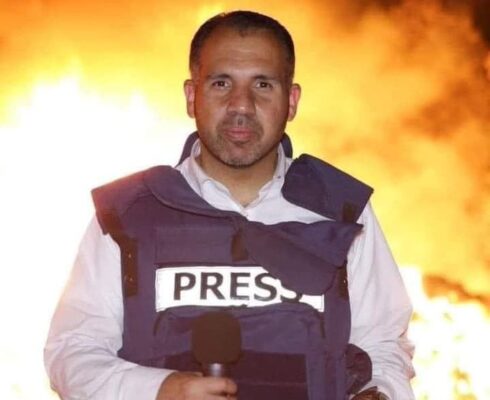
Israeli forces abducted Palestinian journalist and former political prisoner Ala Rimawi, founder of the “Conceding for the Sake of God” initiative, at dawn Thursday after invading his home in Al-Bireh, in the central occupied West Bank.
Members of Rimawi’s family said a large military force surrounded and invaded the home shortly after 1 a.m. Soldiers confined members of the family to a separate room while searching and ransacking the property.
The soldiers handcuffed Rimawi and took him to an undisclosed location. They also confiscated his mobile phone and a camera tripod from the home, according to the family.
The family said the soldiers did not explain the reason for the abduction, and Israeli authorities had not announced any charges against Rimawi by the time of publication.
Rimawi is a Palestinian journalist and former political prisoner who has worked as a correspondent for Al-Jazeera Mubasher and managed the J-Media Network. He is also widely known for his reporting and commentary on Palestinian political, social, and humanitarian affairs.
His latest abduction came less than two weeks after he launched the “Conceding for the Sake of God” initiative—known in Arabic as “Tanazal Lillah”—which encourages merchants to forgive debts owed by Palestinians who are unable to pay.
The initiative began after a Palestinian schoolteacher contacted Rimawi seeking assistance with a debt of 2,000 shekels. She feared that her inability to meet the financial obligation could expose her to legal proceedings and imprisonment.
Rimawi contacted the creditor, who agreed during the brief telephone conversation to forgive the teacher’s debt. The rapid resolution prompted him to consider extending the same approach to other financially distressed Palestinians.
He launched the initiative publicly on September 4, inviting merchants, business owners, lenders, and individuals to waive debts or reduce financial claims against people facing genuine hardship.
The campaign quickly spread through social media and drew participation from Palestinians across the country. Participants announced the cancellation of personal debts, unpaid accounts, checks, and other financial obligations.
Published estimates of the initiative’s value rose as the campaign expanded. Reports placed the total at about 15 million shekels on September 11 and 65 million shekels on September 15, while reports published on September 17 said commitments had exceeded 75 million shekels.
The amounts were publicly reported commitments made by individual creditors and participants rather than funds collected or distributed by a central organization.
The initiative gained attention at a time when Palestinian families face growing financial pressure associated with unemployment, restrictions on movement and commerce, Israel’s withholding of Palestinian revenues, and the widespread economic consequences of the ongoing Israeli assault on the Gaza Strip.
Rimawi’s family emphasized that the campaign was a social initiative based on voluntary debt forgiveness and did not have a political or organizational purpose.
Rimawi has been abducted and imprisoned by Israel on several previous occasions. In April 2021, Israeli forces invaded his home and abducted him before placing him under administrative detention for three months. The order was later reduced, and he was released after approximately six weeks following a hunger strike against his imprisonment.
Administrative detention enables Israeli authorities to imprison Palestinians without filing charges or presenting evidence in an open court. Detention orders can be renewed repeatedly, leaving prisoners uncertain about when they will be released, and many end up spending years in detention.
Israeli forces abducted Rimawi again on October 19, 2023, during a widespread military campaign targeting Palestinians across the occupied West Bank. He remained imprisoned under administrative detention for nearly two years without charge or trial.
Israel released him on October 6, 2025, according to the Committee to Protect Journalists. Thursday’s abduction occurred less than one year after his release.
During his previous periods of imprisonment, Palestinian media and prisoners’ rights organizations raised concerns about his detention and identified his case as part of Israel’s broader targeting of Palestinian journalists.
Following Thursday’s abduction, Palestinian journalists’ organizations condemned Rimawi’s abduction and called for his immediate release. They said his case reflected continuing Israeli efforts to restrict Palestinian journalism and prevent media workers from documenting events in the occupied Palestinian territories.
The broader impact on Palestinian media workers was reflected in figures released after Rimawi’s latest abduction. The Palestinian Prisoners’ Society said the number of Palestinian journalists imprisoned by Israel had risen to 39, including 21 held under administrative detention without charge or trial, based on what Israeli authorities call “secret files.” The organization said all 39 had been abducted since the start of Israel’s assault on Gaza.
Among the cases cited by the organization, Israeli authorities placed Bethlehem journalists Moath Amarna and Sabri Jibrin under administrative detention for four months. It added that Ramallah journalist Niqa’ Hamed, abducted on September 15, remained imprisoned after her detention was extended until September 23, 2026.
The group also reported that five Palestinian women journalists were imprisoned. It highlighted the case of Bushra al-Tawil, whom Israeli authorities transferred from Damon Prison to isolation at Ramla Prison; no information was available about her conditions of imprisonment.
Rimawi’s latest abduction occurred amid continuing Israeli military invasions, home searches, and mass abduction campaigns across the occupied West Bank, where journalists regularly face imprisonment, physical attacks, equipment confiscation, movement restrictions, and obstruction while carrying out their work.
The Palestinian Prisoners’ Society said Israel’s policies against Palestinian journalists extend beyond imprisonment to isolation, abuse, torture, harsh conditions, denial of medical treatment, and attacks while they carry out their work. It said these measures restrict journalists’ ability to report events and document violations.
The group called on international human rights organizations to fulfill their responsibilities to protect Palestinian journalists, safeguard their right to work, and press for an end to policies of imprisonment, persecution, and isolation.
