
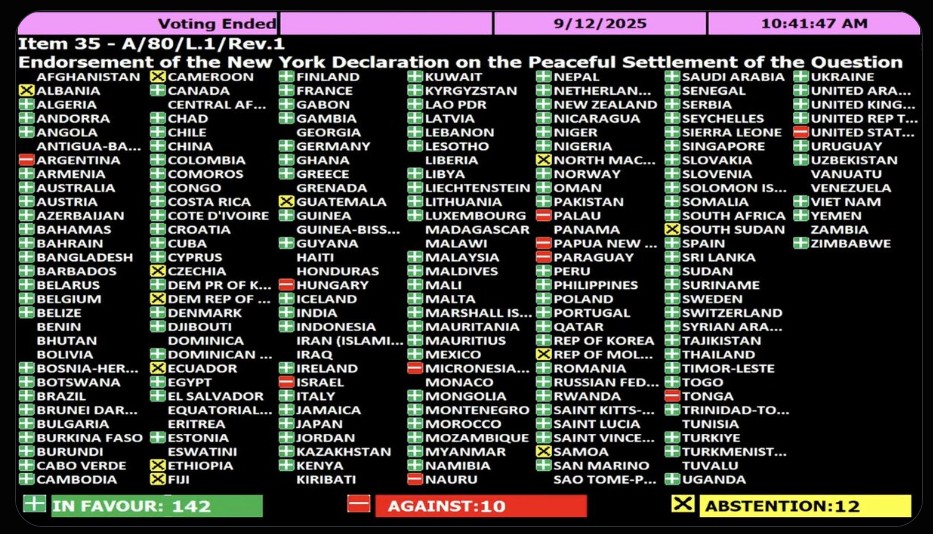
In a decisive overwhelming vote, the United Nations General Assembly adopted a resolution endorsing the “New York Declaration” as a framework for implementing the two-state solution and establishing an independent Palestinian state.
The resolution passed with overwhelming support: 142 countries voted in favor, 10 opposed, and 12 abstained.
The declaration emerged from a high-level international conference on the peaceful resolution of the Palestinian question, co-chaired by Saudi Arabia and France.
It outlines a multi-track approach—political, legal, economic, and security, to ending the Israeli occupation and realizing Palestinian sovereignty.
Palestine welcomed the vote as a significant diplomatic milestone. In a statement issued by the Ministry of Foreign Affairs and Expatriates, the Palestinian leadership praised the broad international consensus and commended Saudi Arabia and France for their role in steering the conference and shaping the declaration into a concrete roadmap.
“This vote affirms the global will to end colonial occupation and uphold the Palestinian people’s right to self-determination,” the statement read. “We thank all nations that sponsored, supported, and voted for this resolution, transforming the New York Declaration into an official UN document.”
The Palestinian Authority urged member states to move beyond symbolic support and begin implementing the declaration’s outcomes.
It called for immediate pressure on Israel to halt its military aggression, lift the siege on Gaza, end the use of starvation as a weapon of war, and stop forced displacement campaigns. The statement also demanded the release of Palestinian prisoners and hostages, and the protection of civilians under international law.
Hussein al-Sheikh, Vice President of the Palestinian Authority, described the resolution as “a turning point in the struggle for justice,” emphasizing that the two-state solution remains the only viable path to peace. “This is not just a diplomatic gesture—it is a call to action,” he said.
The resolution faced opposition from Israel, the United States, and eight other countries. Israeli officials dismissed the declaration as “biased and counterproductive,” while continuing the expansion of its illegal colonies in violation of International Law.
The vote comes amid ongoing genocide in the Gaza Strip and the escalating offensive and violations in the occupied West Bank, where Israeli forces have intensified their attacks and imposed severe restrictions on Palestinian movement and access to humanitarian aid.
The New York Declaration, now formally adopted, calls for an immediate ceasefire, the restoration of civilian infrastructure, and the reactivation of international legal mechanisms to hold perpetrators accountable.
As the resolution enters the implementation phase, Palestine has called on the international community to activate all available tools to dismantle the Israeli colonial regime and enforce the two-state solution.
The Ministry’s statement concluded: “This is a moment of clarity. The world must choose between complicity and accountability.”
In August 2025, the United States government revoked the visa of Palestinian President Mahmoud Abbas, along with those of approximately 80 senior Palestinian officials.
This action was taken shortly before the annual United Nations General Assembly in New York. The decision was announced by Secretary of State Marco Rubio under the administration of President Donald Trump.
The visa revocation effectively barred Abbas from attending the high-level meetings at the UN despite diplomatic pressure. Palestinian diplomats already stationed at the UN mission in New York were not affected and retained their access.
The move drew widespread international criticism, with several European and allied governments—including France, Spain, Ireland, Canada, Australia, and the United Kingdom—condemning the decision.
Legal experts and EU officials cited the 1947 UN Headquarters Agreement, arguing that the United States had violated its obligations as host country by denying entry to a recognized head of state. The Organization of Islamic Cooperation also denounced the ban, calling it discriminatory and politically motivated.
