
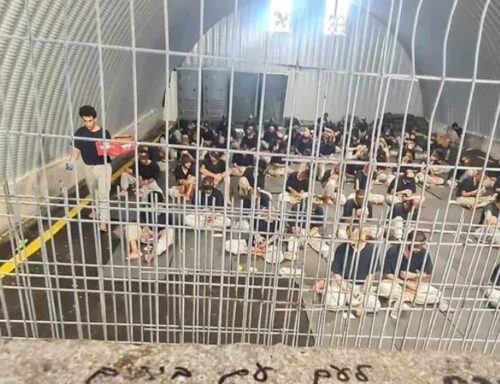
The Commission for Detainees and Ex-Detainees Affairs and the Palestinian Prisoners’ Society (PPS) have jointly condemned Israel’s escalating restrictions on legal teams monitoring the conditions of Palestinian political prisoners. These measures, they assert, have severely obstructed field visits and court proceedings, further isolating detainees held in Israeli prisons.
In a statement issued Monday, the organizations revealed that in addition to long-standing constraints imposed since the onset of the genocide in Gaza, Israeli prison authorities have now barred lawyers from delivering family greetings or messages to detainees.
Legal representatives were explicitly warned that any attempt to convey such communications, whether during prison visits or court sessions, would result in punitive measures.
The statement emphasized that these actions are part of a broader strategy aimed at severing all contact between political prisoners and the outside world, particularly their families.
This isolation is compounded by Israel’s continued denial of access to the International Committee of the Red Cross and the ongoing ban on family visits since the beginning of the war.
Initially, Israeli authorities prohibited all legal visits to detainees. Although sustained efforts by human rights organizations eventually led to the partial resumption of visits, significant obstacles remain.
Among the most flagrant tactics is the deliberate declaration of a “state of emergency” upon a lawyer’s arrival at the prison—an excuse used to cancel scheduled visits after long travel. This practice has occurred repeatedly.
Additionally, responses to visitation requests are routinely delayed for weeks or even months, especially in cases involving detainees serving life sentences.
The statement also documented incidents of physical assaults and threats against detainees before or after meeting with their lawyers. Furthermore, several attorneys have been denied access to detainees for consecutive months.
Of grave concern is the continued practice of enforced disappearance targeting numerous detainees from Gaza. Legal teams have been systematically prevented from locating or communicating with them.
Despite recent amendments to regulations concerning Gaza detainees, which allowed limited visits under heavy security protocols, the majority remain inaccessible to legal counsel.
By July 2025, the number of Palestinians political prisoners in Israeli prisons, detention camps and interrogation facilities, had surged past 10,80, an unprecedented figure not seen since the Second Intifada in 2000.
This sharp rise, documented by Al Jazeera and affirmed by international legal and human rights organizations including the Israeli rights group HaMoked, underscores the intensification of mass arrests following the onset of the genocide in Gaza in October 2023.
Among those imprisoned are roughly 50 women, two of whom are from Gaza, and an estimated 450 minors.
Over 3,600 detainees are held under administrative detention, a practice that allows continued imprisonment without charges or trial.
Additionally, nearly 1,750 individuals from Gaza have been labeled by Israeli authorities as “unlawful combatants,” a classification that effectively denies them the protections afforded under international humanitarian law.
These statistics exclude thousands of Gazans held in military detention centers operated by the Israeli army. Many of these individuals have been forcibly disappeared, with legal representatives and rights organizations barred from accessing information about their status or location.
Since the beginning of the genocide, Israeli occupation forces have abducted more than 16,400 Palestinians, including over 1,300 children and 510 women.
Reports from detainees and advocacy groups point to widespread mistreatment, including physical violence, psychological abuse, and systematic medical neglect.
Hundreds of prisoners suffer from serious health conditions, such as cancer, yet remain without proper care.
Moreover, Israeli occupation authorities continue to withhold the remains of 72 Palestinians who died in custody, among them 17-year-old Walid Ahmad, who is believed to have died of starvation in Megiddo prison.
The breadth and severity of these detentions have drawn condemnation from legal scholars and humanitarian advocates, who argue that Israel’s policies constitute collective punishment and violate international legal standards governing the treatment of detainees during armed conflict.
