
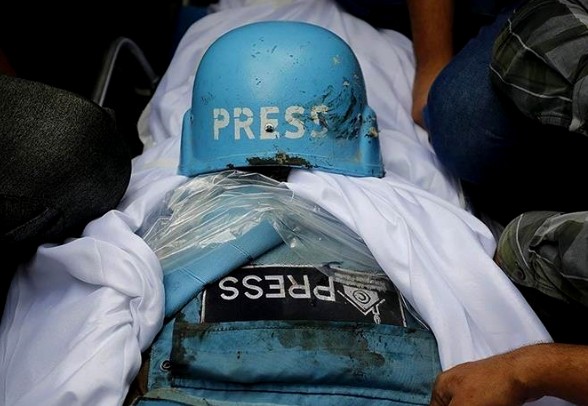
Monitoring and documentation compiled by the Freedoms Committee of the Palestinian Journalists’ Syndicate, covering the period from 7 October 2023 through the end of 2025, reveal a systematic and escalating pattern of lethal targeting against Palestinian journalists.
The data show a clear shift from sporadic violations to a sustained policy aimed at silencing the press through killing, injury, and permanent disability, reaching its peak in 2025.
According to the findings, 76 journalists were seriously wounded by the end of November 2025—an alarming indicator of the intensifying pattern of attacks. The committee noted that journalists were no longer treated as “potential targets,” but as deliberate and repeatedly targeted individuals.
In its report, the Syndicate said that throughout 2025, Israeli forces moved from restricting journalistic work to a policy of “neutralizing” the press through lethal force, with the aim of silencing witnesses, preventing documentation of violations, and undermining the Palestinian narrative on the ground.
2025: The Deadliest Year for Journalists in Palestine:
The committee described 2025 as the deadliest and most violent year for journalists in Palestine—marked by repeated mass targeting in tented press areas, hospitals, and media gatherings.
It was also the year of disabling and fatal strikes, with injuries concentrated in the head, neck, chest, and abdomen, resulting in amputations, loss of eyesight, and permanent disabilities.
The sources of danger overlapped, including the Israeli army, illegal paramilitary Israeli colonizers, drones, artillery fire, and airstrikes.
Timeline of Escalation:
January–March 2025:
Israeli forces continued bombing the homes of journalists in Gaza, while live‑fire injuries were recorded in the West Bank—particularly in Jenin, Hebron, and Ramallah.
The period also saw the beginning of direct targeting of media offices and journalists inside residential neighborhoods, where attacks were no longer tied to moments of coverage but to the identity of the journalist.
April–May 2025:
This period marked the onset of what the committee described as “media massacres.” The attacks on the journalists’ tent at Nasser Hospital on 7–8 April were a turning point: nine journalists were wounded at once, equipment was destroyed, and several journalists later died of their injuries.
The incident, documented and repeated, occurred in a known location and involved heavy weaponry—amounting to a compound war crime and collective targeting of the press.
June 2025:
Multiple journalists were killed while covering events in schools, hospitals, and public squares.
July–August 2025:
A pattern of permanent disabilities emerged. Journalist Akram Dalloul lost his eyesight; journalist Jamal Baddah had a leg amputated; and journalist Mohammad Fayeq was left paralyzed.
Repeated head and neck injuries indicated a pattern of intentional disabling strikes, not incidental harm.
September–November 2025:
Violence expanded with continued bombardment in Gaza and escalating attacks by illegal paramilitary Israeli colonizers in the West Bank—particularly in Beita and Hebron.
These included beatings, vehicular assaults, arson targeting vehicles, and the destruction of press equipment.
Journalists were also injured while covering the olive harvest, a purely civilian event, underscoring the convergence of military and settler violence.
Geographic Distribution:
The data show that the Gaza Strip remained the most dangerous place in the world for journalists, especially in Gaza City, Khan Younis, Deir al‑Balah, Nuseirat, Jabalia, and Rafah.
Targeting was concentrated in press tents, hospitals, displacement shelters, and private homes.
In the West Bank, attacks were concentrated in Jerusalem, Jenin, Nablus, Beita, Tulkarem, Hebron, and Ramallah.
Methods of Targeting:
The Syndicate documented a wide range of tactics, including:
- Direct physical assault.
- Live ammunition.
- Tear gas and stun grenades.
- Attacks by illegal paramilitary Israeli colonizers under army protection.
- Drone strikes.
- Heavy airstrikes and artillery fire.
- Live and rubber‑coated bullets.
- Beating with batons and rifle butts.
- Military vehicle ramming attacks.
Injuries were concentrated in the head, neck, chest, abdomen, pelvis, spine, and limbs, resulting in paralysis, amputations, and other permanent disabilities—consistent with intentional, disabling, and often fatal targeting.
Targeting Journalists Despite Clear Identification
The committee stressed that the overwhelming majority of these injuries occurred during field coverage in locations known to be occupied by journalists, despite their wearing protective vests and press markings. Several journalists were targeted repeatedly on separate occasions.
“A Direct Attack on Truth”:
The Freedoms Committee concluded that the targeting of journalists in Palestine constitutes a direct assault on truth, press freedom, and the right to document events, and that ongoing impunity encourages further crimes against media workers.
Mohammad al‑Lahham, head of the committee, said the events of 2025 amount to war crimes and crimes against humanity, representing a systematic assault on a protected civilian group.
He described the policy as an official strategy to silence the press through force, adding that these are not isolated incidents but “a field doctrine built on the principle: no witnesses, no narrative, no image.”
Al‑Lahham added that the targeting of journalists in Palestine is no longer incidental or circumstantial but has become a structural component of the military and security conduct of the occupation.
