
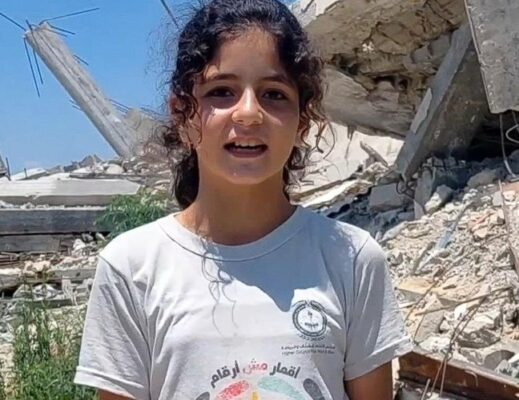
By Ali Al‑Farra – Published in Arabic on WAFA News: One day before she was meant to return to class for remedial lessons, 13‑year‑old Eline Al‑Farra sat inside her family’s tent east of Khan Younis, carefully arranging her notebooks and schoolbooks. She had been looking forward to the new courses designed to help children recover months of lost learning. Eline wanted to arrive early. She wanted to feel like a student again.
As she organized her bag, an Israeli artillery shell landed near the tent. A piece of shrapnel struck the back of her head. Her life ended before she could take her first step back toward the classroom she had been dreaming of.
The Al‑Farra family had returned to the plot where their home once stood, pitching a tent on Environment Street near Bani Suhaila — just outside what Israel calls the “yellow line.” The area is officially designated as safe under the ceasefire agreement, yet Israeli forces continue to fire on neighborhoods beyond that boundary.
More than 22,000 children have been killed in Gaza since the beginning of the war. Many died in places labeled “safe.”
“She was getting ready for school”
Eline’s father, Islam Mohammed Al‑Farra, was sitting with his children under a tree, trying to escape the heat, when the shell landed.
“We heard the tanks firing,” he said. “We did not think much of it. We have grown used to the sound of shells and bullets around us. But this time was different. The shell fell right behind our tents.”
He ran toward the tent where Eline had been preparing for school.
“I found her lying face down,” he said quietly. “A piece of shrapnel had struck the back of her head.”
Ignoring the shrapnel wounds in his own body, he carried her himself and ran until he reached Nasser Hospital. Doctors tried to treat him first, not realizing he was holding his dying daughter.
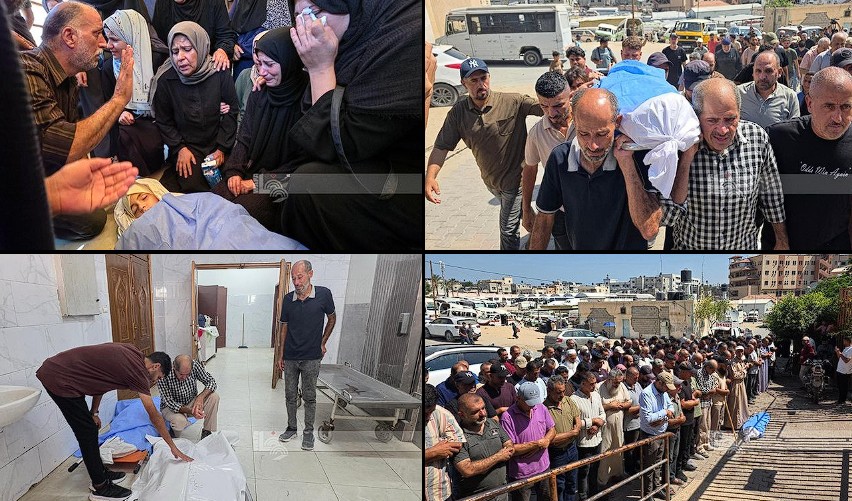
“They told me she was gone,” he said.
Eline was the youngest of his children — “the last blossom,” he called her. She was known for her academic excellence and her gentle humor. The family has five children: one boy and four girls. They have now lost three daughters — one to illness in 2022, another to shrapnel inside her tent earlier in the war, and now Eline.
A child who loved learning — and carried grief
Her brother Mohammed, 27, said Eline was devoted to her studies and to memorizing the Qur’an. She had won several awards and hoped to complete the full memorization.
But she had also been carrying grief. Her closest friend, Adyan Issam Al‑Farra, was killed along with most of her family when their home was bombed at the start of the war. Eline visited her grave often.
“She missed her terribly,” Mohammed said. “She always talked about her.”
Life on the edge of the “yellow line”
The family had hesitated before returning to their land. Life in Al‑Mawasi, west of Khan Younis, had become unbearable — overcrowded tents, insects, rodents, and disease. Their land, just 15 meters from the “yellow line,” seemed like the only option.
At first, the area was empty. Slowly, families began returning. Neighbors helped one another rebuild routines, share food, and endure the isolation.
“Our return encouraged others,” Mohammed said. “People were desperate to escape the overcrowding in Al‑Mawasi.”
But as more families came back, Israeli fire intensified. Daily gunfire and shells have wounded many residents, forcing some to flee west again.
A pattern of attacks on ‘safe’ areas
A recent report by an independent UN commission found that Israeli military operations continued “on a wide and systematic scale” against children, even after the October 2025 ceasefire. The commission said Israel has repeatedly ignored international legal protections for children.
Hours after Eline was killed, medical sources reported another tragedy: Diana Mohammad Salem Abu Darraz, 23, and her one‑year‑old daughter Sewar, were killed when Israeli shelling ignited tents in Al‑Mawasi. More than 220 families were displaced again after their shelters burned.
At Nasser Hospital, physical therapist Nour Al‑Shawa said the facility receives daily casualties — from minor to moderate — from areas near the “yellow line.”
“The army fires at homes every day,” he said. “People are injured constantly. Some are killed.”
“We returned to what remains of our homes”
Neighbor Sa’id Al‑Aqqad said families returned out of longing for their land, even if only rubble remained.
“We promised each other we would stay and rebuild,” he said.
His twin sons were wounded by shrapnel. He considered leaving, but after they recovered — and with encouragement from the Al‑Farra family — he stayed.
Another resident, Awad Barbakh, lost his two sons, Mohammed and Bilal, to stray bullets while living in a displacement camp near the telecommunications building in central Khan Younis. One was killed inside the tent, the other while fetching water.
He refuses to leave.
“There is no safe place in Gaza,” he said. “The entire strip is under fire — land, sea, and air. We do not have the luxury of choosing safety. So, we stay.”
Aid workers forced to relocate
Ibrahim Khshan, director of the Mayasem Charity, said he shut down the organization’s office near Bani Suhaila after several aid recipients were hit by shrapnel or stray bullets while collecting food parcels.
“We moved our operations to Deir Al‑Balah,” he said. “We couldn’t risk people’s lives.”
He urged international organizations to intervene to protect civilians living in areas Israel labels as “safe.”
A war with no refuge
The genocide in Gaza has led to the killing of more than 73,058 Palestinians and the injury of at least 173,488, the majority women and children.
Eline’s father keeps her schoolbooks in a small plastic bag. He has not opened it since the day she died.
“She was ready to go back to school,” he said. “She just wanted to learn.”
