
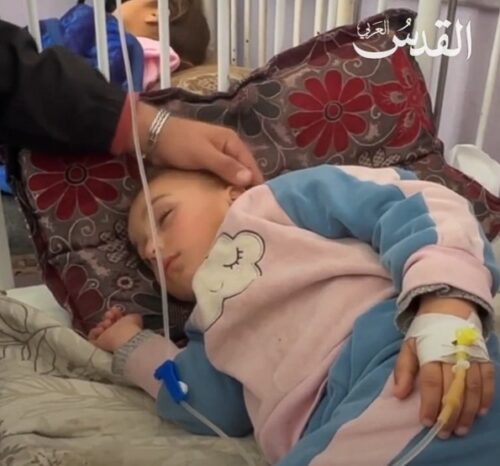
A new image of Gaza’s deepening humanitarian tragedy emerges in the story of three young sisters from the Al‑Khatib family, all suffering from a rare genetic immune disorder that cannot be treated inside the besieged enclave.
Israel’s destruction of medical facilities, combined with severe restrictions on movement through the Rafah crossing, has left the girls without access to the lifesaving care they urgently need.
Inside the pediatric ward of Al‑Aqsa Hospital in central Gaza, six‑year‑old Masa Al‑Khatib lies on a narrow bed, her frail body connected to IV lines that keep her alive. Her face is pale, her frame visibly weakened.
Beside her sit her two sisters, who share the same hereditary condition — a scene that captures the suffering of an entire family trapped between illness and an unrelenting blockade.
Their father, Ahmad Al‑Khatib, says the girls have struggled since birth with a rare immune system disorder that causes repeated infections and severe growth failure. None of the treatments available in Gaza have been effective.
“We received a medical referral through the World Health Organization back in 2024,” he says, “but we have not been able to travel because the crossings remain closed.”
Masa’s condition is deteriorating rapidly. She urgently needs a bone marrow transplant, a procedure unavailable in Gaza, leaving her at immediate risk of losing her life.
A choice between traveling for treatment — or waiting for death
Dr. Eyad Abu Muailek, the physician overseeing Masa’s case, explains that the disorder exposes her to constant bacterial and viral infections and has caused extreme weight loss.
“The current protocol involves immune‑boosting supplements,” he says, “but this is only temporary. The only definitive treatment is a bone marrow transplant in a specialized center outside Gaza.”
He warns that without this intervention, Masa’s life is in real and imminent danger, especially as Gaza’s health system collapses under the weight of war, shortages, and destroyed infrastructure.
A family pushed to the edge
The girls’ mother describes a daily struggle to secure even the most basic necessities.
“My daughters need special nutrition and vitamins,” she says, “but many days we cannot find even regular food.”
She adds that the family’s life has become a constant battle against illness, hunger, and the absence of medical care, urging the international community and the World Health Organization to intervene and allow her daughters to travel for treatment.
A collapsing health system
Gaza’s healthcare system is facing unprecedented strain due to the Israeli siege, the destruction of hospitals, and severe shortages of medicines and medical supplies.
Health Ministry’s estimates indicate that at least 22,000 patients and wounded people require evacuation for treatment outside the Strip, yet Israel continues to impose strict restrictions on travel.
Although the Rafah crossing was partially reopened in March, movement remains extremely limited and subject to complex Israeli procedures, lengthy interrogations, and tight controls on patients. Under the first phase of the “ceasefire” agreement that took effect on October 10, 2025, Israel was expected to fully reopen the crossing — a commitment it has not fulfilled.
For the Al‑Khatib sisters, the consequences of this failure are painfully clear: without immediate access to specialized care, their lives hang in the balance.
