
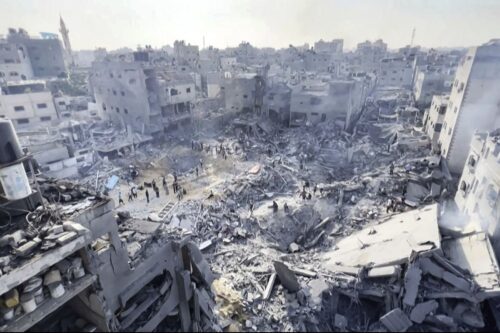
By Maha Sheikh – WAFA (Arabic): For two years, Gaza has endured a relentless campaign of annihilation. Since October 7, 2023, Israeli forces have carried out genocide—killing and injuring nearly 240,000 people, most of them women and children. Thousands remain missing beneath the rubble.
Entire neighborhoods have been erased. Hospitals, schools, universities, and water systems lie in ruins. And famine has claimed the lives of 459 Palestinians, including 154 children.
The numbers are staggering. As of October 4, 2025, the Palestinian Ministry of Health reports 67,074 confirmed killed and 169,430 injured.
Many of the wounded suffer life-threatening conditions, amputations, or psychological trauma. Rescue teams are still unable to reach thousands trapped under collapsed buildings and bombed-out streets.
Since March 18 alone, 13,486 Palestinians have been killed and 57,389 injured.
But the devastation goes far beyond the body count. Gaza’s healthcare system has been systematically dismantled. Of the 36 hospitals that operated before the genocide began, 34 have been damaged or destroyed.
More than 400 attacks have targeted medical facilities and personnel. Only a handful of hospitals, Shifa, Al-Ahli Arabi (Baptist), Al-Aqsa, Al-Awda, and Nasser—remain partially functional, supported by emergency field hospitals.
Ambulance fleets have been decimated, with 150 vehicles destroyed and crews repeatedly obstructed or targeted.
Israel’s blockade has weaponized hunger. In August, the UN-backed food security classification confirmed famine in Gaza Governorate and warned of its spread to Deir al-Balah and Khan Younis.
Over 500,000 people face catastrophic conditions, marked by starvation, death, and acute malnutrition.
Another 1.07 million are in emergency-level food insecurity, and 396,000 are in crisis. The UN called it the worst deterioration since food security monitoring began in Gaza, and the first officially confirmed famine in the Middle East.
Despite thousands of aid trucks stalled at Gaza’s borders, Israel continues to block or restrict their entry, often diverting supplies away from UN oversight.
Since March 2, the siege has tightened further, choking off humanitarian access and deepening the crisis.
Forced displacement has reached unprecedented levels. UNRWA reports that 1.9 million Palestinians—over 80% of Gaza’s population—have been forcibly displaced since the war began.
More than 1.2 million were uprooted from Gaza City alone since mid-March. In August, Israeli forces launched a wide-scale assault on Gaza’s neighborhoods, using explosive robots, artillery, and live fire to demolish homes and drive residents out.
The Israeli government has openly endorsed a plan to reoccupy Gaza in stages, starting with Gaza City.
By July, the UN’s humanitarian office reported that 88% of Gaza’s 360 square kilometers were under evacuation orders.
Between September 20 and 27, 15% of displaced families were forced to walk for hours, some selling their last possessions to afford transport. Others had no choice but to walk, including the elderly and disabled.
Hundreds of thousands remain trapped in northern Gaza, where shelter sites collapsed from 95 in July to just 40 by late September. Many now sleep in the open, without protection or aid.
Environmental collapse is another legacy of the war. In September, the UN Environment Programme warned that recovery could take decades. Fresh water is nearly gone, and what remains is often contaminated. Sewage systems have failed, poisoning Gaza’s aquifer and coastline.
Since 2023, Gaza has lost 97% of its tree crops, 95% of its grazing lands, and 82% of its seasonal harvests—making local food production virtually impossible.
Of Gaza’s estimated 250,000 buildings, 78% have been damaged or destroyed, leaving behind 61 million tons of rubble. Roughly 15% of this debris is believed to be contaminated with asbestos, industrial waste, or heavy metals.
Satellite imagery from UNOSAT shows a dramatic rise in destruction: 42,470 buildings fully destroyed in Gaza and North Gaza governorates as of July 8, up from 33,837 in February.
Education has not been spared. According to the Ministry of Education, Israel has destroyed 179 public schools and damaged 118 more. Over 100 UNRWA schools have been hit, and 20 higher education institutions have suffered severe damage. More than 63 university buildings have been demolished.
Over the past two years, Israel has dropped 200,000 tonnes of explosives on Gaza, including the ‘safe zone’ of al-Mawasi 136 times.
Here are other catastrophic figures from the Gaza Government Media Office ⤵️
🔴 LIVE updates: https://t.co/vV4P0bLrJD pic.twitter.com/te5vEkCoOL
— Al Jazeera English (@AJEnglish) October 5, 2025
The toll on students and educators is devastating. Over 18,069 schoolchildren have been killed and 26,391 injured. Among university students, 1,319 have been killed and 2,809 injured. At least 1,016 educators have been killed and 4,667 wounded.
Thirty schools have been erased from educational registry. More than 630,000 students have been denied their right to education, not including tens of thousands of preschool-aged children.
Despite the destruction, Gaza’s education ministry has fought to preserve learning. In 2024, it held online high school exams for students born in 2006, with 27,000 registered. It now prepares to test students born in 2007—many of whom were displaced, orphaned, or injured. Virtual schools and improvised learning spaces have emerged as lifelines for a generation under siege.
This is Gaza after two years of genocide: a place where hospitals are bombed, children starve, families vanish, and schools become graves. It is a place where survival itself is resistance—and where the world’s silence is part of violence.
