
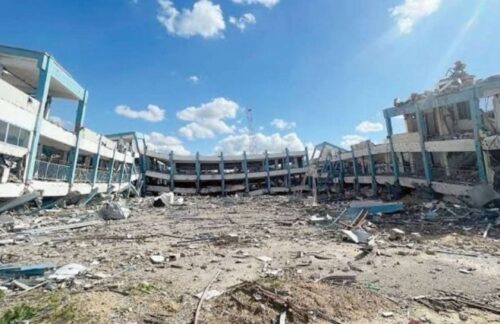
The UN Relief and Works Agency for Palestine Refugees (UNRWA) says nearly all school buildings in the Gaza Strip have been damaged or destroyed during the ongoing Israeli military offensive, a level of devastation the agency describes as unprecedented in the history of its operations.
In a statement from Gaza, UNRWA reported that about 90 percent of the Strip’s school infrastructure has been hit, leaving only a handful of buildings partially standing.
Most of those remaining structures have been converted into overcrowded shelters for displaced families, forcing children to rely on temporary learning spaces set up in tents, damaged courtyards, or other improvised locations.
When possible, UNRWA teams have also turned to digital learning, though electricity cuts and the collapse of telecommunications often make this impossible.
The agency said it continues to provide education and psychosocial support “under all circumstances,” noting that Gaza’s children have endured repeated cycles of displacement, trauma, and loss.
UNRWA has warned that the destruction of schools is not only a humanitarian emergency but a long‑term crisis that threatens the stability and recovery of the entire community.
The scale of damage has been echoed by the UN Children’s Fund (UNICEF), which recently launched a broad initiative aimed at restoring some form of education for hundreds of thousands of children in the war‑torn enclave.
UNICEF spokesperson James Elder told reporters in Geneva that nearly two and a half years of repeated attacks on Gaza’s schools have placed an entire generation at risk, with more than 700,000 school‑aged children now deprived of formal education.
Elder said that since the start of the current war, around 90 percent of Gaza’s schools have been damaged or destroyed, a figure consistent with UNRWA’s assessments.
He added that the loss of safe learning spaces has compounded the psychological toll on children who have already endured mass displacement, family separation, and the destruction of their neighborhoods.
Humanitarian organizations have repeatedly warned that the collapse of Gaza’s education system will have long‑lasting consequences.
Beyond the immediate loss of schooling, children face severe trauma, limited access to mental‑health support, and the erosion of social structures that typically provide stability and routine.
Aid agencies say that without sustained international support, the damage to Gaza’s education sector could take decades to repair.
UNRWA and UNICEF continue to call for the protection of remaining educational facilities, unimpeded humanitarian access, and urgent reconstruction efforts to prevent what they describe as the “permanent loss of an entire generation’s future.”
