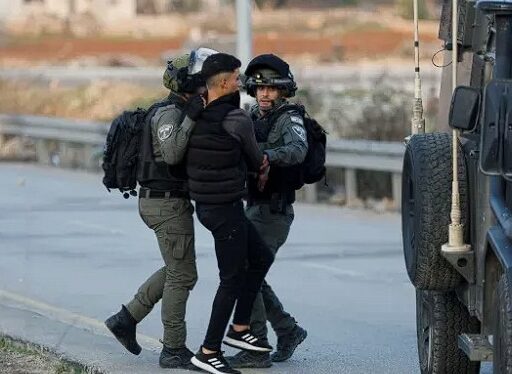
Israeli forces carried out a series of invasions across the occupied West Bank early Wednesday, breaking into homes, damaging property, and abducting many Palestinians, including a woman and a person with a disability. An illegal Israeli paramilitary colonizer also abducted two siblings near Nablus.
The operations stretched from Jenin in the northern West Bank to Hebron in the southern West Bank, while colonizers carried out separate attacks under military protection.
In Jenin in the northern West Bank, Israeli forces continued their intensive operations, invading the town of Arraba southwest of the city, the town of Meithalun to the south, and the village of Aaba to the east.
During the invasions, soldiers broke into homes and conducted searches. According to the Palestinian Prisoners’ Society in Jenin, forces abducted three Palestinians, including a person with a disability.
Forces abducted Suleiman Ibrahim Diab Amer from Jenin refugee camp after invading housing for displaced residents near the Arab American University. The Prisoners’ Society said Amer had previously been wounded by Israeli gunfire and became disabled.
Forces also abducted Eman Mousa Turkman from Jenin refugee camp after breaking into her family’s home in Jenin city’s Az-Zahra neighborhood, and abducted Mohammad Fouad Jaradat after breaking into and searching his home in the village of Zububa west of Jenin.
In Tulkarem in the northwestern West Bank, Israeli forces invaded the towns of Deir al-Ghusoon and Attil north of the city, carrying out widespread home invasions and searches.
The operations resulted in the abduction of three Palestinians from Deir al-Ghusoon: Mazen Al-Zubaidi, Ekrema Ghanem, and Saher Ghanem. The military activity coincided with an invasion of the town of Bal’a northeast of Tulkarem.
In Nablus in the northern West Bank, Israeli soldiers vandalized and tore down photographs and murals honoring Palestinians killed by Israeli forces during an invasion of the town of Beita south of the city. Troops also invaded the town of Sebastia northwest of Nablus and conducted searches.
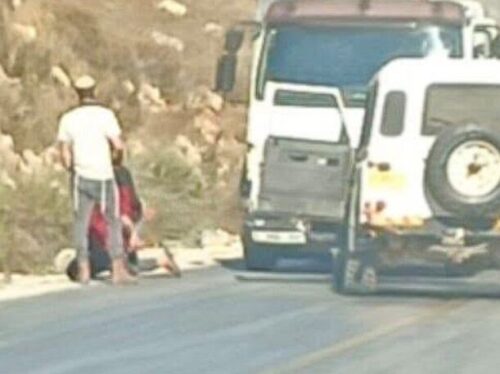 In addition, an illegal Israeli paramilitary colonizer abducted two Palestinian brothers on Wednesday on the road linking Asira Ash-Shamaliya with Nablus in the northern West Bank.
Media sources said the colonizer stopped a gas delivery truck near the northern entrance to Nablus, along Route 17, seized the vehicle’s keys, and abducted Mohammad and Omar Hamadna, both from Asira Ash-Shamaliya. The brothers were taken to an unknown location.
In Qalqilia in the northwestern West Bank, Israeli forces abducted Taher Yousef Salim after invading the town of Azzun east of the city.
According to local sources, soldiers invaded the area through the northern entrance, deployed in the Al-Muthallath neighborhood, broke into Salim’s home, searched it, ransacked its contents, and abducted him.
In Tubas in the northeastern West Bank, Israeli forces broke into a home during an invasion of Tubas city. Hours later, troops invaded the town of Aqqaba north of the city for a second time, searched another home, and operated amid intensive drone activity over the area.
Protests erupted after Israeli forces invaded Qalandia Institute Street near Qalandia refugee camp, north of occupied Jerusalem. During ensuing protests, soldiers fired large amounts of tear gas toward residents.
Furthermore, Israeli forces abducted six Palestinians on Wednesday from various communities in the Jerusalem Governorate.
The Jerusalem Governorate said Israeli forces abducted three Palestinian children from the town of Abu Dis, southeast of occupied Jerusalem. Troops also abducted one Palestinian from the town of Al-Qubeiba, northwest of occupied Jerusalem, and two Palestinians from the Al-‘Arara Bedouin community near Jaba’ Junction, north of occupied Jerusalem.
In addition, soldiers abducted Khaled Nasser Houshiya, a young man from Qatanna, northwest of Jerusalem, after summoning him for interrogation. They had repeatedly pressured and detained his father to force Houshiya to turn himself in.
Immediately after abducting Houshiya, the army issued a three-month administrative detention order against him, without charge or trial.
Israeli forces also invaded Bir Nabala, northwest of occupied Jerusalem, and shut down its main street, hindering the movement of residents.
In the Bethlehem area of the southern West Bank, Israeli forces abducted 27-year-old Odai Rabea’ Shamroukh from Dheisheh refugee camp south of the city. Soldiers also broke into the home of Ali Abu Jaber in the town of Nahalin west of Bethlehem, although no abductions were reported.
Separately, Israeli paramilitary colonizers stole a number of sheep belonging to Omran Abu Sarhan in the town of Al-Ubeidiya east of Bethlehem.
In Hebron in the southern West Bank, Israeli forces abducted two Palestinians after breaking into and searching their homes.
Nidal Nafeth Al-Hawarin was abducted during an invasion of the town of ath-Thaheriya south of Hebron, while Yaman Omar Mohammad Khashan was abducted from Al-Fawwar refugee camp north of the city. Local sources reported that soldiers severely beat both men before abducting them.
Israeli forces also invaded several homes in the center of the town of Sa’ir northeast of Hebron, damaging property and assaulting residents.
In addition, troops established multiple military roadblocks at the entrances to Hebron and surrounding towns, villages, and refugee camps, while closing main and secondary roads with iron gates, concrete blocks, and earth mounds.
The measures coincided with provocative tours carried out by colonizers in the Huwara area east of Yatta, south of Hebron, under heavy Israeli military deployment.
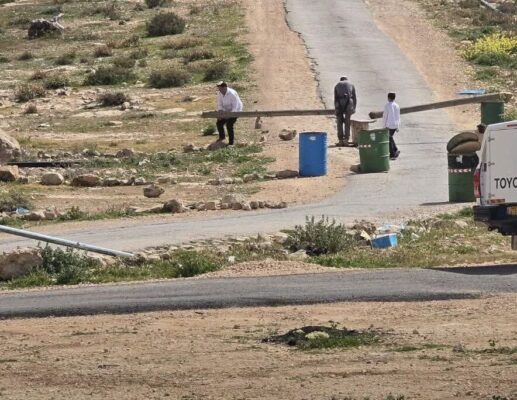
Israeli colonizers also obstructed the main road leading to Um Al-Kheir village in Masafer Yatta, south of Hebron, by placing wooden and electricity poles near a caravan site.
This report reflects some of the invasions and violations documented across the occupied West Bank on Wednesday.
As Israeli military operations continue in multiple areas, additional incidents may emerge or be confirmed later. Reporting from some locations remains challenging because of ongoing invasions, military roadblocks, and restrictions on movement.