
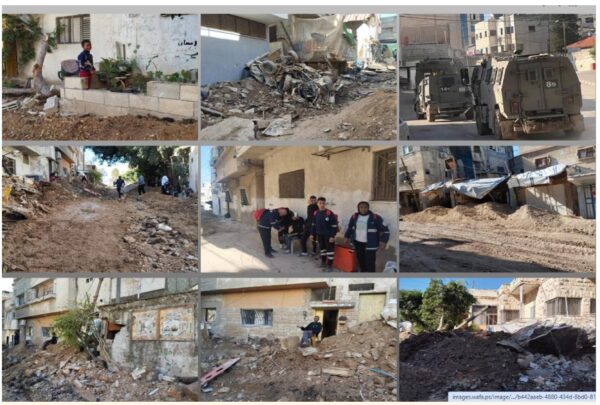
Nur Shams and Tulkarem camps witnessed large‑scale demolitions that destroyed hundreds of homes and partially damaged thousands more over the past year. Israeli forces also bulldozed streets and tore apart water, electricity, and sewage networks, fundamentally altering the physical landscape of both camps in what residents describe as a deliberate attempt to erase their geographic and urban identity.
The assault forced more than 5,000 families, over 25,000 people, into displacement, with children making up approximately 38% of the total. Families scattered across nearby towns and villages, seeking shelter in mosques, community centers, clubs, and wedding halls under harsh humanitarian conditions.
The year also saw repeated airstrikes, home explosions and burnings, heavy live‑fire, extensive use of sound and gas grenades, and constant drone surveillance. Civilian vehicles and property were attacked, and arrest campaigns and field interrogations continued without interruption.
830 Abductions and Homes Turned Into Military Bases
The Palestinian Prisoners’ Society (PPS) documented around 830 abductions in Tulkarem governorate over the past year, affecting all age groups and social sectors, in what it described as a campaign defined by “comprehensiveness and organized violence.”
According to the PPS, Israeli forces routinely converted civilian homes into military bases and field interrogation centers, accompanied by physical assaults, torture, intimidation, direct threats to families, the use of civilians as human shields, and field executions. Looting, vandalism, and the destruction of hundreds of homes were also documented as part of a systematic policy of erasure.
Severe Humanitarian and Economic Impact
The consequences of the assault extended far beyond security. Thousands of families lost their homes, many of which were occupied by Israeli forces for months and turned into military posts. Residents were prevented from accessing their properties under threat of armed force, and only a small number were allowed to retrieve limited belongings under harsh restrictions.
Commercial activity declined sharply due to intensified military measures at the main military roadblocks, particularly the Ennab military roadblock to the east and the Jabara gate to the south. Schools and universities, including UNRWA schools, were closed for extended periods during the early months of the assault.
Official Statement
Tulkarem Governor Abdullah Kamil said the year‑long offensive reflects “the practical expression of the ideology of Israel’s extreme right,” stressing that Israeli forces continue their crimes with no regard for international law or humanitarian appeals.
He added that the aggression has left severe humanitarian and economic devastation, especially in Tulkarem and Nur Shams camps, where thousands of families continue to suffer from forced displacement, loss of homes, and loss of livelihoods amid ongoing closures, military roadblocks, and invasions.
Kamil described the situation in Tulkarem as a “full‑fledged crime and a blatant violation of international humanitarian law,” holding Israeli authorities fully responsible for its consequences. He praised the resilience of residents and the efforts of official institutions, civil society groups, popular committees, and the private sector, particularly through the Karama Relief and Shelter Committee, which has worked to ease the suffering of displaced families.
