
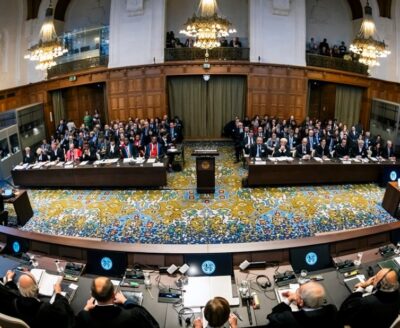
The International Court of Justice issued an advisory opinion on Wednesday finding that Israel, as the occupying power in Gaza, must facilitate and secure United Nations relief operations and ensure that the territory’s civilian population receives the basic supplies necessary for survival.
The court said Israel may not rely on generalized security claims to justify blanket restrictions on humanitarian access, including operations conducted by the United Nations Relief and Works Agency for Palestine Refugees (UNRWA).
Ruling and legal findings
An 11-judge panel at the ICJ concluded that Israel is obliged to permit, facilitate and, where necessary, secure the delivery and distribution of urgently needed relief consignments into Gaza, including those run by UN agencies and the UN system.
The court framed this obligation as a positive duty under international humanitarian law: an occupying power must take practicable measures to ensure civilians in occupied territory receive food, potable water, medical supplies, fuel for essential services, shelter and other items “necessary for survival.”
Presiding Judge Yuji Iwasawa delivered the court’s opinion in public proceedings in The Hague, saying the evidence before the tribunal “did not substantiate Israel’s broad allegation that a significant number of UNRWA staff were members of terrorist groups” and that those allegations did not justify a comprehensive suspension of the agency’s activities.
The court warned that invoking security concerns to halt all humanitarian operations would be inconsistent with the occupying power’s obligations under the laws of occupation.
The opinion is advisory rather than a binding judgment in contentious proceedings; it does not create an enforcement mechanism. Still, the court’s interpretation carries considerable legal authority and moral force as an authoritative reading of international humanitarian law.
Background and context
The United Nations requested the ICJ to clarify the scope of an occupying power’s duties to allow and facilitate relief after Israel imposed restrictions on UNRWA and other UN operations following the 7 October 2023 attacks and subsequent allegations that some agency staff had been involved.
Several donor states paused or reviewed funding for UNRWA amid those allegations, and Israel introduced operational constraints on the agency’s activities in Gaza.
An independent review led by former French foreign minister Catherine Colonna in April 2024 flagged concerns about neutrality in some UNRWA procedures but concluded that Israel had not provided sufficient evidence that a substantial proportion of UNRWA staff were members of terrorist organizations. Israel did not participate in oral hearings before the court in April 2025.
Practical implications
The ICJ opinion strengthens the legal case advanced by the UN and humanitarian organizations that Israel must allow predictable, sustained access for lifesaving assistance. It undermines the legal rationale for broad suspensions of UNRWA’s activities based on unverified, generalized allegations and reaffirms that the protection of civilian life must take precedence over blanket operational restrictions.
Practically, the ruling is likely to intensify diplomatic pressure on Israel and on donor states that paused funding, encouraging restoration of aid flows and rehabilitation of UNRWA’s operational capacity.
The opinion also provides legal and political cover for states, the UN system and humanitarian organizations advocating for expanded access while maintaining narrowly tailored security screening that does not impede lifesaving deliveries.
|Israel Advances Trump Plan Amid Gaza Ruins, “Yellow Line” Controversy|
Limits, likely reactions and next steps
- Enforcement limits: The ICJ lacks direct enforcement powers; compliance will depend on diplomatic pressure, decisions by donor states, actions in the UN Security Council and General Assembly, and negotiated operational arrangements among Israel, the UN and aid organizations.
- United Nations and humanitarian agencies: Expected to cite the opinion when calling for immediate operational steps to reopen aid corridors and restore UNRWA services.
- Israeli government: Likely to reiterate security concerns, insist on the right to vet staff and deliveries, and press for accountability mechanisms to address any credible allegations of wrongdoing.
- Donor states: Governments that suspended funding will face renewed pressure to either restore assistance or impose narrowly tailored conditions that preserve agency capacity while addressing oversight.
- Oversight measures: International and independent monitoring mechanisms to review allegations of staff misconduct, if credibly framed to protect both accountability and operational continuity, will be central to bridging political divisions.
What to watch next
Restoration of UNRWA field operations and suspended services, changes in daily aid convoy numbers and tonnage into Gaza, diplomatic activity at the UN including potential resolutions or statements, and any joint independent mechanisms established to review staff-misconduct allegations while safeguarding aid delivery.
The ICJ advisory opinion clarifies that an occupying power’s security concerns cannot justify blocking the flow of essential humanitarian assistance to civilians.
While the opinion does not itself compel enforcement, it strengthens the legal and moral case for immediate action to restore and protect humanitarian operations in Gaza, increasing pressure on political actors to turn legal obligations into lifesaving deliveries.
|Gaza Struggles to Recover Bodies and Restore Services|
Casualties Gaza and West Bank
In the Gaza Strip, Israel has killed at least 67,253 Palestinians, including 20,178 children, 12,236 women, 4,820 elders and 301 journalists, and injured more than 170,203, the majority of whom are children, women and elderly, since October 7, 2023.
Israeli occupation forces and illegal paramilitary colonizers have killed 220 Palestinian citizens in the occupied West Bank, including 40 children and 6 women, since the beginning of this year.
Occupation forces have killed 74 Palestinians in Jenin, 39 in Nablus, 29 in Tubas, 17 in Tulkarem, 18 in Hebron, 17 in Ramallah, 9 in Bethlehem, 7 in Jerusalem, 6 in Qalqilia, 3 in Salfit, and 1 in Jericho, according to the Shireen Observatory.
Since October 7, 2023, Israeli soldiers and paramilitary colonizers have killed 1,056 Palestinians, including 213 children, 22 women, 1 journalist and 2 medics in the West Bank, and still refuses to release the bodies of 263 slain Palestinians.
