
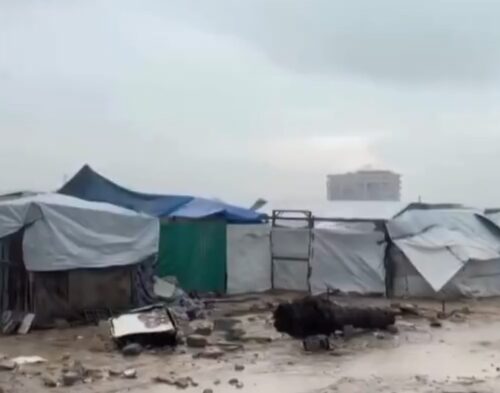
The World Health Organization (WHO) said Friday that while Gaza has seen slight improvements in healthcare, the territory remains in deep crisis, with severe shortages of medical supplies and equipment. Winter conditions, the agency warned, are compounding risks of disease among displaced families.
Speaking from Gaza to journalists in Geneva, Dr. Rik Peeperkorn delivered his final press briefing as WHO’s representative in the occupied Palestinian territory.
He noted that only half of Gaza’s hospitals are partially functioning, while access remains impossible for an estimated 37,000 people in northern Gaza.
Peeperkorn explained that the Indonesian Hospital and Al‑Awda Hospital currently lie outside the “ceasefire line,” while Al‑Shahid Kamal Adwan Hospital is within the designated coordination zone.
“UNRWA has shelter supplies for more than a million people sitting outside the #Gaza Strip that we could bring in. So there’s a political choice to deny us the possibility of bringing that aid in…
But our colleagues are working to the degree that they can, to try to alleviate… pic.twitter.com/jIBwedL3hP
— UNRWA (@UNRWA) December 12, 2025
WHO had attempted to establish a health center at Kamal Adwan but was prevented from doing so. Instead, the agency identified a nearby site in Beit Lahia, where services are expected to begin soon.
In Gaza City, Al‑Shifa Hospital has resumed partial operations as a tertiary care facility, with several services restored.
WHO also supported the renewal of the hospital’s water desalination plant, enabling kidney dialysis services to function at full capacity.
Improvised Repairs Keep Hospitals Running
Across Gaza, Peeperkorn praised local ingenuity for driving rehabilitation efforts despite the absence of construction materials.
“You see a lot of rehabilitation underway,” he said. “But all of it is creative, because no building materials are allowed in. They are reusing rubble from destroyed buildings to restore hospitals in highly innovative ways.”
Still, he stressed that Gaza faces acute shortages of essential medicines and equipment across critical fields including cardiology, kidney transplants, dialysis, orthopedics, and chemotherapy.
Half of the drugs on WHO’s essential medicines list are either unavailable or nearly depleted. Imaging services remain scarce: Gaza has no MRI machine and only two CT scanners to serve more than two million people.
Peeperkorn urged a review of Israel’s “dual‑use” restrictions, insisting that medical supplies must be granted blanket approval to enter Gaza and reach hospitals without delay.
Winter Storms Compound Gaza’s Health Emergency
The WHO official warned that cold, rainy winter weather is making families more vulnerable to disease amid collapsing water and sanitation systems and dire shelter conditions.
Thousands of displaced families are sheltering in low‑lying coastal areas or rubble‑strewn zones lacking sanitation and protective barriers.
Storm Byron hits Gaza as nearly 1.5 million Palestinians shelter in flood-prone camps with little protection. Aid groups say Israel’s restrictions on vital shelter materials have left families exposed. Al Jazeera’s @vpietromarchi explains ⤵️ pic.twitter.com/JhZk11zZye
— Al Jazeera English (@AJEnglish) December 12, 2025
The recent Byron storm intensified their suffering, with at least 10 deaths reported in 24 hours due to flooding and heavy rain.
He cautioned that winter conditions, combined with poor sanitation, are expected to trigger a sharp rise in acute respiratory infections.
Medical Evacuations Urgently Needed
WHO confirmed that 25 patients and 92 companions were evacuated this week to Europe, including Italy, Norway, Belgium, and Romania. Since October 2023, a total of 10,645 patients have been evacuated, among them 5,632 children.
However, more than 18,500 patients remain in urgent need of evacuation. Peeperkorn called on states to accept more patients from Gaza and urged the resumption of medical referrals to the West Bank, including East Jerusalem.
“There is a ceasefire. There is no reason not to reopen this traditional referral route—the most effective and efficient—to hospitals in East Jerusalem and the West Bank,” he said.
WHO, he added, is prepared to accelerate medical evacuations daily wherever possible, stressing that the pathway to the West Bank and East Jerusalem “must be opened now.”
