
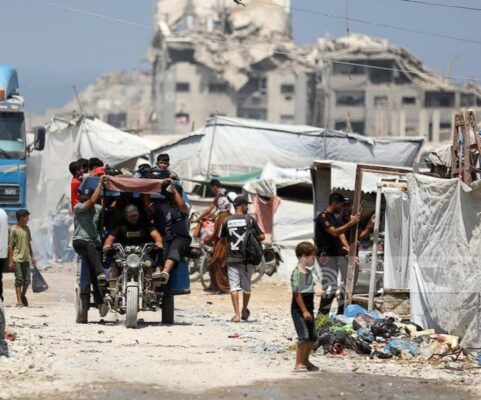
Israeli forces continued to violate the Gaza “ceasefire” on Friday, killing five Palestinians and wounding several others across the besieged and devastated coastal enclave.
Al Jazeera reported that an Israeli drone struck a tent sheltering displaced Palestinians in Al-Mashahra, east of Gaza City, killing one Palestinian and wounding several others.
In Hamad City, west of Khan Younis, Israeli soldiers shot and wounded three Palestinians, including a child.
In Al-Qarara, north of Khan Younis, an Israeli drone struck civilians near Al-Matahin Junction, killing Lafi Fayez Lafi Abdeen, 42; Taysir Fayez Lafi Abdeen, 28; and Abdul-Hamid Mohammad Abdeen, 42. Witnesses said the victims—two brothers and their cousin—were outside their home when they were attacked. Their bodies were transferred to Nasser Medical Complex.
Three Palestinian farmers were killed in an Israeli strike on Khan Younis on Friday.
Their family expressed their despair at the continued violations of the ceasefire agreement, saying that their loved ones were farmers with no connections to armed groups. pic.twitter.com/xeT9kvdTGk
— Middle East Eye (@MiddleEastEye) August 28, 2026
Earlier Friday, an Israeli drone struck a bicycle in the Sabra neighborhood, southwest of Gaza City, killing another Palestinian, according to Gaza Civil Defense spokesperson Mahmoud Basal.
Israeli forces later fired live rounds and artillery shells at Tuffah and Zeitoun in Gaza City, areas northeast of the Al-Bureij refugee camp, southern Khan Younis and locations toward Rafah. Israeli navy ships also opened fire along the coast.
“بدي أشوفه”.. أب فلسطيني يودّع نجله الشهيد بدموع الفقد، بعد استشهاده برفقة اثنين من أفراد عائلته، في قصف إسرائيلي استهدف حطام منزلهم بمنطقة القرارة شمال خان يونس، جنوبي قطاع غزة. pic.twitter.com/0kGEzjWV2t
— وكالة سند للأنباء – Snd News Agency (@Snd_pal) August 28, 2026
In central Gaza, Israeli military vehicles shot and moderately wounded a Palestinian east of Deir al-Balah, according to a medical source at Al-Aqsa Martyrs Hospital.
The attacks occurred as Gaza’s humanitarian crisis remained severe. The World Food Programme said 1.4 million Palestinians—about two-thirds of Gaza’s population—were experiencing crisis-level or worse acute food insecurity.
WFP said it reaches about 1.5 million Palestinians in Gaza each month with food parcels, wheat flour, bread, hot meals, nutrition services and cash assistance.
The agency supports community kitchens serving 250,000 hot meals daily and 28 bakeries producing about 130,000 bread bundles each day.
It also provides digital cash assistance to 100,000 families. WFP warned that without sustained humanitarian food assistance, up to 90 percent of Gaza’s population could face high levels of acute food insecurity by the end of 2026.
WFP’s August market update recorded 5,677 humanitarian and commercial trucks entering Gaza in July, compared with 4,965 in June. Only 15 percent of households surveyed reported improved access to food, while 45 percent said access had worsened. Three-quarters reported difficulty reaching markets, and fewer than 10 percent could obtain cooking gas.
Video shows children in Gaza taking cover behind a shopping cart loaded with water cans during a reported gun attack by an Israeli quadcopter drone.
A recent UN commission of inquiry found Israel responsible of deliberately killing children in Gaza as an act of genocide. pic.twitter.com/OOZry7Yeri
— Al Jazeera English (@AJEnglish) August 28, 2026
OCHA reported that most Palestinians in Gaza remained displaced in harsh conditions and that 90 percent of the population experienced moderate-to-high water insecurity in early July.
Life in Gaza… unending suffering. pic.twitter.com/j8IbcvIdHp
— TIMES OF GAZA (@Timesofgaza) August 28, 2026
A UNICEF nutrition survey published August 24 found that, among residents of accessible areas surveyed from May 31 to June 15, stunting affected 12.2 percent of children under five. Only 22.4 percent of children aged 6 to 23 months received a minimum acceptable diet, while 37.1 percent of children under five had experienced diarrhea during the preceding two weeks.
UNICEF said the findings covered about 83 percent of Gaza’s estimated population; roughly 17 percent was excluded because of access and security restrictions. The agency warned that nutrition gains remained fragile and depended on sustained humanitarian access, adequate funding and functioning markets.
Israel is still starving Palestinians in Gaza. @b1san0wda2 explains how children are having to learn how to track their calories. pic.twitter.com/Nb6CAzRlWQ
— Bisan (@b1san0wda2) August 26, 2026
WFP said it needs $426 million to sustain operations in Gaza and the West Bank from July through December 2026.
Gaza’s Health Ministry said Israeli attacks since the “ceasefire” took effect on October 10, 2025, have killed 1,303 Palestinians and wounded 4,336. The ministry added that rescue teams recovered 814 bodies during the same period.
Since October 7, 2023, the ministry said Israel has killed at least 73,438 Palestinians and wounded more than 174,447. It added that many victims remain beneath rubble because rescue teams lack equipment and access to destroyed areas.
