
Israeli colonizers carried out widespread invasions and attacks across multiple areas of the occupied West Bank on Friday, targeting towns, villages, refugee camps, and Bedouin communities from the northern West Bank to the southern districts.
The assaults included breaking into homes, burning agricultural land, shooting residents, including children, expanding illegal outposts, and cutting vital water infrastructure, alongside intensified military roadblocks imposed by occupation forces.
In Nablus, in the northern West Bank, dozens of colonizers invaded neighborhoods west of the city and the town of Tell, south of Nablus, breaking into homes in the Ein al‑Mizrab and Ameriya areas.
Local sources reported coordinated colonizer attacks on agricultural land in Burin, south of Nablus, where colonizers set fire to olive groves and obstructed Palestinian Civil Defense crews attempting to reach the burning orchards.
Additional colonizer gatherings were reported near the illegal colony of Yitzhar, where groups attacked farmland belonging to Iraq Burin, Madama, and Asira al‑Qibliya.
The Palestinian Red Crescent confirmed that eleven Palestinians, including four children, were injured when colonizers and occupation soldiers invaded the Jneid neighborhood west of Nablus, triggering renewed Protests. Soldiers fired live rounds and tear gas to secure the colonizers’ presence.
In Jenin, in the northern West Bank, colonizers invaded areas near Umm ar-Reehan, attempting to break into several homes before residents confronted them. Occupation soldiers later installed new military roadblocks at the entrances of Ya’bad and Toura.
In Tulkarem, in the northwestern West Bank, colonizers invaded the vicinity of Shweika and Ektaba, throwing stones at Palestinian vehicles and forcing several cars to turn back.
In Ramallah, in the central West Bank, colonizers shot and injured a ten‑year‑old child in the village of al‑Mughayyer after attacking a sheep farm west of the village and opening live fire at residents.
Additional colonizer invasions were reported west of Deir Ammar, where colonizers raised Israeli flags while invading Palestinian land, and east of Taybeh, where groups invaded the vicinity of the Abu Fazza’ Bedouin community.
Colonizers also uprooted olive saplings and attempted to break into homes in Ras Karkar and al‑Janiya, while another group attempted to establish a new outpost on land belonging to al‑Mazra’a al‑Gharbiya.
In Salfit, in the central West Bank, colonizers invaded the outskirts of Kafr ad‑Deek and Bruqin, harassing farmers and preventing them from accessing their olive groves. Meanwhile, Israeli occupation soldiers installed additional military roadblocks around Salfit and nearby villages.
In Tubas, in the northeastern West Bank, colonizers invaded the al‑Farisiyya area in the northern Jordan Valley, attacking shepherds and forcing them from grazing lands. Soldiers later declared the area a “closed military zone.”
In occupied Jerusalem, colonizers cut a main water pipeline near Khan al‑Ahmar, depriving the Bedouin communities of al-Mahtoush, al-Ar’ara, and at-Tabna of drinking and irrigation water.
The Jerusalem Governorate said the attack is part of ongoing efforts to pressure Bedouin communities and force them to leave the area.
Additional colonizer invasions were reported in Jabal al‑Mukabber, Um Safa, and Atara, where colonizers attempted to seize a Palestinian‑owned plot of land before residents confronted them.
In Hebron, in the southern West Bank, colonizers invaded the Tel Romeida neighborhood in the center of the city, breaking into homes under the protection of occupation soldiers.
Further attacks were reported in Susiya and Masafer Yatta, where colonizers chased shepherds and attempted to seize grazing areas.
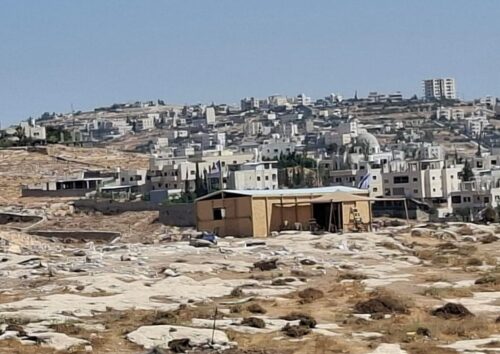
In Bethlehem, in the southern West Bank, colonizers expanded an illegal outpost built on land belonging to the village of Jannata.
Additional attacks were reported in al‑Khader, south of Bethlehem, where colonizers threw stones at Palestinian vehicles and attempted to break into a home near the town’s main roundabout.
Across all districts, occupation soldiers intensified closures and installed additional military roadblocks, restricting Palestinian movement and reinforcing colonizer attack, amidst constant military invasions and abductions across the West Bank.
The Wall & Colonization Resistance Commission reports that illegal paramilitary Israeli colonizers carried out 3,488 attacks against Palestinian civilians and their property during the first half of 2026.
These assaults included physical attacks on residents, arson targeting homes and vehicles, the bulldozing of agricultural land, blocking farmers from reaching their fields, and the establishment of new colonial outposts across the occupied West Bank.
The United Nations reiterates that all Israeli colonies built on occupied Palestinian land are illegal under international law, while Palestinians warn that Israel’s accelerating colonial expansion is erasing the possibility of establishing an independent Palestinian state.
Since the beginning of 2026, Israeli soldiers and illegal paramilitary Israeli colonizers have killed 87 Palestinians, including 26 who were fatally shot by colonizers, and one journalist. At least 759 Palestinians, among them children and women, have been injured in attacks across multiple areas of the occupied West Bank.
These incidents include live‑fire assaults during military invasions, ambushes by colonizer militias on roads and agricultural areas, and coordinated attacks on homes, vehicles, and farmers attempting to reach their land.
Field sources report that the pace and geographic spread of these assaults have sharply increased since early January, reflecting a pattern of escalating violence tied to expanding colonial outposts and intensified military protection for colonizer groups.
These are some of the documented colonizer violations reported across the occupied West Bank on Friday.
Due to the ongoing nature of colonizer assaults, the presence of armed groups under military protection, and the extensive Israeli military closures and movement restrictions imposed on Palestinian communities, it remains difficult to fully document every incident as they occur.
