
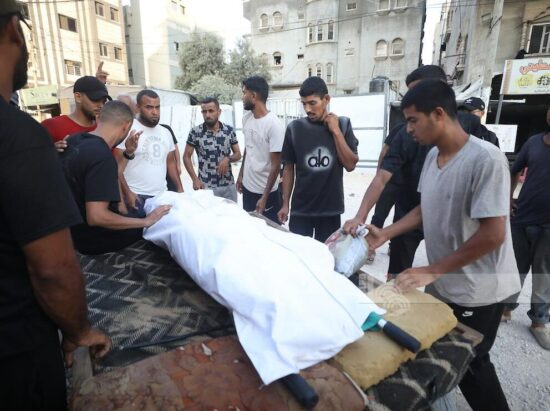
Israeli airstrikes and artillery fire killed at least two Palestinians and wounded dozens more across the Gaza Strip on Friday, as bombardment continued despite political announcements regarding the second phase of the “ceasefire roadmap.” The attacks struck multiple areas including Gaza City, Deir al‑Balah, Khan Younis, the central refugee camps, and Rafah.
A Palestinian man, Mohammad Abdul Nasser Al‑Khatib, was killed when an Israeli drone fired a missile at Salahuddin Street near Al‑Zawayda in the central Gaza Strip. His body was transferred to Al‑Aqsa Hospital in Deir al‑Balah.
Another Palestinian was killed in a separate drone strike targeting the Sabra neighborhood in southern Gaza City.
Furthermore, Israeli artillery units shelled eastern areas of Al‑Bureij refugee camp in central Gaza, accompanied by heavy gunfire from military vehicles positioned nearby.
Medical teams at Al‑Awda Hospital reported ten injuries after Israeli forces bombed a residential building near the Royal Restaurant east of the Nuseirat refugee camp.
Additional strikes targeted homes in Deir al‑Balah and Nuseirat, with local sources confirming multiple injuries but noting that the full casualty toll remains unclear due to ongoing bombardment and restricted movement of ambulance crews.
Earlier in the day, several Palestinians were wounded when Israeli forces bombed the Rahma area south of the slaughterhouse west of Khan Younis in the southern Gaza Strip.
In Rafah, in Gaza’s southernmost area, Israeli military vehicles advanced near the new gate along the “yellow line” in the Al‑Shakoush area, firing heavily in the surrounding region. In addition, Israeli soldiers shot and injured a Palestinian in the Al‑Mawasi area of Rafah.
In Gaza City, Israeli forces issued an evacuation order for residents of the Saftawi neighborhood in the northern part of the city.
According to local accounts, a resident identified as Abu Rami Al‑Na’ouq received a phone call from an Israeli intelligence officer instructing him to evacuate his home.
Artillery fire also struck eastern Gaza City, while drones carried out repeated attacks on the Sabra neighborhood.
These attacks come as political developments unfold around the “ceasefire framework.” According to Al‑Jazeera, the newly announced “Board of Peace”—established as part of the U.S.-brokered roadmap—confirmed that Hamas has agreed to a disarmament arrangement under the second phase of the ceasefire deal.
The Board stated that its mandate includes “restoring public administration, improving humanitarian conditions, and establishing a Palestinian-run governance structure described as efficient, transparent, and service‑oriented.”
The report noted that the Board’s formation is intended to facilitate governance in Gaza following the ceasefire, though conditions on the ground remain unstable due to ongoing Israeli military operations.
Despite these political announcements, Israeli attacks have continued across the Gaza Strip, complicating humanitarian access, and raising concerns among aid agencies. Ambulance crews and civil defense teams report ongoing difficulties reaching bombed areas due to active fire, destroyed roads, and repeated drone strikes.
Gaza’s hospitals are struggling to function under the weight of continuous Israeli attacks and the long‑standing siege, with medical teams saying the health system is no longer capable of absorbing the scale of injuries arriving each day.
The World Health Organization reports that more than half of Gaza’s hospitals are either partially functioning or completely out of service, the result of repeated strikes, fuel shortages, and the collapse of basic water and sanitation infrastructure.
Emergency rooms are packed with trauma cases, and intensive care units are operating with unreliable electricity, limited sterilization capacity, and equipment that cannot be properly maintained.
UNRWA and OCHA warn that thousands of wounded Palestinians are unable to receive lifesaving treatment, while medical evacuations remain heavily restricted.
Humanitarian organizations say the siege has pushed Gaza’s health network to the brink of total failure. Hospitals face severe shortages of antibiotics, anesthesia, blood products, and essential surgical materials, forcing doctors to perform procedures without adequate pain relief or proper sterilization.
Israeli attacks continue across Gaza, as the UN warns many of the nearly 1.9 million displaced Palestinians are forced to shelter dangerously close to active military positions pic.twitter.com/uuPbo7UFEf
— TRT World (@trtworld) July 31, 2026
Civil defense crews often cannot reach bombed neighborhoods because roads are destroyed or under active fire, leaving many injured without timely rescue.
Médecins Sans Frontières (MSF) describes the situation as “catastrophic,” noting that repeated strikes on medical facilities, ambulances, and access routes have crippled emergency response capacity. With fuel nearly exhausted and humanitarian access tightly restricted, health officials warn that the system cannot sustain operations, and that preventable deaths will continue to rise as bombardment and siege conditions persist.
The Palestinian Health Ministry in Gaza did not issue its cumulative casualty report on Friday. However, in its Thursday update, the Ministry stated that since the “ceasefire” announced on October 11, 2025, the cumulative number of Palestinians killed has risen to 1,214, while the total number of recorded injuries has reached 3,977, and 804 bodies have been recovered from beneath destroyed homes.
The Ministry added that the overall toll since the beginning of the genocide on October 7, 2023, has climbed to 73,341 Palestinians killed, while the cumulative number of injuries has reached 174,086.
Health officials continue to warn that the real figures are likely higher due to the large number of missing persons and the severe restrictions on rescue operations caused by ongoing Israeli attacks, destroyed roads, and repeated strikes targeting civil defense crews.
