
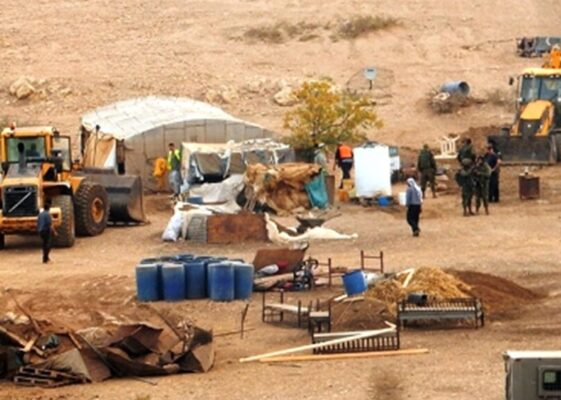
Illegal paramilitary Israeli colonizer groups renewed their field incursions into the Ras al‑Ahmar Bedouin community east of Atouf in the northern Jordan Valley, threatening residents with forced removal within ten days — a new escalation aimed at emptying this strategic area of its Palestinian population.
Local sources said colonizers, wearing uniforms resembling those of the Israeli occupation army, invaded the community’s homes overnight and cut electricity to the eastern section of Ras al‑Ahmar to intensify pressure on the families. At the same time, they tightened the siege by closing all access roads except for a single difficult passage.
Residents warned that a new road being carved through the area will lead to the complete isolation of Ras al‑Ahmar, especially after occupation machinery demolished three artesian wells in Atouf and the community itself — part of an escalating “water war” designed to deprive Palestinians of the basic means of survival.
This development is linked to the wide‑scale bulldozing and uprooting campaign underway in the Atouf and al-Baqi’a plains since early this year to implement what Israel calls the “Crimson Thread Project,” a colonial plan involving military roads and a wall that would carve out vast areas of Tubas and the northern Jordan Valley.
The bulldozing has already destroyed main water networks and uprooted trees, cutting water access to roughly 30,000 dunams — about one‑third of the al-Baqi’a Plain — and striking at the region’s vital agricultural base.
These coordinated attacks by colonizers and occupation forces form part of a systematic policy to dismantle infrastructure and expand colonial outposts, turning life in one of the West Bank’s key food‑production and water‑reserve areas into an environment designed to force Palestinians into displacement.
