
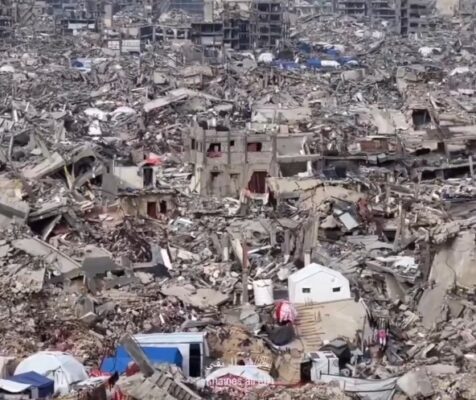
The Gaza Strip endured another difficult day as Israeli bombings and closures continued to shape life across the besieged territory, despite the “ceasefire” framework announced on 11 October. Residents across the Strip describe nights marked by explosions, the constant presence of drones, and the sense that the war has not truly paused.
The Palestinian Ministry of Health in Gaza reported that one Palestinian was killed and nine others were wounded during the past twenty‑four hours.
Medical teams stressed that these figures represent only the casualties they were able to reach. Many victims remain trapped under collapsed buildings or lying in streets that ambulances cannot safely access due to ongoing Israeli fire, destroyed roads, and the absence of heavy rescue equipment.
Since the start of the “ceasefire” period, the number of Palestinians killed has risen to 651, with 1,741 injured. Civil defense crews have recovered 756 bodies from beneath the rubble during this same period, underscoring the scale of destruction that continues to define daily life in Gaza.
The cumulative toll since the beginning of the genocide in Gaza on October 7, 2023, has now reached 72,136 Palestinians killed and 171,839 injured.
Hospitals across the Strip remain overwhelmed, operating with limited supplies, intermittent electricity, and medical teams who have themselves been displaced or bereaved.
Many of the wounded require specialized treatment that is unavailable due to the closure of crossings and the continued blockade on medical evacuations.
Field reports from several districts indicate that Israeli forces continue to carry out incursions and attacks in areas east of Gaza City and Khan Younis.
Residents describe sporadic shelling, gunfire, and the demolition of homes and infrastructure, leaving behind neighborhoods that are barely recognizable.
Fishermen continue to face arrests and boat seizures at sea, further undermining one of the few remaining sources of livelihood for families already pushed to the brink.
The humanitarian situation continues to deteriorate as aid entering Gaza remains far below what is required. Fuel, medical supplies, and heavy machinery needed for rubble removal are tightly restricted, leaving hospitals struggling to keep generators running and civil defense teams forced to dig through collapsed buildings with basic tools. Water and sanitation networks fail repeatedly, and food insecurity has become widespread, with families reducing meals and facing soaring prices for whatever remains available.
Public health risks are rising sharply. Overcrowded shelters, damaged water systems, and limited sanitation create conditions ripe for disease, particularly among children, the elderly, and people with chronic illnesses. Doctors describe having to make impossible decisions about who receives scarce medicines or intensive care beds.
Politically, the situation remains stalled. International discussions about ceasefire mechanisms and reconstruction have yet to produce meaningful change on the ground. The continued deployment of Israeli forces in parts of the Strip, combined with ongoing attacks and strict border controls, reinforces the sense among Palestinians that the war has simply shifted into a different phase.
Thursday’s figures add another painful chapter to an already staggering toll. For families in Gaza, survival now extends far beyond the immediate threat of bombardment. It has become a daily struggle to navigate a landscape where homes, infrastructure, and community life have been systematically torn apart, with no clear path toward recovery.
