
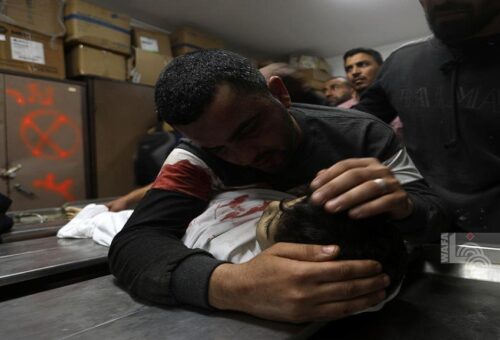
Medical sources in the Gaza Strip announced on Wednesday that the death toll from Israel’s ongoing assault on the besieged enclave has risen to 72,344 Palestinians, with 172,242 wounded, since the beginning of genocide in the devastated coastal regions on October 7, 2023.
Hospitals across the Strip received eight newly killed Palestinians and twenty‑four wounded over the past 24 hours.
The sources added that since the “ceasefire” declared on October 11, 2025, the number of Palestinians killed has climbed to 765, while the total number of injuries has reached 2,140, and 760 bodies have been recovered from beneath the rubble.
Urgent Humanitarian Appeal: Save 13-Year-Old Ali Abu Tayr
With heartbreaking words, Ali (13 years old) recalls the moment he was critically injured by a “Quadcopter” drone strike while collecting firewood in Abasan, east of Khan Yunis. pic.twitter.com/jyuyRbn7it— Eye on Palestine (@EyeonPalestine) April 15, 2026
Medical teams warn that an unknown number of victims remain trapped under destroyed buildings and in the streets, as ambulance and rescue crews are unable to reach many areas due to ongoing Israeli fire and the destruction of roads.
In a separate development, twelve Palestinian detainees, including one woman, who were recently released from Israeli prisons, arrived at Al‑Aqsa Hospital in Deir al‑Balah aboard vehicles operated by the International Committee of the Red Cross.
In addition, health officials reiterated that more than 20,000 wounded and chronically ill Palestinians urgently require medical evacuation abroad for treatment that is no longer available inside Gaza.
A child carries the body of his uncle, who was killed in the Israeli bombing that targeted the Shati camp, west of Gaza City, last night. pic.twitter.com/zfM5VdFDPc
— PALESTINE ONLINE 🇵🇸 (@OnlinePalEng) April 15, 2026
A senior official in the Gaza Ministry of Health recently told Al‑Jazeera that 1,268 patients have died while waiting for permission to leave Gaza for treatment since the Israeli army seized the Rafah Crossing.
According to the official, around 20,000 patients hold completed medical referrals and are awaiting evacuation, including 440 classified as “life‑saving” cases, 4,500 children, 6,000 wounded, and 4,000 cancer patients.
The Ministry’s Director‑General of Administrative Affairs, Mahmoud Hammad, described the catastrophic challenges facing ambulance and medical transport services.
He said that 70% of Gaza’s ambulances and medical transport vehicles are now out of service, either destroyed in Israeli attacks or disabled due to accumulated mechanical failures.
🇵🇸👉El ejército terrorista israelíes bombardean a la población civil en Gaza.. y las consecuencias son tan graves que los niños y niñas sufren las explosiones de misiles estadounidenses que los aviones sionistas lanzan indiscriminadamente contra los Palestinos pic.twitter.com/WarCnvlOHf
— aapayés (@aapayes) April 16, 2026
Hammad added that the lack of spare parts, tires, oils, and basic maintenance supplies has made it nearly impossible to repair the remaining vehicles.
He warned that the crisis is severely undermining the ability of emergency teams to respond to daily needs, including transporting the wounded, the sick, and released detainees.
He stressed that urgent provision of medical supplies, spare parts, and operational support is essential to prevent a total collapse of ambulance and patient‑transport services, calling on all relevant bodies monitoring the humanitarian and health situation in Gaza to act immediately.
