
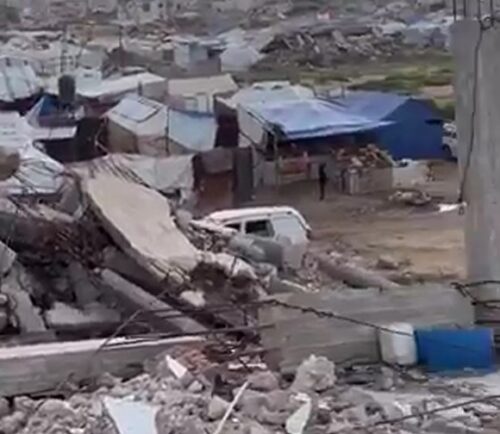
Israeli military fire and restrictions on aid continued across the Gaza Strip on Monday, deepening the humanitarian crisis that has persisted despite the “ceasefire” declared in mid‑October 2025.
The Gaza Health Ministry said hospitals received the body of one Palestinian and treated five others wounded in the past 24 hours.
It stated that Israeli soldiers shot and killed a Palestinian man near the Kuwait Roundabout south of Gaza City, while sporadic fire and limited strikes continued in northern and eastern areas.
Palestinian officials said these incidents reflect repeated violations of the ceasefire, which they say has been undermined by near‑daily Israeli military activity. Israeli authorities have not issued detailed public responses to the individual reports.
Humanitarian conditions deteriorated further after winter storms flooded displacement camps across the Strip. Tens of thousands of tents were inundated in al‑Mawasi west of Khan Younis, in parts of Gaza City, and in neighborhoods near the port.
Civil Defense teams said they rescued residents trapped in flooded shelters, while aid agencies warned that the storms compounded the hardships faced by nearly two million displaced Palestinians living without adequate housing, sanitation, or basic services.
Humanitarian groups said shelter conditions remain precarious as Israel continues to restrict the entry of tents, prefabricated housing, and construction materials.
Movement into and out of Gaza was further curtailed after Israeli authorities closed the Rafah crossing in late February, halting most civilian travel and restricting the movement of humanitarian personnel.
Human rights organizations said the closure has further reduced already limited aid deliveries and medical evacuations.
Aid agencies said uncertainty over access persists despite an Israeli Supreme Court decision temporarily blocking a government plan that would have barred dozens of international organizations from operating in Gaza.
On Sunday, Israeli shelling killed two Palestinians, while two infants died as a result of the collapse of medical services and the prolonged siege.
The deaths highlight the continuing impact of the blockade and the breakdown of essential infrastructure, including hospitals that remain unable to function due to fuel shortages, damaged equipment, and restrictions on medical supplies.
Humanitarian officials said the infants’ deaths reflect the broader collapse of neonatal and emergency care across the Strip.
Political tensions rose after a senior adviser to the Israeli prime minister said Israel could resume full‑scale military operations if Hamas does not disarm within a specified timeframe.
Hamas political leaders said they had received no formal ultimatum and described the remarks as political messaging. Meanwhile, U.S. Secretary of State Marco Rubio arrived in Israel for meetings expected to focus on Gaza and broader regional developments.
The United Nations renewed warnings about reconstruction plans for Gaza, stressing that any rebuilding must respect Palestinian self‑determination and comply with International Law.
UN experts estimate that more than 90 percent of Gaza’s housing stock was destroyed or damaged between 2023 and 2025. Recent reports by UN special rapporteurs described the widespread destruction of civilian housing as “domicide,” saying it may constitute violations of international humanitarian and criminal law.
Gaza residents face ongoing security incidents, severe limits on movement and aid, and worsening humanitarian conditions amid political and diplomatic uncertainty.
Since the “ceasefire” took effect on October 11, 2025, the ministry has documented 630 Palestinians killed, 1,698 injured, and 735 bodies recovered.
The cumulative toll since October 7, 2023, has risen to 72,097 killed and 171,796 injured, the majority of them children, women, and elderly people, in addition to hundreds of medics and journalists killed when Israeli forces bombarded residential buildings, including the homes of media workers.
Many victims remain trapped under rubble in areas emergency crews cannot reach due to destroyed infrastructure and ongoing security risks.
