
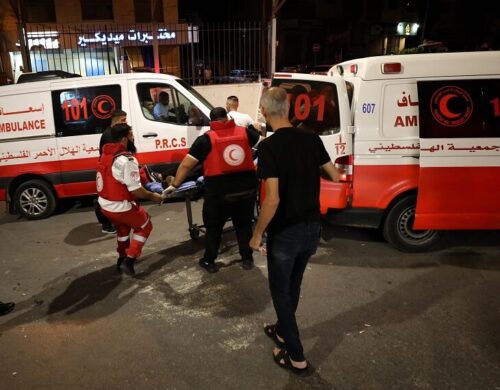
The Ministry of Health in Gaza warned on Monday that the ambulance and medical‑transport system is on the verge of complete shutdown, as Israeli restrictions and continued attacks have left most service vehicles out of operation.
Officials said the crisis is now directly threatening the ability of thousands of wounded and chronically ill patients to reach hospitals across the besieged Strip.
Mahmoud Hammad, Director‑General of Administrative Affairs at the Gaza Ministry of Health, said nearly 70 percent of the ministry’s vehicles have been forced out of service due to the ongoing blockade, direct targeting, and Israel’s continued ban on the entry of tires, batteries, oils, and essential spare parts. He added that months of accumulated mechanical failures have pushed the system toward collapse.
Hammad stated that the ministry owns 82 ambulances, but 39 have already stopped functioning entirely, while 17 more require urgent repairs. He warned that the continued ban on maintenance supplies is driving the ambulance network toward “total paralysis,” leaving thousands of wounded and sick Palestinians at risk.
Dr. Eyad Zaqqout, Director of the Emergency and Ambulance Unit, said the system is now operating at less than one‑third of its capacity.
He explained that an ambulance can be taken out of service simply because it needs a single tire, as basic spare parts have completely run out, and added that Israel continues to block the entry of new ambulances to replace those destroyed or worn-down during months of nonstop emergency operations.
Zaqqout said only 30 percent of the ambulance fleet remains functional, while 35 vehicles have stopped working due to the lack of spare parts. The most critical shortages include tires, batteries, oils, and essential consumable components.
He noted that the crisis has already caused a sharp increase in response times for emergency calls, even as the unit continues to carry out around 1,500 missions per week despite operating with less than one‑third of its fleet.
Ambulances are also suffering sudden breakdowns while transporting patients, Zaqqout added, due to damaged tires and severely deteriorated roads, further endangering the lives of wounded civilians.
The crisis extends beyond ambulances. Hammad said technical teams oversee nearly 5,000 transport operations per week—about 20,000 per month, including patient transfers, staff movement, and 140 weekly truck trips carrying medicines and medical supplies.
He confirmed that 100 service vehicles have gone out of operation, including 30 that are beyond repair, while 80 others require urgent maintenance. This threatens the continuity of medicine and supply distribution between hospitals.
The ministry also warned that private transport companies contracted to support medical operations have been unable to conduct routine maintenance for months due to the lack of oils, tires, and spare parts.
Health officials said the remaining vehicles require at least 250 liters of oil per month to stay operational, but Israel’s continued ban on maintenance materials makes sustaining the fleet increasingly impossible.
The Ministry of Health issued an urgent appeal to the international community, the United Nations, and humanitarian organizations to pressure Israel to allow the entry of spare parts, tires, batteries, oils, and at least 60 new diesel‑powered ambulances.
Officials stressed that without immediate intervention, the ambulance and emergency system faces imminent collapse, placing thousands of wounded and chronically ill Palestinians in grave danger.
In related news, hospitals across the Strip received six new fatalities twenty injures, some seriously, Monday. The figures only include those who have been officially admitted to hospitals and medical centers.
Since the “ceasefire” declared on October 11, 2025, the cumulative toll has risen to 1,158 Palestinians killed and 3,756 wounded, with 802 bodies recovered from destroyed areas.
The overall death toll since the beginning of the genocide in Gaza on October 7, 2023, has reached 73,283, with 173,864 documented injuries.
The Health Ministry noted that many victims remain trapped under rubble or in unreachable areas due to ongoing bombardment and the inability of ambulance and civil defense crews to safely access strike locations.
