
By Walid al‑Awwad: In Gaza, children no longer have homes to return to, nor a sky they can safely play under. The Israeli occupation destroyed their houses and buried beneath the rubble their small rooms, their schoolbooks, their dolls, and the toys they once believed would stay with them for years.
Under that rubble, something far larger was buried — small dreams that grew a little every day, and bigger dreams that were waiting to grow with them.
When the children crawled out from under the ruins, they found only tents.
But even the tents were not safe. The occupation’s missiles followed them into displacement areas, while hunger, thirst, cold, heat, and swarms of insects chased them from every direction. In Gaza, death no longer needs an address.
On Gaza’s shoreline — where children once ran after the waves — drone-fired missiles tore their bodies apart, scattering pieces of tomorrow’s generation across the sand.
And yet, one thing remained beyond the reach of destruction: a child’s imagination.
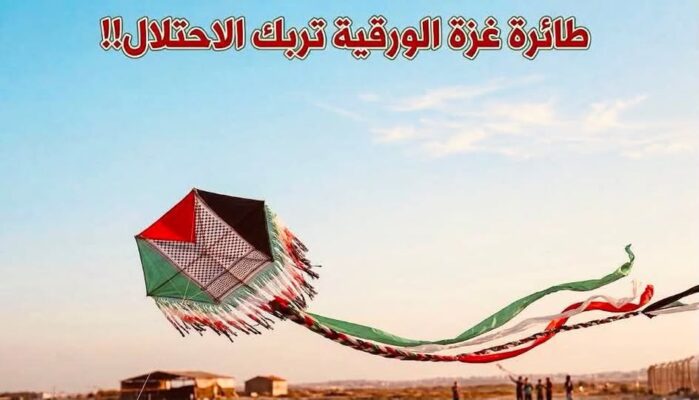
From between the tents, small paper kites began to appear — colorful, fragile, stitched together from scraps, and carrying the dreams of the children who made them. They rose into Gaza’s sky as if the children were telling the world: We are still here.
A paper kite.
Sometimes it fell between the tents, and the children would run to me asking for help to retrieve it. I always did, watching their joy as they reclaimed their tiny toy — as if they had recovered a piece of the life the war tried to steal from them.
Just a kite made of paper and string, crafted by a child from whatever he can find, tying to it a small hope of reaching the sky.
But it seems the occupation — with its warplanes, drones, missiles, and tanks — has found these paper kites worthy of alarm.
On August 23, Israeli Defense Minister Yisrael Katz said he had instructed the army to act “immediately and forcefully” against launches from Gaza, including kites, according to Israeli media reports. Those reports said the kites had drifted eastward with the wind and posed no threat.
What fear grips a state with one of the world’s most heavily armed militaries… from a paper kite?
What kind of “battle” requires an army, aircraft, and weapons to confront a child’s toy?
It is not a battle against the kite.
It is a battle against the meaning it carries.
The kite says that the child in Gaza — despite everything — still dreams, still looks upward, still insists on the sky.
It says the rubble did not kill imagination.
It says that even a narrow tent can open a window to the sky.
And it says, above all, that a people surrounded by death from every direction can still create something beautiful.
This is why the occupation fears it.
It fears the kite because it exposes the imbalance of power: a fully armed army facing a child holding a string and a piece of paper.
It fears it because it reminds the world that Gaza’s children were not born to be targets — they were born to go to school, to play, to laugh, and to fly their kites.
Paper kites are not new to Gaza’s children. For years they were a game, a moment of joy, a small escape from the harshness of war. Today, after vast areas of Gaza have been destroyed and large parts of the Strip placed under military control, the occupation wants even the sky to be off‑limits.
It wants to tell them: you have no home, no school, no beach, no safe tent — and even the sky is not yours.
But the child in Gaza does not understand this language.
He lifts his kite.
He wraps the string around his small hand.
And he runs.
He runs across the sand, between the tents, away from the rubble — perhaps even over the cemetery of dreams the occupation tried to bury.
Then he lets the kite rise.
And with it, his hopes rise too.
In that brief moment, the child becomes stronger than the war.
The paper kite carries no bomb.
It carries a dream.
And dreams — no matter how many missiles, tanks, or drones try to kill them — do not die easily.
Gaza cannot bear more missiles.
Gaza needs its children to reclaim their natural right to simply be children: to run, to laugh, to play, to build their kites, and to lift them into the sky without fearing that the sky will turn into another graveyard.
In Gaza, the paper kite is no longer just a child’s toy; it has become a small declaration that life, despite everything, still resists.
And perhaps this is why the occupation fears a paper kite more than many other things.
It can destroy a house, but it cannot destroy a dream.
It can chase a child, but it cannot chase the sky.
And in Gaza, every time a paper kite rises from the rubble, something rises with it — something no warplane can shoot down: a child’s dream of life.
Gaza — 23 August 2026
About the Author: Walid Hussein al‑Awwad is a Palestinian political figure, a member of the Palestinian National Council, and a senior leader in the Palestinian People’s Party. He has been involved in political work and Palestinian national institutions and appears in the media as a political analyst and commentator.
He was born on June 16, 1962, in al‑Bass refugee camp near the city of Tyre in Lebanon. His family is originally from the depopulated village of Najmat al‑Subh in the Safad district. Al‑Awwad grew up in refugee camp conditions and studied in UNRWA schools before continuing his education abroad.
In 1979, he joined the Palestinian Communist Party, marking the beginning of a political path that would span decades.
He later traveled to the Soviet Union in 1986 to study social sciences and eventually earned a bachelor’s degree in political science from Al‑Azhar University in Gaza in 2001.
