
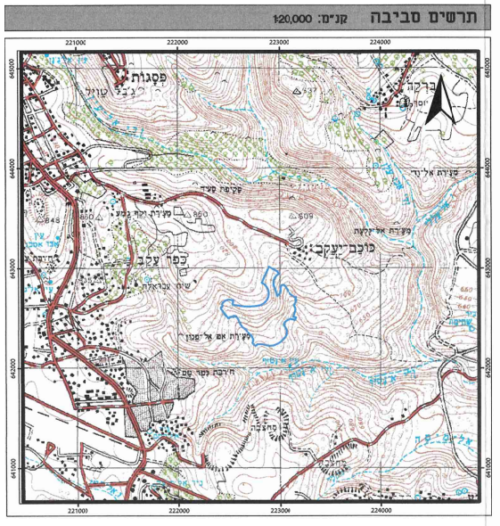
The Wall & Colonization Resistance Commission reported that the so‑called Israeli “Land Authority” has issued a new tender, numbered (177/2026), for the construction of 627 illegal colony units in the “Kochav Ya’akov” illegal colony, built on lands belonging to the Ramallah and al‑Biereh governorate, as part of an intensive residential expansion project.
The tender, published on August 6, 2026, sets November 30, 2026, at noon as the deadline for development and construction companies to submit bids. It follows Israel’s approval, on April 27, 2025, of the planning scheme that forms the basis of the project, targeting an area of 253.7 dunams.
The tender’s release, fifteen months after the planning approval, marks the transition from the planning stage to the marketing and implementation phase.
The Commission stated that the tender reflects the integrated stages of colonial expansion: planning approval grants the project its regulatory status, while tenders allocate construction plots and bring in developers and contractors to begin execution.
|Israel Expands Illegal Colony Outpost on Sinjil Farmlands|
This process transforms planned units into a tangible residential project, increasing the colony’s capacity and reinforcing its demographic and structural presence.
The plan carries particular significance due to the location of “Kochav Ya’akov” between northern Jerusalem and the cities of Ramallah and al‑Biereh, within the colonial bloc administered by Israeli authorities under the name “Binyamin.”
The addition of 627 new units will expand the colony’s built‑up area and strengthen its connection to surrounding colonies and bypass roads, further fragmenting Palestinian geography, and deepening the separation between Jerusalem and its Palestinian surroundings and the Ramallah–al‑Biereh area.
“Kochav Ya’akov” is among several colonies and outposts established on lands belonging to the Ramallah and al‑Biereh governorate.
During the first half of 2026, the Wall & Colonization Resistance Commission documented 12 Israeli tenders for colonial construction, covering residential, commercial, industrial, and service projects.
These tenders included 1,138 housing units ready for implementation, concentrated in five major colonial blocs: “Ariel” (342 units), “Ma’ale Adumim” (581 units), “Immanuel” (21 units), and “Ganei Modi’in” (194 units).
Other tenders targeted industrial and commercial zones, offices, elderly care facilities, and tourism and recreation sites, reflecting a growing trend toward developing the economic and service infrastructure of colonies rather than limiting expansion to residential construction alone.
The Commission said these projects form part of Israel’s ongoing strategy to consolidate its colonial presence across the occupied West Bank, expand demographic control, and entrench permanent separation between Palestinian population centers through a network of colonies, roads, and military zones.
All of Israel’s colonies in the occupied West Bank, including those in and around occupied East Jerusalem, are illegal under International Law, the Fourth Geneva Convention in addition to various United Nations and Security Council resolutions. They also constitute war crimes under International Law.
Article 33 of the Fourth Geneva Convention prohibits collective punishment and acts of terror against civilian populations.
Article 49 of the Fourth Geneva Convention states: “The Occupying Power shall not deport or transfer parts of its own civilian population into the territory it occupies.” It also prohibits the “individual or mass forcible transfers, as well as deportations of protected persons from occupied territory”.
Articles 53 and 147, prohibit the destruction of civilian property and classify pillage as a war crime.
