
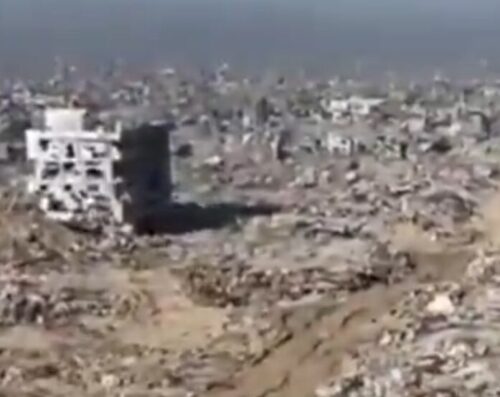
Israeli occupation forces continued their violations across the devastated Gaza Strip on Thursday, issuing new forced‑evacuation orders in Gaza City, expanding demolition zones, and continuing attacks that left additional casualties in the north and south.
The developments came as Israeli political and military officials signaled growing tensions over the future of Gaza and the composition of the proposed international force expected to deploy under the second phase of the ceasefire framework.
The humanitarian toll of the genocide continues to deepen. The Ministry of Health announced that the number of Palestinians killed since October 7, 2023, has risen to 70,942, with 171,195 injured, according to the latest figures published on December 25.
Among the dead are more than 20,179 children, a staggering proportion that reflects the scale of destruction in densely populated civilian areas.
🚨BREAKING: Israeli forces shelled the Shuja’iyya neighborhood, east of Gaza City, earlier today. pic.twitter.com/LAuXFFuef6
— Gaza Notifications (@gazanotice) December 25, 2025
The violations have also been catastrophic for frontline workers: at least 247 journalists have been killed, making Gaza the deadliest conflict for media workers ever recorded, while 1,151 doctors, nurses, paramedics, and other medical staff have been killed as hospitals and clinics came under repeated attack.
Since the “ceasefire began” on October 11, 2025, Israeli fire, building collapses, starvation, dehydration, and the collapse of medical services have killed at least 383 Palestinians and injured 1,002 more, with children and women again making up a significant share of the victims.
In eastern Tuffah, Gaza City, Israeli forces delivered fresh evacuation orders to residents of an entire residential block that Israel had previously designated as a “safe” zone.
According to WAFA’s correspondent, the order precedes the planned demolition of the block and the expansion of what Israel calls the “yellow cubes”—a network of militarized control zones—by more than one hundred meters in depth and over three hundred meters in width.
The announcement triggered a new wave of displacement, with hundreds of families fleeing the area on foot, many for the second or third time since the beginning of the genocide.
⚡️🇮🇱JUST IN:
Israeli soldiers marked Christmas by shooting at homes in Tulkarm in the West Bank and destroying residential neighborhoods in Gaza, not by bringing gifts to children.pic.twitter.com/NjMorvoQdR
— Suppressed News. (@SuppressedNws1) December 25, 2025
The forced evacuations unfolded as Israeli attacks continued in several parts of the Strip. Al‑Jazeera reported that Israeli forces opened fire in Jabalia, killing at least one Palestinian and injuring others.
In the south, Gaza’s Civil Defense recovered the bodies of twenty‑five Palestinians from beneath the rubble of a destroyed home northwest of Khan Younis, including the remains of journalist Hiba al‑Abadla and her mother, who had been missing since January 2024.
Rescue teams said the recovery operation was hampered by the lack of heavy equipment, fuel, and medical supplies, all of which remain severely restricted under Israel’s blockade.
Despite the “ceasefire” framework negotiated by the United States, Israeli bulldozers continued to level large sections of northern Gaza.
Gaza on Christmas Eve: Israeli forces demolished homes overnight. pic.twitter.com/Djae240CTS
— Ramy Abdu| رامي عبده (@RamAbdu) December 25, 2025
Al‑Jazeera’s correspondents documented ongoing demolitions in areas Israel has kept under military control, including the systematic destruction of remaining residential structures in neighborhoods already depopulated by earlier offensives.
Humanitarian agencies warned that the continued bulldozing is making it impossible for displaced families to return, even temporarily, to assess damage or retrieve belongings.
The humanitarian situation across Gaza remained catastrophic. Aid organizations reported that Israeli restrictions on the entry of food, fuel, and medical supplies have pushed the humanitarian system to the brink of collapse.
🚨An Israeli Channel 14 correspondent published a video from Tel al-Zaatar in Jabalia, northern Gaza, showing the Indonesian Hospital and Al-Awda Hospital in the background, surrounded by total destruction after being repeatedly targeted by the Israeli army and having doctors… pic.twitter.com/ws8QjMwnHX
— Gaza Notifications (@gazanotice) December 25, 2025
UN agencies estimate that more than 1.6 million Palestinians face acute food insecurity, with many surviving on minimal rations.
Hospitals in the central and southern area of the Gaza Strip are operating with dwindling supplies, and several medical centers have warned that they may be forced to halt critical services if fuel deliveries do not resume.
Alongside the military escalation, Israeli media reported growing political friction over the future of Gaza’s governance.
The Israeli Public Broadcaster (KAN) reported Thursday that Tel Aviv may be forced to reconsider its veto on Turkish participation in the international force expected to enter Gaza during the second phase of the ceasefire agreement.
According to the report, senior Israeli officials believe Prime Minister Benjamin Netanyahu will face a significant dilemma in his upcoming meeting with U.S. President Donald Trump, who is expected to press Israel to allow Turkey to join the mission.
مقطعٌ يوثّق الدمار الذي حلّ بمخيم جباليا شمال قطاع غزة. pic.twitter.com/kTB0kmNDgv
— أنس الشريف Anas Al-Sharif (@AnasAlSharif0) December 25, 2025
Netanyahu has previously described Turkish involvement as a “red line,” but Israeli officials now acknowledge that many countries are unwilling to contribute troops, potentially leaving Israel with limited options.
Turkish media outlets have also reported that Washington intends to push for Ankara’s inclusion, arguing that Turkey’s participation would help stabilize the Strip and support reconstruction efforts.
Israeli officials quoted by KAN said the government may ultimately have to decide whether to maintain its veto or accept Turkish involvement to ensure the force can be deployed at all.
Meanwhile, Israeli Defense Minister Israel Katz reiterated that Israel intends to maintain a permanent security presence inside Gaza, contradicting the ceasefire’s requirement for a phased Israeli withdrawal.
His remarks drew criticism from Palestinian officials, who said the statements confirm Israel’s intention to prolong its military occupation and undermine any political resolution.
Thursday’s events underscored the widening gap between diplomatic negotiations and the reality on the ground.
As forced displacement continued in Gaza City, bodies were pulled from rubble in Khan Younis, and bulldozers leveled more neighborhoods in the north, Palestinian families faced yet another day of uncertainty, loss, and forced movement.
With political tensions rising in Tel Aviv and Washington, and humanitarian conditions deteriorating across the Strip, the prospects for stability in Gaza remain distant.
