
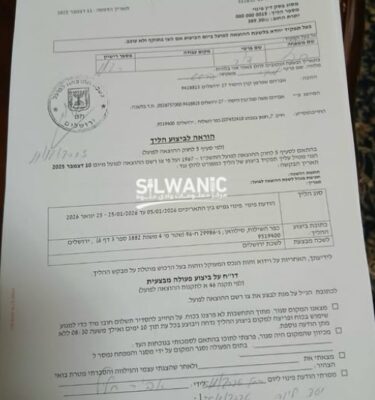
Israeli occupation authorities on Wednesday delivered eviction notices to Palestinian citizen Khalil Basbous and his son Bilal in the Baten al-Hawa neighborhood, while illegal paramilitary Israeli colonizers seized the homes of brothers Nasser and Ayed Rajabi and their mother in the same neighborhood, in Silwan, south of the Al-Aqsa Mosque in occupied Jerusalem in the West Bank.
Both actions were carried out in favor of the extremist “Ateret Cohanim” colonization group, under the pretext of alleged “Jewish ownership” of the land.
The eviction orders require the Basbous family to vacate their two homes by January 5. Local sources said the properties shelter eight family members, including children, raising fears of imminent displacement and denial of their right to housing.
Residents described the move as part of a systematic policy to empty the neighborhood of its Palestinian population in favor of expanding colonization.
In the Rajabi case, colonizers raised the Israeli flag over the seized homes after the family was forcibly evicted days earlier.
The takeover was also executed in favor of “Ateret Cohanim,” which has been at the center of efforts to expand colonization in Silwan.
Baten al-Hawa has witnessed a dangerous escalation in forced evictions and property seizures, forming part of a wider colonization plan aimed at altering the demographic character of the area and imposing a new reality by force.
|Forced Evictions in Baten al-Hawa, Silwan December 15 – IMEMC|
Palestinian officials and human rights groups stress that these actions constitute a flagrant violation of international law and UN resolutions.
Ateret Cohanim bases its lawsuits on claims of “Jewish ownership dating back to 1881,” asserting that approximately 5.2 dunams of Baten al-Hawa land belonged to a Jewish trust for Yemenite Jews. These claims were revived in 2015 and have since drawn dozens of Palestinian families into protracted court battles.
Israeli courts rely on the 1970 “Legal and Administrative Matters Law,” which allows Jews to “reclaim property lost in East Jerusalem in 1948.”
Palestinians, however, are barred from reclaiming their own properties in West Jerusalem under the “Absentee Property Law” of 1950. This discriminatory legal framework has enabled Ateret Cohanim to pursue mass evictions.
Human rights groups have noted that the trust Ateret Cohanim claims to manage is effectively a fictitious entity run entirely by the colonialist group, in violation of its founding charter.
|Israeli Colonizer Kills a Palestinian Child Near Bethlehem|
Despite this, Israeli courts continue to uphold its claims. As one Israeli legal analyst observed, “The law is applied in a way that privileges one community while denying the same rights to another.”
Strategic Targeting of Silwan
Baten al-Hawa, located just 400 meters from Al-Aqsa Mosque and home to nearly 10,000 Palestinians, is among the most targeted areas in Silwan.
Analysts note that the evictions are part of a broader plan to link colonialist outposts around Al-Aqsa, consolidating Israeli control over the Old City’s surroundings.
U.S. Funding and the Continuation of Palestinian Dispossession
Ateret Cohanim, the Israeli colonialist organization driving evictions in occupied East Jerusalem, is sustained by millions of dollars in tax‑deductible donations from the United States.
Its New York–registered charity, American Friends of Ateret Cohanim, has raised more than ten million dollars over the past decade to finance lawsuits, property seizures, and settlement expansion in Silwan and the Old City.
The injustice inflicted on Palestinian families today cannot be separated from the original dispossession of 1948.
During the Nakba, more than 750,000 Palestinians were expelled or fled from their homes, and Israel has since refused to allow their return, despite UN General Assembly Resolution 194, which affirms the right of refugees to return to their homes and receive compensation.
That denial remains at the heart of the conflict: Palestinians are barred from reclaiming their properties in West Jerusalem under the Absentee Property Law of 1950, while Jewish claimants are permitted to pursue restitution in East Jerusalem under the 1970 “Legal and Administrative Matters Law.”
This double standard entrenches a system of legal apartheid, where one community’s rights are recognized and enforced, while another’s systematically erased.
The funds raised abroad are not neutral. They are deployed to finance lawsuits that force Palestinian families out of homes they have lived in for generations, to purchase or seize properties in Silwan, and to sustain religious institutions that train students in the ideology of colonialist expansion.
Each eviction in Baten al‑Hawa echoes the original expulsions of 1948, extending the Nakba into the present day. Families who survived one wave of displacement are now subjected to another, under the cover of Israeli courts that critics say function as instruments of occupation rather than impartial justice.
International law is clear: the Fourth Geneva Convention prohibits the forcible transfer of protected populations under occupation. The UN Security Council, most notably in Resolution 2334, has reaffirmed that Israeli settlements in occupied territory have “no legal validity” and constitute a “flagrant violation” of international law.
Yet Israel continues to build and expand colonies and enforce evictions, while foreign charitable structures provide the financial lifeline that makes these violations possible.
The injustice is therefore twofold. Palestinians are denied their historic and internationally guaranteed rights to return to the homes and lands from which they were expelled in 1948, and they are simultaneously subjected to ongoing displacement in East Jerusalem today.
What is presented as a legal dispute over property is in fact the continuation of a decades‑long project of erasure, financed by tax‑exempt donations abroad and enforced through discriminatory laws at home.
All of Israel’s colonies in the occupied West Bank, including those in and around occupied East Jerusalem, are illegal under International Law, the Fourth Geneva Convention in addition to various United Nations and Security Council resolutions. They also constitute war crimes under International Law.
Article 33 of the Fourth Geneva Convention prohibits collective punishment and acts of terror against civilian populations.
Article 49 of the Fourth Geneva Convention states: “The Occupying Power shall not deport or transfer parts of its own civilian population into the territory it occupies.” It also prohibits the “individual or mass forcible transfers, as well as deportations of protected persons from occupied territory”.
Articles 53 and 147, prohibit the destruction of civilian property and classify pillage as a war crime.
