
Illegal Israeli paramilitary colonizers carried out a series of attacks across the occupied West Bank on Thursday, injuring Palestinians, stealing livestock and property, damaging homes and farmland, and installing mobile homes for a new colonial outpost, according to local officials and residents.
The attacks followed extensive incidents reported across the West Bank on Wednesday, when Israeli forces invaded Palestinian communities, detained residents and demolished homes and structures, while colonists entered villages and agricultural areas.
Before dawn, colonists attacked the home and farm of the Al-Jabarin family in the Jabal Al-Qarn area of Al-Minya, east of Bethlehem in the southern West Bank.
Ahmad Kawazba, head of the Al-Minya Village Council, said the attack began around 3 a.m. Colonists physically assaulted family members, injuring two Palestinians. One was taken to Al-Hussein Hospital in Beit Jala, while Israeli forces detained the other injured person along with two relatives and took all three to an undisclosed location.
Kawazba identified the detainees as Hussein Abdul-Aziz Jabarin, Mohammad Abdul-Aziz Jabarin, and Sultan Jaser Abdul-Aziz Jabarin.
Kawazba said the colonists stole more than 100 sheep and a vehicle, vandalized a second vehicle, broke into the home, destroyed its contents, damaged the solar energy system supplying electricity to the property, cut the water line, and uprooted more than 100 olive trees before leaving the area.
Local officials said attacks by colonists have intensified in Al-Minya and the surrounding Jabal Al-Qarn area, targeting residents, agricultural property, and water and electricity infrastructure.
In the northern West Bank, three Palestinians, including a child, were injured after colonists sprayed pepper gas at their vehicle on the road between Arraba and Ya’bad, southwest of Jenin.
Local sources said a 64-year-old man, a 40-year-old man, and a child received treatment from paramedics at the scene.
Elsewhere in the northern West Bank, footage showed Israeli soldiers who had recently occupied a home belonging to the Tubassi family in Jalud, southeast of Nablus, playing soccer with colonists in front of the property.
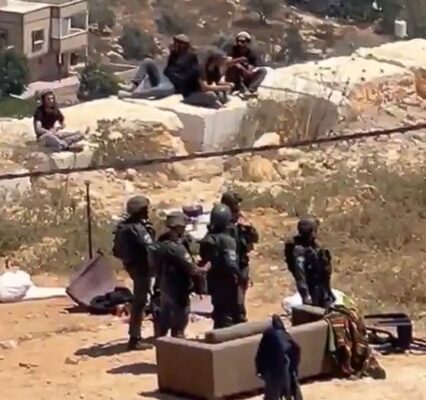
Also in Nablus, a group of colonizers and soldiers performed provocative tours around Palestinian homes in the town of Qusra, south of the city, as part of ongoing violations and harassment of the locals in the area.
Meanwhile, colonists began installing mobile homes on Palestinian-owned land in an-Nazla ash-Sharqiya, north of Tulkarem in the northwestern West Bank, in preparation for establishing a new colonial outpost.
Wael Kattana, head of the village council, said the targeted area links the illegal Hermesh colony with an existing pastoral outpost established on village land.
According to Kattana, colonists spent nearly a month bulldozing land, opening roads and extending electricity lines before bringing in mobile homes.
Qusrae.
Another day of siege.
The settlers arrived in massive numbers. The most powerful army in the world failed to evacuate them.
After a mass rampage by the settlers and an attempt to break into the house, the army withdrew.
No arrests.
The media, unlike the settlers, is… pic.twitter.com/d04k0YBJ1L— מסתכלים לכיבוש בעיניים (@Mistaclim) August 12, 2026
Kattana said approximately 20 structures had been installed by that point and that the nearby pastoral outpost lay about 150 meters from the village. He warned that the outpost posed a direct threat to residents and their agricultural lands.
Kattana added that farmers and residents are subjected to daily attacks, including being forced from their land, denied access to agricultural areas, prevented from grazing livestock, and targeted through repeated attacks on village property, particularly water facilities.
He warned that continued infrastructure development and expansion of the new outpost could lead to the seizure of additional Palestinian land and further undermine local livelihoods.
Local sources said Israeli soldiers confiscated large areas of Palestinian farmland east of Tayasir, near Tubas, in the northeastern West Bank. They said the army then began bulldozing and leveling the land as additional bulldozers and trucks entered the area.
Furtehrmore, Israeli soldiers and colonists invaded Burqa village, east of Ramallah in the central West Bank, detained three Palestinians and confiscated a village council tractor used for collecting trash.
In Taybeh, northeast of Ramallah in the central West Bank, colonists dismantled and stole metal fencing surrounding agricultural land and stole construction materials.
Suleiman Khoury, head of the Taybeh Municipality, said colonists removed fencing from an almond and olive farm spanning 20 to 30 dunams and stole dozens of containers holding construction materials from the Sharqiya Concrete Factory.
Khoury said the attacks also included grazing sheep on privately owned Palestinian farmland, causing additional damage to agricultural areas that provide income for local families.
He said the violations continued in the days after the Israeli army declared Taybeh a closed military zone. According to Hebrew-language media, the order bars anyone who does not live in the town or its surrounding area, including colonists and foreigners. Khoury said the municipality learned of the order through the media and had not received it officially.
Khoury also said residents have seen no reduction in colonist attacks since the order was announced and have instead witnessed an increase in both colonist presence and property destruction.
Khoury said colonists continue to operate freely around the town and from five colonial outposts established on Taybeh land. He added that residents are prevented from accessing about 16,000 of the town’s 24,000 dunams—roughly two-thirds of its total land area—and described most of the inaccessible area as olive-planted agricultural land supporting hundreds of families.
Beyond agriculture, Khoury said the attacks have severely affected local industries, including a quarry and cement factory. He also said tourism in the predominantly Christian town has declined sharply, leaving hotels and restaurants struggling.
He warned that the combination of insecurity, land loss, and economic pressure is creating conditions that could force residents to leave their land, stressing that the attacks are directed at Palestinians regardless of religion.
“We face the same fate,” Khoury said. “For them, there is no difference between Christian and Muslim. They attack us because we are Palestinians.”
