
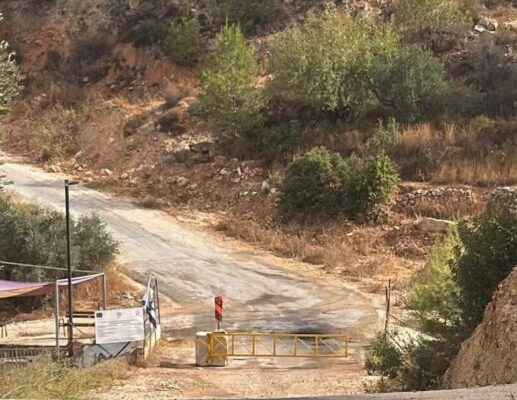
Illegal Israeli paramilitary colonizers seized a public Palestinian park in the Wadi Hamad area of Kafr Ni’ma, west of Ramallah in the central West Bank, on Sunday. They installed an iron gate at the entrance and raised an Israeli flag as part of ongoing efforts targeting village land.
Ra’fat Khalifa, head of the Kafr Ni’ma Village Council, said the approximately 2.5-dunum park was established about two and a half years ago with European Union funding provided through the Palestinian Local Authorities Union. The site lies on land classified as Area B under the Oslo Accords.
Khalifa said the newly installed gate would prevent residents from reaching both the park and their agricultural land. The park has served as a recreational space for village residents.
He added that colonizers had previously taken over a natural spring in the area, where they later built a small pool and a leisure site in the valley.
Residents who use the entrance to reach nearby agricultural plots now face restricted access, Khalifa said, affecting both cultivation and movement in the area.
The village council has not received any official notice regarding the gate or the takeover of the area, Khalifa said, describing the move as part of an ongoing colonial expansion campaign targeting village land.
The village council said it is following up with the relevant Palestinian authorities and international organizations regarding the seizure, but no action had been announced at the time of publication.
|Colonizers Attack Communities, Injure Palestinians Across West Bank|
The seizure comes amid a dangerous escalation in colonizer attacks across the occupied West Bank. The United Nations said colonizer violence had reached unprecedented levels in 2026, documenting more than 1,430 incidents resulting in casualties, property damage, or both as of August 10 and affecting approximately 260 Palestinian communities.
|Army Bulldozes Dozens of Dunams of Palestinian Land Near Salfit|
Beyond immediate casualties and property damage, these attacks and related access restrictions can force families from their homes, damage farmland, crops, livestock, water sources, and equipment, and prevent residents from reaching agricultural land, schools, medical care, markets, and workplaces.
