
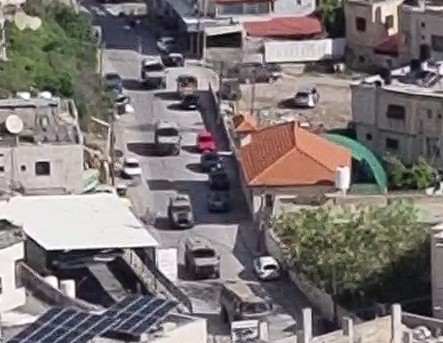
Israeli occupation forces carried out a series of invasions across the occupied West Bank on Monday, abducting dozens of Palestinians, including children, and breaking into multiple homes in occupied Jerusalem, Ramallah in the central West Bank, Tubas in the northeastern West Bank, Qalqilia in the northwestern West Bank, Nablus in the northern West Bank, and Hebron in the southern West Bank. Several Palestinians were also injured by live fire and tear gas during separate incidents.
In occupied Jerusalem, Israeli forces invaded the town of al‑‘Isawiya and abducted ten young men after breaking into numerous homes and destroying their contents.
The detainees were identified as Yousef Fareed ‘Obeid, Yousef Khalil Mahmoud ‘Obeid, ‘Issa Abu Riyala, Hassoun ‘Obeid, Tamer Mohareb, Ahmad ‘Atif ‘Obeid, Majd Marwan Dari, Adam Mamoun, and Mohammad Saleh Abu Rmeileh.
The soldiers also invaded the al‑Bustan neighborhood in Silwan, south of the Al‑Aqsa Mosque, inspecting homes whose owners had been forced to demolish them themselves last week to ensure they had not rebuilt.
In addition, two workers were shot and injured by Israeli forces southeast of Jerusalem while attempting to cross the Annexation Wall in the Wadi al‑Hummus area. Their identities and medical conditions were not immediately known. Three additional workers were abducted, and their identities also remained unclear.
In Ramallah in the central West Bank, Israeli forces abducted four Palestinians, including a child.
Troops invaded the village of Yabrud, east of the city, breaking into homes and abducting ‘Abdul‑Rahim Daoud, 23, and ‘Alaa Daoud, 33.
In the village of Beit ‘Ur al‑Tahta west of Ramallah, forces broke into two homes and abducted 16‑year‑old Farid Othman and 18‑year‑old Ahmad Suleiman.
In Tubas in the northeastern West Bank, Israeli forces invaded the town of Tammun with a large number of military vehicles, spreading through several neighborhoods for nearly five hours.
During the invasion, troops broke into the home of Ahmad ‘Alaa Bani ‘Odah, searched it, damaged its contents, and abducted him.
In Qalqilia in the northwestern West Bank, seven Palestinians were abducted during coordinated invasions of the city and the nearby town of Jayyous. Forces stormed Qalqilia from the eastern side, spread through the Shreim and Naqqar neighborhoods, broke into homes, and abducted Arbakan Tabsiyya, Mousa Swai, and Hassan Melhem.
In Jayyous, east of Qalqilia, troops patrolled residential areas before breaking into homes in the western neighborhood and abducting Samih Samha, Laith Saleem, ‘Ala Shamasna, and Murad Qaddoumi.
In Nablus in the northern West Bank, the army invaded the city from the Deir Sharaf military roadblock and moved toward Tunis Street, where they broke into a home and abducted Samir and Bashar al‑Bizra.
After midnight, forces also invaded the nearby town of al‑Lubban al‑Sharqiya, firing tear gas and sound bombs before closing the eastern entrance with a military gate.
The closure obstructed the movement of residents, including patients and students attempting to reach the boys’ and girls’ secondary schools in the town.
In Hebron in the southern West Bank, Israeli forces abducted Adham Abu Hadid after breaking into and searching his home in the city.
Troops also invaded the home of Mahmoud Hussein al‑Hamamda in the village of al‑Mufaqara in Masafer Yatta, damaging its contents and conducting a field interrogation with him.
In Masafer Yatta south of Hebron, several schoolchildren suffered from tear‑gas inhalation after Israeli forces fired gas and sound bombs toward students walking to school in the village of Umm al‑Khair.
ילדים פלסטינים באום אל-ח׳יר שבדרום הר חברון לא יצליחו להגיע לבית הספר היום.
הצבא, יחד עם מתנחלים, משליך לעברם רימוני גז.
עכשיו עם יד על הלב: מה הייתם עושים אם אלה היו הילדים שלכם? איך ייתכן שילדים הולכים לבית ספר הפכה לסכנה כל כך גדולה?
כשיש כיבוש, דברים איומים כאלה קורים… pic.twitter.com/Wf5plTBmtJ
— איימן עודה أيمن عودة Ayman Odeh (@AyOdeh) April 13, 2026
Local activist Osama Makhamra stated that illegal paramilitary Israeli colonizers had closed the main road to the school the previous night with fencing, preventing residents and students from using it, after which Israeli forces fired gas at the children attempting to reach their classrooms
In addition, the army installed multiple military roadblocks at the entrances to Hebron’s towns, villages, and refugee camps, closing several main and secondary roads with iron gates, concrete blocks, and earth mounds.
