
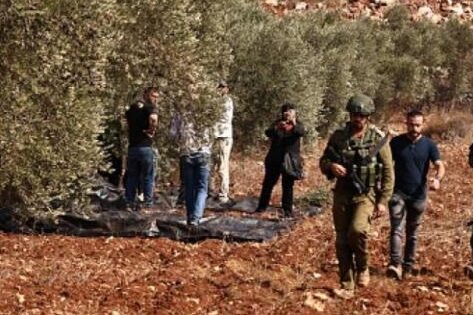
Israeli soldiers assaulted several Palestinian civilians on Sunday while they were harvesting olives in the town of Nahhalin, west of Bethlehem in the occupied West Bank. The incident occurred in the “Seder Ein Faris” area, where farmers had gathered to collect seasonal crops.
Local resident Mohammad Fannoun told reporters that Israeli troops stormed the area and physically and verbally assaulted him and his brother Ahmad.
The soldiers detained both men for several hours before abducting Ahmad and transferring him to an undisclosed location.
Fannoun also reported that the soldiers deliberately damaged the olives they had harvested and confiscated their picking tools.
This attack is part of a broader pattern of violence targeting Palestinian farmers during the annual olive harvest—a season that has increasingly become a flashpoint for Israeli aggression.
According to recent reports by the United Nations Office for the Coordination of Humanitarian Affairs (OCHA), the 2025 harvest has witnessed the highest level of colonizer violence in five years, with over 126 documented attacks across 70 Palestinian communities.
The olive harvest, a cornerstone of Palestinian rural life and economic survival, has been systematically disrupted by illegal paramilitary Israeli colonizers and Israeli forces.
Farmers have faced physical assaults, crop destruction, and restricted access to their groves. In many cases, colonizers operate under the protection or passive observation of Israeli soldiers, further entrenching impunity.
Under the protection of the Israeli army, illegal Israeli settlers prevented Palestinian farmers from harvesting their olive crops in Hebron, occupied West Bank on October 23, amid ongoing restrictions on access to agricultural land during the harvest season pic.twitter.com/pzWPCbRgKO
— TRT World (@trtworld) October 23, 2025
OCHA’s findings detail the vandalism of more than 4,000 olive trees and saplings this season alone, with attacks ranging from arson and stone-throwing to coordinated invasions of agricultural lands.
The destruction of these trees—some centuries old—not only undermines livelihoods but also constitutes a targeted assault on Palestinian heritage and land tenure.
The incident in Nahhalin reflects this escalating campaign of territorial control and displacement. Human rights organizations have warned that such attacks are part of a deliberate strategy to pressure landowners, sever their connection to the land, and facilitate further annexation.
West Bank | Settlers are harvesting olive trees on Palestinian lands during the season, while the Israeli army prevents the landowners from accessing their property. pic.twitter.com/WVids4UooG
— Eye on Palestine (@EyeonPalestine) October 18, 2025
Colonizers have been harvesting Palestinian olive trees and stealing the produce in broad daylight, often in front of Israeli soldiers and border police officers who accompany them and block Palestinians from accessing their own orchards.
A recent video circulating on TikTok shows a group of female Israeli colonizer—self-identified as “Hilltop Girls”—stealing olive harvests in the Banias Mountain area near Nahhalin.
The “Hilltop Girls” are part of a broader extremist colonizer movement known as the Hilltop Youth, which includes young men and women who establish unauthorized outposts on stolen Palestinian lands and routinely engage in violent acts against Palestinian civilians.
Female participants, sometimes glamorized on social media, have increasingly taken part in direct actions such as land seizures, harassment of Palestinian farmers, and theft of agricultural produce.
Their presence in videos—often masked or laughing while uprooting trees or looting harvests—has drawn condemnation from human rights organizations, who warn that such acts are not isolated incidents but part of a coordinated campaign to displace Palestinian communities and assert control over farmland.
The Banias Mountain incident is one of dozens reported during the 2025 olive harvest season, which has seen record levels of colonizer violence.
Attacks have included physical assaults, destruction of centuries-old olive trees, and armed raids on groves. These actions are frequently carried out under the protection or passive observation of Israeli soldiers, reinforcing a climate of impunity.
Despite international sanctions targeting colonizer groups, including the Hilltop Youth, enforcement remains weak. Palestinian farmers continue to face escalating threats to their safety, livelihoods, and land ownership—particularly in areas adjacent to expanding colonies and illegal outposts.
On Saturday, illegal Israeli settlers shot three Palestinians with live ammunition in the Bethlehem governorate, while others attacked farmers in the Ramallah and Hebron governorates.
An illegal Israeli colonizer shot and killed a Palestinian young man on Monday, at the entrance to the city of Hebron, in the southern occupied West Bank.
WAFA correspondent reported that the young man, Ahmad Ribhi Al-Atrash, was killed before dawn Monday, after being shot in the head with live ammunition at the northern entrance to Hebron city.
On Wednesday evening, illegal paramilitary Israeli colonizers stormed a Bedouin village in the al-Hathrawa area near Khan al-Ahmar, east of occupied Jerusalem in the West Bank, on Wednesday evening.
Also Wednesday, Israeli colonizers cut down dozens of olive trees belonging to citizens in the Nablus and Hebron governorates, in the northern and southern parts of the occupied West Bank.
In addition, Israeli paramilitary colonizers set fire to two civilian vehicles during an assault on the town of Surif, northwest of Hebron.
Since the beginning of the year, Israeli forces and colonizers have killed 230 Palestinian citizens in the occupied West Bank, including 42 children and 6 women.
All of Israel’s colonies in the occupied West Bank, including those in and around occupied East Jerusalem, are illegal under International Law, the Fourth Geneva Convention in addition to various United Nations and Security Council resolutions. They also constitute war crimes under International Law.
Article 33 of the Fourth Geneva Convention prohibits collective punishment and acts of terror against civilian populations.
Article 49 of the Fourth Geneva Convention states: “The Occupying Power shall not deport or transfer parts of its own civilian population into the territory it occupies.” It also prohibits the “individual or mass forcible transfers, as well as deportations of protected persons from occupied territory”.
Articles 53 and 147, prohibit the destruction of civilian property and classify pillage as a war crime.
