
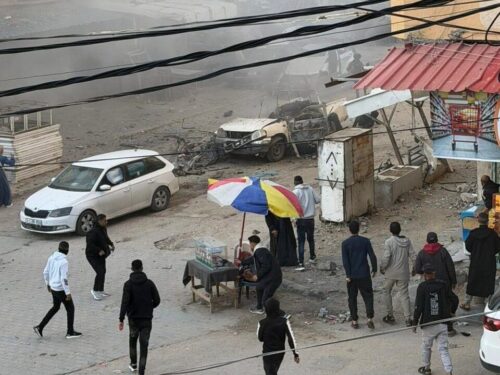
Israeli drone strikes on Sunday killed five Palestinians and wounded more than eight others in separate attacks across the Gaza Strip, as Israeli forces continued daily violations of the ceasefire agreement in place since October 2025.
Medical teams at Al‑Awda Hospital in the Nuseirat refugee camp in central Gaza confirmed that four Palestinians were killed and eight others injured when an Israeli drone fired a missile at a police vehicle near the Abu Sirar junction. The Gaza Ministry of Interior said the targeted vehicle was on an official assignment when it was struck.
In Gaza City, another Palestinian was killed and several others were wounded when an Israeli drone fired a missile at a gathering of civilians in the Sheikh Radwan neighborhood.
Medical staff at the Shifa Hospital said the casualties arrived shortly after the strike, which witnesses described as a sudden attack on a group of residents standing near a residential block.
The attacks occurred on the third day of Eid al‑Fitr, deepening the sense of fear and instability among residents who have endured repeated violations of the ceasefire.
🚨 BREAKING: An Israeli strike on a group of civilians near the old courthouse in Sheikh Radwan, northern Gaza killed Yousef Lafi and wounded several others. pic.twitter.com/z8Arak76Gv
— Gaza Notifications (@gazanotice) March 22, 2026
Local journalists reported additional drone activity over several neighborhoods in Gaza City and central Gaza, with intermittent gunfire and explosions heard throughout the day.
Israeli violations of the ceasefire have killed 677 Palestinians and injured 1,813 since the agreement came into force on 11 October 2025.
The ceasefire followed two years of devastating Israeli military onslaught that began in October 2023, leaving more than 72,000 Palestinians killed, over 171,000 injured, and widespread destruction affecting nearly 90 percent of civilian infrastructure.
Humanitarian agencies warn that the continued attacks are compounding an already severe crisis.
Hospitals are operating with limited fuel, medical supplies, and equipment, while shortages of clean water, food, and shelter continue to affect hundreds of thousands of displaced families.
Aid workers say repeated strikes on residential areas and public spaces are placing additional strain on emergency services already struggling to cope with months of continuous casualties.
Residents describe a climate of constant uncertainty, with drone activity, sporadic shelling, and military incursions undermining any sense of stability despite the formal ceasefire.
Humanitarian organizations caution that without sustained protection for civilians and unrestricted access for aid, the situation is likely to deteriorate further.
