
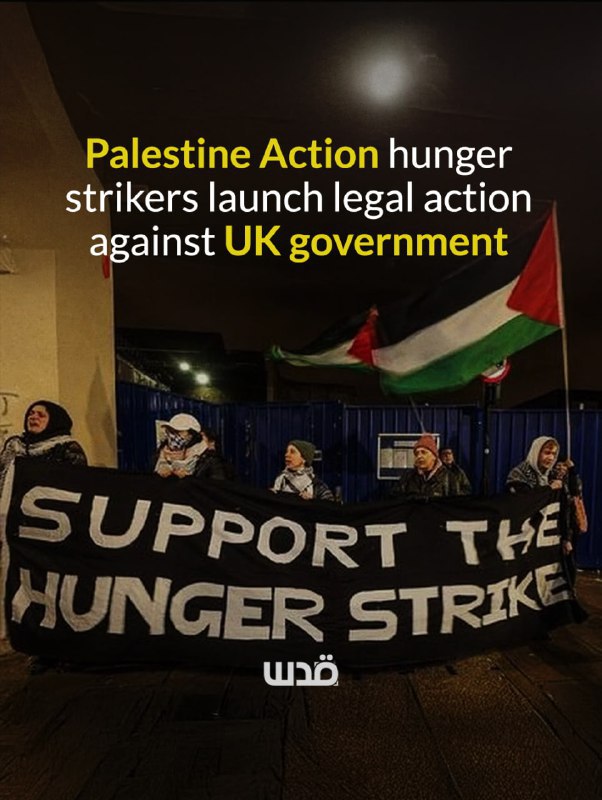
A British doctor says she was “strangled” by police officers at a protest outside a British prison demanding an ambulance for a critically ill Palestine Action-linked prisoner on hunger strike.
At the same time, lawyers representing detained hunger-striking activists linked to Palestine Action have warned the British government of potential legal action after the justice secretary declined to meet them.
The firm Imran Khan & Partners said it would pursue a High Court challenge unless officials respond, amid growing concerns over the health of eight activists on a rolling hunger strike since November, which lawyers describe as the largest coordinated prison hunger strike in the UK since 1981.
Olivia Brandon, an Accident and Emergency doctor at a London hospital, told Middle East Eye that she was dragged by the hood of her coat by police, causing her airways to become restricted and resulting in her losing consciousness.
She also reported that another doctor, Ayo Moiett, who had been repeatedly demanding that Bronzefield prison call an ambulance for prisoner Qesser Zuhrah, was arrested by two police officers after he declined to attend a “voluntary interview” following allegations that he had assaulted a prison officer.
According to a report by the Middle East Eye, on December 17th, Qesser Zuhrah was refused an ambulance by British prison staff.
The prison where she is being held, HMP Bronzefield, has refused repeated requests to call an ambulance. Her friends have repeatedly called the South East Coast Ambulance Service, but were told that if one were sent, the prison would turn it away.
A spokesperson for the ambulance service told Middle East Eye that they would “not send an ambulance to attend a prison at the request of a third party but would instead work with the prison health team to establish if a response is required”.
Ella Moulsdale, Zuhrah’s next of kin, told MEE that she has been on the phone with Zuhrah, “trying to help her breathe through the pain”.
Through the weekend, a group of supporters waited outside HMP Bronzefield throughout the night, demanding an ambulance for Zuhrah, who had been on hunger strike for over 50 days.
She is among six prisoners who launched hunger strikes over their treatment and the proscription of the direct action group. The action has drawn comparisons with the 1981 hunger strike by Irish republican prisoners led by Bobby Sands in Northern Ireland.
The prisoners, all accused of involvement with Palestine Action before it was declared a ‘terrorist organization’ in July, will have been in jail for over a year by the time they stand trial. They are demanding immediate bail.
Zuhrah said she was suffering from severe pain in her chest, lower back and around her kidneys from around 5pm on Tuesday.
According to her friends, a nurse finally came to check her key bodily functions and conduct an ECG (electrocardiogram) test at around 12:47am.
Brandon said that the hospital refused to call an ambulance on the basis that the test results were normal.
“Anyone who has severe chest pain needs to go to hospital straight away,” Brandon told MEE.
When Brandon called the South East Coast Ambulance Service directly, she was informed that they could not send an ambulance as the prison told them they would turn it away.
NHS policy states that cases of chest pain “may require rapid assessment and/or urgent transport”.
It stipulates that ambulance response time “should be under 19 minutes”.
South East Coast Ambulance Service said in response to a request for comment that they “do not send an ambulance to attend a prison at the request of a third party but would instead work with the prison health team to establish if a response is required.
An HMP Bronzefield spokesperson said they could not comment on individual cases.
Brandon emphasised that in cases of severe chest pain, normal test results do not rule out other causes. These can include a pulmonary embolism – a life-threatening clot in the vessels supplying the lungs, which Zuhrah is currently at high risk of.
Brandon added that the severe chest pain Zuhrah was experiencing could have also been caused by pneumonia.
