
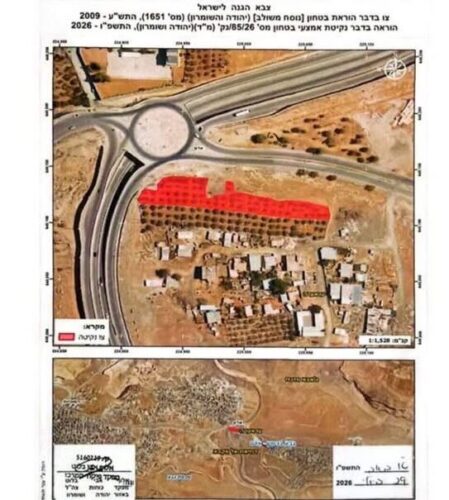
Israeli occupation authorities issued a new military order on Thursday requiring the removal of wild vegetation and the uprooting of olive trees from Palestinian‑owned lands in the Jaba’ plain, in the town of Jaba’, north of occupied Jerusalem.
The order targets an area measuring two dunams and 502 square meters, forming a new phase in the expansion of the colonial Road 437, which extends from the Hizma military roadblock to the Jaba’ roundabout.
The Jerusalem Governorate said that the order is part of a broader colonial project aimed at reshaping the road network surrounding Jerusalem.
The plan includes widening the existing road, seizing privately owned Palestinian land, creating buffer zones, and linking illegal colonies built north and east of Jerusalem to the colonial road system.
According to the Governorate, these measures are designed to entrench Israeli control over the area and isolate Palestinian communities by restricting movement and limiting access to agricultural land.
The Governorate noted that this latest order follows another military order issued recently, placing Israeli control over five dunams and 283 square meters of land belonging to Jaba’, under the pretext of “military purposes.”
These orders form part of a series of land seizures targeting the town, tied to a project to carve and upgrade a colonial road connecting Road 60 near the Jaba’ military roadblock to the illegal Annexation Wall adjacent to the “Neve Yaakov” colony.
The Governorate stressed that the ongoing seizure of land, uprooting of trees, and imposition of colonial road schemes constitute a systematic violation of Palestinians’ rights to their land.
It added that these measures aim to impose a new colonial reality in the Jerusalem Governorate and undermine the geographic and urban continuity between Palestinian towns, further restricting their ability to expand or maintain agricultural livelihoods.
The expansion of Road 437 is part of a long‑term Israeli plan to integrate northern Jerusalem colonies into a unified metropolitan network while fragmenting Palestinian areas into isolated enclaves.
The road serves several illegal colonies, including Adam, Kochav Yaakov, and Neve Yaakov, and is designed to facilitate movement for colonizers while diverting Palestinian traffic and limiting access to main routes.
The uprooting of olive trees has been a recurring practice used by occupation authorities to clear land for settlement expansion.
Palestinian agricultural institutions have documented thousands of uprooted olive trees across the West Bank since late 2023, particularly in areas targeted for road expansion, settlement growth, or military infrastructure.
The Jerusalem Governorate reaffirmed that these measures form part of a systematic policy aimed at consolidating Israeli colonial control, fragmenting Palestinian territorial continuity, and preventing any future Palestinian development in the area.
It warned that continued land seizures and the imposition of colonial road networks will further erode Palestinian access to their lands and deepen the isolation of communities in the Jerusalem periphery.
