
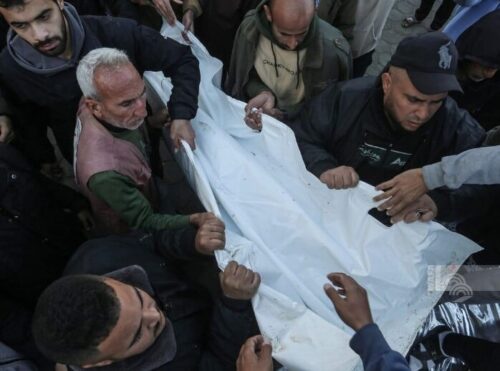
Two Palestinians were killed and several others were injured on Tuesday in Israeli strikes targeting Khan Younis and Beit Lahia, amidst ongoing violations across the devastated Gaza Strip, as humanitarian conditions continue to worsen under relentless attacks and severe winter weather.
Medical sources said one Palestinian was killed and two others were injured in an Israeli strike on an area south of Khan Younis, in the southern Gaza Strip.
They added that several additional Palestinians were wounded in a separate Israeli bombing targeting another location south of the city.
In Jabalia, in northern Gaza, an Israeli drone fired live rounds at displaced Palestinians near Abu Hussein School, wounding a young man.
Medical teams also confirmed that another Palestinian was killed and several others sustained injuries of varying severity in a separate Israeli strike targeting a group of displaced Palestinians sheltering in Beit Lahia, in northern Gaza.
Journalists also documented intense Israeli gunfire directed at a gathering of displaced families near al‑Shati’ refugee camp, west of Gaza City.
The refugee camp is the third‑largest Palestinian refugee camp and one of the most densely populated areas in the Gaza Strip, established in 1949.
The suffering of displaced Palestinians has deepened as heavy rainfall flooded tents and turned makeshift shelters into pools of mud.
Months of bombardment have destroyed homes, infrastructure, and essential services across the Gaza Strip, forcing hundreds of thousands of people to live in fragile tents that collapse under rain and winter storms.
As the current weather system intensified, dozens of tents in displacement camps—particularly in Nuseirat in central Gaza and the Zeitoun neighborhood of Gaza City—collapsed or flooded, renewing a humanitarian crisis that began with the outbreak of the war and worsened under ongoing restrictions on border crossings and the stalled reconstruction process.
Journalist Ghazi al‑Aloul reported from Nuseirat that families spent the night digging makeshift trenches to divert water away from their shelters.
Many were unable to eat their pre‑dawn meal before Ramadan fasting as they struggled to drain water and reinforce tent fabric torn by strong winds. By morning, water had seeped into most tents, destroying the few belongings that the families had managed to keep.
One displaced resident described the first moments of rainfall as “extremely harsh,” with cold winds and heavy water flow causing tents to collapse and pathways between shelters to disappear under rising water.
In the Zeitoun neighborhood of Gaza City, journalist Shadi Shamieh reported that dozens of tents flooded again after weeks without rain, forcing families to abandon their shelters.
Thousands of displaced Palestinians were left in the streets after losing what remained of their possessions.
Children were among the most affected, with soaked clothing and blankets and no means to dry them, while families waited for emergency aid to provide replacement tents and basic supplies.
In this context, Khan Younis Mayor Ala’ al‑Batta said that the limited aid entering through the crossings remains far below the needs of the population. He noted that the shortage of tents persists, and that the small number of newly approved tents does not come close to meeting the actual demand.
Al-Batta explained that the recent wave of heavy rainfall exposed the extreme fragility of the humanitarian situation, as many tents were torn apart and most were flooded, at a time when nearly 80% of Gaza’s population is living in makeshift shelters that cannot withstand winter conditions.
Al‑Batta added that municipalities receive only 15–20% of their required fuel, restricting their ability to operate essential machinery and respond to flooding inside displacement camps.
Mohammad Sameh Ishaq, displaced trom eastern Bani Suheila more than ten times, is living with his family of six under a destroyed building at risk of collapse, amid the spread of insects and rodents. pic.twitter.com/R7JC7Dk3WO
— Eye on Palestine (@EyeonPalestine) February 24, 2026
He said that Israel’s continued ban on the entry of machinery and spare parts has further deepened the crisis, forcing municipalities to rent equipment from the private sector and purchase fuel on the black market at inflated prices just to maintain minimal services.
He also noted that the number of available water‑pumping vehicles is extremely limited and insufficient for the scale of flooding sweeping through the camps, resulting in slow and inadequate response efforts compared with the magnitude of the disaster.
Medical sources added that hospitals in Gaza received seven injured Palestinians over the past 48 hours, while many victims remain under the rubble or on the roads, unreachable due to continued bombardment and the inability of ambulance and rescue teams to access affected areas.
Since the “ceasefire” declared on October 11 of last year, the number of Palestinians killed has risen to 615, with 1,658 injured, and 726 bodies recovered from destroyed areas.
The Ministry of Health in Gaza reported that the death toll from the genocide in Gaza has risen to 72,073 Palestinians, with 171,756 injured since October 7, 2023.
