
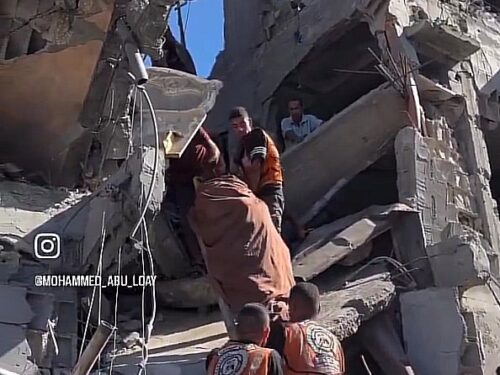
So apparently—and hopefully—the genocide in Gaza is “kind of” over, or to be more accurate, over-ish … although the bombs are still raining over Gaza as we speak. The bombs may pause. The headlines may shift. But the question remains: Now what?
Will the architects of this horror face justice at the International Criminal Court? Will the world finally hold accountable those who ordered mass killings, starvation, and the systematic destruction of civilian life? Of course not.
The machinery of impunity is well-oiled. Investigations stall. Evidence is buried. And the survivors are told to move on.
Even as I write these lines, Israel is still relentlessly bombing Gaza—as if racing against time to drop the largest number of shells on a hungry, exhausted, and devastated population before a ceasefire is declared. Gaza is still being bombed, starved, and erased.
What about the thousands upon thousands of Palestinian political prisoners held by Israel—many without charge, trial, or due process? Will they all be released? Will those who’ve spent decades behind bars, some serving life sentences for resisting occupation, finally walk free? Or will their names be forgotten in the rush to declare “peace”?
And the children who lost their entire families, their limbs, their homes, their sense of safety, their childhood itself, are they supposed to suddenly smile again?
Will trauma vanish with a ceasefire? Will the rubble be swept away and replaced with playgrounds and promises?
Now what?
Where is the liberty of Palestine? Where is the independent, sovereign Palestinian state with East Jerusalem as its capital? Where is the right of return for millions of refugees exiled for generations?
Just like with every previous ceasefire, people will be acting as if a deal—any deal—means the conflict is resolved. As if the illegal, criminal Israeli occupation of Palestine has ended. As if apartheid, land theft, and colonial oppression will evaporate with a press conference.
But genocide is not just about death tolls. It’s about erasure. It’s about the destruction of a people’s future, identity, and dignity.
And unless the root causes are addressed—occupation, dispossession, impunity—then the genocide isn’t over. It’s just paused.
So again: Now what?
Let’s be clear: Israeli leaders have offered no guarantees—none—that the genocide will not resume once all hostages are released. Not a single binding commitment.
Not a single clause in any draft agreement that prevents Israel from restarting its military campaign, bombing shelters, targeting aid lines, or starving civilians.
The language is vague. The timelines are fluid. The enforcement mechanisms? Nonexistent.
There’s no international force mandated to monitor compliance. No penalties for violations.
No legal framework holds Israel accountable if it resumes airstrikes the moment the last hostage crosses the border.
The so-called “ceasefire” is conditional, temporary, and entirely subject to Israel’s discretion.
And history speaks for itself. Every previous truce has been broken—by Israel—without consequence. Every pause has been used to regroup, rearm, and resume the killing. So why should this time be different?
The genocide may “pause,” but the machinery remains intact. The siege is still in place. The occupation is still expanding. Colonial violence continues in the occupied West Bank. Political prisoners remain behind bars.
So again: Now what?
Until there are enforceable guarantees—monitored by independent international bodies, backed by legal consequences, and tied to a permanent end to occupation—then no deal, no ceasefire, no press release can be trusted.
Even with a final deal, the genocide will not be over. It will be just waiting for its next green light.
Will the international community finally enforce its own resolutions? Will the billions pledged for reconstruction come with political accountability? Will the media stop sanitizing war crimes and start naming them?
Will Palestine be free—not just from bombs, but from colonial rule?
Until then, the question remains unanswered. And the silence is complicit.
And let’s be absolutely clear: the end of genocide cannot mean the continuation of occupation.
The path forward must begin—not with vague promises or symbolic gestures—but with the full, unconditional withdrawal of Israel from all occupied Palestinian territories, including entirety of the West Bank, Gaza Strip, and East Jerusalem.
This is not a radical demand. It is the foundation of international law. It is the core of countless UN resolutions. It is the bare minimum for justice.
Palestinians are not asking for favors. They are demanding rights—inalienable, internationally guaranteed rights.
The right to live free from military rule. The right to return to their homes. The right to self-determination. The right to build a future without military roadblocks, apartheid walls, sieges, and colonizer militias.
There must be a clear, irreversible process to establish an independent, contiguous, and sovereign Palestinian state. Not a fragmented archipelago of enclaves. Not a provisional authority under foreign oversight.
But a real state—with full control over its borders, airspace, resources, and destiny. A state recognized not just on paper, but in practice. A state with East Jerusalem as its capital. A state where refugees are welcomed home, not buried in statistics.
Anything less than this is not peace, it is managed oppression.
So again: Now what?
Now is the time for the international community to stop issuing statements and start enforcing laws.
Now is the time for global institutions to move from observation to intervention.
Now is the time for Palestine to rise—not from rubble alone, but from recognition, restoration, and rightful sovereignty.
Because this isn’t just about borders and resolutions. It’s about children who sleep in silence because their parents are gone. It’s about amputees learning to walk again in bombed-out clinics.
It’s about mothers who dig through rubble with bare hands, hoping to find a piece of their child.
It’s about people who have been told, generation after generation, to wait for justice that never comes.
Until that happens, the genocide may be paused, but the injustice continues. And the question remains—burning, urgent, human: Now what?
