
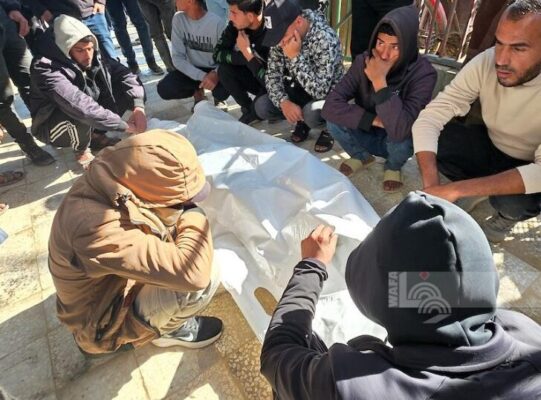
Israeli forces killed three Palestinians and wounded several others on Thursday in a series of attacks across the Gaza Strip, as humanitarian agencies warned that ongoing ceasefire violations and severe restrictions on aid access are deepening an already catastrophic situation for the civilian population.
The incidents occurred amid repeated media reports, the United Nations, and international relief organizations that Gaza remains on the brink of total humanitarian collapse.
Israeli aircraft fired on a group of Palestinians near al‑Mahatta Park in the Tuffah neighborhood northeast of Gaza City, killing two people and injuring others.
In southern Gaza, Hassan Abdul‑Rahman Hassan al‑Lahham was shot and killed by Israeli forces in the Qizan Rashwan area south of Khan Younis.
Medical teams also reported that several Palestinians were wounded when an Israeli drone targeted fishermen along the Gaza City shoreline.
In central Gaza, residents in Deir al‑Balah buried a man killed by Israeli drone fire near areas controlled by Israeli forces east of the city.
The Israeli military claimed that troops operating in southern Gaza killed an “armed Palestinian who allegedly crossed the yellow line,” a temporary demarcation established under the U.S.‑brokered ceasefire agreement.
The army described the incident as a violation of the ceasefire, which has been in place since October 10, 2025.
The “yellow line” separates the roughly 53 percent of the Strip still under Israeli military control from the western areas where Palestinians are permitted to move.
Humanitarian operations faced new setbacks as 57 international aid workers left Gaza through the Karem Abu Salem (Kerem Shalom) crossing after their organizations were unable to renew Israeli‑required permits.
🚨“Al-Zeitoun neighbourhood is one of the largest in the Gaza Strip but today it’s the most devastated.” Palestinian Civil Defense spokesperson Mahmoud Basal says that more than 600,000 people once called the area home, but since the start of the genocide, Israeli occupation… pic.twitter.com/ZZjsbpcODD
— Translating Falasteen (Palestine) (@translatingpal) February 25, 2026
Israel has imposed new conditions on humanitarian agencies, including extensive background checks on staff and expanded oversight mechanisms that aid groups say hinder their ability to operate independently.
Relief organizations warned that these restrictions grant the Israeli authorities even greater control over humanitarian programs and staffing decisions.
Médecins Sans Frontières emergency coordinator Claire Nicolhalted. Israel to lift the restrictions, warning that Gaza’s population “will be deprived of care, services, and water, with marginalized groups suffering the most if our work is halted.”
She added that MSF cannot meet the scale or quality of medical needs under the current constraints.
UNRWA has repeatedly warned that Gaza’s humanitarian system is “on the verge of total collapse,” citing Israeli limits on aid convoys, fuel shortages, and the inability of agencies to safely reach communities trapped near front‑line areas.
The UN Office for the Coordination of Humanitarian Affairs (OCHA) has also documented continued Israeli fire in areas designated as “safe movement zones,” including those near the yellow line, despite the ceasefire.
Israel continues to violate the ceasefire daily, killing 618 Palestinians since October 10, 2025, many of them shot or targeted under claims of crossing the yellow line.
At the same time, Israel has blocked the agreed‑upon quantities of humanitarian aid from entering Gaza, where 2.4 million Palestinians, including 1.5 million displaced people, are living in catastrophic conditions.
Two years of Israeli bombardment and ground offensives have killed more than 72,000 Palestinians and wounded over 172,000, the vast majority women and children.
The destruction has left 90 percent of Gaza’s civilian infrastructure damaged or destroyed, with UN agencies warning that without immediate, unrestricted humanitarian access, preventable deaths will continue to rise.
