
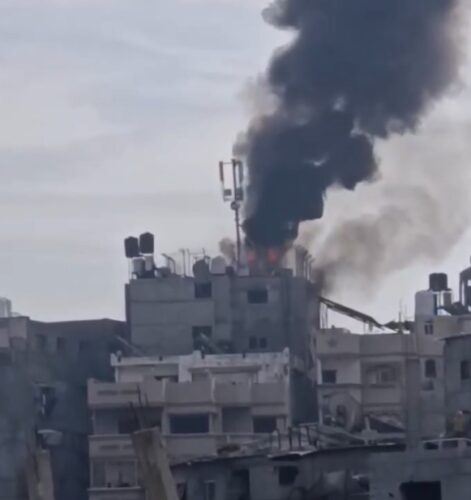
Israeli forces carried out a series of attacks across the Gaza Strip on Wednesday, killing two Palestinians and injuring several others in the Tuffah neighborhood of Gaza City, as the fragile “ceasefire” continued to unravel for the 88th consecutive day.
The latest strike targeted a residential home belonging to the Al‑Alwan family on Yaffa Street.
The blast leveled the building, ignited a large fire, and left several residents trapped beneath the rubble.
Ambulance crews transported the wounded to the Al‑Ahli Baptist Hospital, while Gaza Civil Defense teams worked through the night to extinguish the flames and search for missing family members.
The Israeli military later claimed it had targeted a Hamas commander, alleging that fighters had opened fire toward Israeli forces in northern Gaza. Residents and local journalists disputed the claim, noting that the destroyed structure was a civilian home and that no armed activity had been reported in the area at the time of the strike.
The attack in Al‑Tuffah was part of a broader pattern of Israeli operations across Gaza throughout the day.
Airstrikes and artillery shelling were reported in eastern Gaza City, Khan Younis, and Deir al‑Balah, where armored vehicles also opened fire toward residential blocks and agricultural lands.
Several homes were detonated or bulldozed by Israeli engineering units, continuing a tactic that has flattened entire neighborhoods in recent weeks.
In Khan Younis, in southern Gaza, families sheltering in schools and makeshift tents fled once again after Israeli vehicles opened fire toward the southern outskirts of the city.
In central Gaza, residents of the Maghazi and Bureij refugee camps reported renewed bombardment overnight, adding to the destruction of already‑damaged districts.
In addition, the Israeli army fired several missiles and shells at areas in the eastern part of the Jabalia refugee camp, in northern Gaza.
The Palestinian Health Ministry said more than 70,000 Palestinians have been killed and over 170,000 injured since October 7, 2023. Although a ceasefire framework remains nominally in place, hundreds of Palestinians have been killed and more than a thousand wounded since the agreement began due to continued Israeli attacks.
Humanitarian conditions in the Gaza Strip continue to deteriorate sharply as winter storms sweep across the region, flooding displacement camps and leaving thousands of families without dry shelter.
Tents have collapsed under heavy rain, and makeshift structures offer little protection from the cold, forcing many displaced residents to endure the storm in open areas or overcrowded shelters.
This is winter in Gaza. People are facing torrential rain and heavy winds while living in makeshift shelters.
All the while Israel continues to block or delay the entry of vital supplies like tents, tarpaulins, and temporary housing.
Our medical teams are treating respiratory… pic.twitter.com/EIvm4UOeKj
— MSF International (@MSF) January 7, 2026
Medical facilities, already operating far beyond capacity, remain overwhelmed. Hospitals face severe shortages of fuel, essential equipment, and basic medicines, limiting their ability to treat the growing number of patients suffering from exposure, respiratory infections, and injuries from ongoing Israeli attacks. Health workers warn that the system is on the brink of total collapse.
Aid organizations say the crisis is being compounded by Israeli restrictions on humanitarian supplies, which continue to block or limit the entry of food, clean water, winter clothing, and heating materials. These constraints have left hundreds of thousands of people without adequate nutrition or warmth as temperatures drop.
Civil defense crews report that they are unable to reach many bombed areas due to destroyed roads, debris, and continued fire from Israeli positions. Rescue teams say these conditions are delaying lifesaving operations and leaving victims trapped under rubble for extended periods, further deepening the humanitarian emergency.
The UN Secretary‑General recently invoked Article 99 of the UN Charter, warning the Security Council that the situation in Gaza poses a threat to international peace and security. Humanitarian agencies have echoed the alarm, describing the scale of destruction and civilian suffering as unprecedented.
The World Health Organization has documented extensive attacks on healthcare facilities across the occupied Palestinian territory, calling the pattern “systematic and devastating.” Several international NGOs have urged Israel to lift restrictions on aid and allow independent monitoring inside Gaza.
Efforts by mediators to advance the ceasefire into a second phase remain stalled. Diplomats say progress has been blocked by continued Israeli military operations and disagreements over prisoner exchanges, humanitarian guarantees, and the return of displaced families to northern Gaza.
