
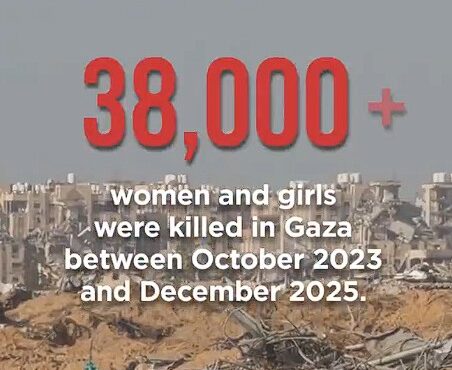
The United Nations Entity for Gender Equality and the Empowerment of Women (UN Women) reported on Friday that more than 38,000 women and girls were killed in the Gaza Strip by the end of last year, averaging 47 female fatalities per day, as a result of the Israeli assault that began on October 7, 2023.
According to the agency’s newly released report, 22,000 women and 16,000 girls were killed between October 2023 and December 2025 due to Israeli aerial bombardments and ground operations across the Gaza Strip.
UN Women stated that despite the declared ceasefire in October of last year, documented killings of women and girls have continued in recent months, indicating that the threats to their lives remain ongoing.
The agency called for full adherence to the ceasefire and international law, and for unhindered, large‑scale humanitarian access to the Gaza Strip. It stressed the urgent need to ensure protection for women and girls who continue to face severe hardship, displacement, and life‑threatening conditions.
More than 38,000 women and girls killed.
Nearly 11,000 women and girls in Gaza now living with lifelong disabilities.
Many still missing. Even with a ceasefire, killings continue.
Women and girls in #Gaza must be protected.
🔗 https://t.co/KaTsu987kX#ForAllWomenAndGirls pic.twitter.com/zkEHxjIAEU
— UN Women (@UN_Women) April 17, 2026
Sophia Calltorp, Head of Humanitarian Action at UN Women, told reporters in Geneva that the victims “are more than numbers. They were mothers, daughters, sisters, and friends, deeply loved by those around them. They were individuals with their own lives and dreams.”
She emphasized that the scale of loss has reshaped the social fabric of Gaza, leaving tens of thousands of women as the sole providers for their families after losing their husbands, often without income, support, or access to essential services.
The report also highlighted that nearly 11,000 women and girls have sustained lifelong disabilities as a result of the ongoing assault.
UN Women warned that the actual number of women and girls killed is likely higher, as many bodies remain trapped under rubble, and the collapse of Gaza’s health information systems has severely limited documentation efforts.
Calltorp added that the extensive destruction of infrastructure has made it nearly impossible for women and girls in Gaza to access basic necessities, including healthcare.
She noted that the situation has worsened due to the recent escalation in the Middle East, with the closure of crossings and restrictions on humanitarian aid further limiting access to life‑saving assistance.
The UN official stressed the need to uphold international law, ensure accountability for violations, and guarantee protection for women and girls. She reiterated that humanitarian aid must reach those in need at scale and without obstruction, and that women and girls must be at the center of response and recovery efforts.
Calltorp concluded by stating that international humanitarian and human rights law “have not failed; the failure lies with those who choose to ignore these laws, those who have the power to enforce them, and the profound lack of humanity that has allowed this horror in Gaza to continue.”
