
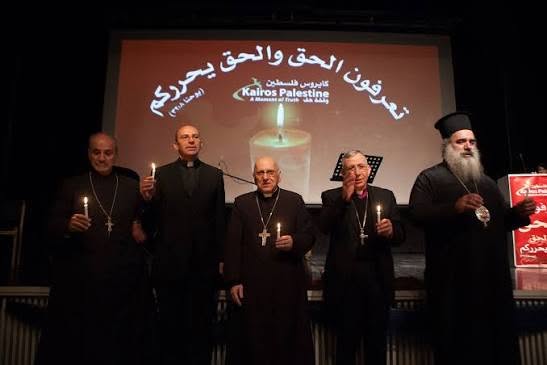
By Rifat Kassis: A Preliminary Reading of the Background to the Campaign Against the Church of England’s Decision.
The Church of England’s General Synod decision in July 2026—calling on the Church to listen to Palestinian Christians and to study the second “Kairos Palestine” document—sparked an unprecedented wave of objections and pressure led by Christian and Jewish Zionist groups.
The scale of the campaign was striking, especially when compared to the nature of the decision itself, which was balanced, limited, and free of any practical or punitive measures. This raises an important question: why was this decision met with such escalation?
In my view, the strategic question is: how can this unprecedented attack by Christian and Jewish Zionist groups on the Church of England be explained?
This is particularly relevant given that many churches in the United States and Europe have taken far bolder steps—including divestment and boycott—without provoking this level of reaction. In this brief initial assessment, I will outline several hypotheses.
- The unique status of the Church of England
The first hypothesis concerns the Church of England’s special standing. It is not just another church; it is the established church of England, headed by the monarch.
It also carries significant influence within the global Anglican Communion and maintains a strong presence in British public life. Therefore, any decision it issues carries symbolic and political weight that exceeds its practical implications.
- The political moment and timing
The second hypothesis relates to the political context and timing. This debate emerged nearly three years into the genocidal war on Gaza, at a moment when international public opinion has undergone a notable shift.
Churches, governments, universities, and humanitarian organizations have become more willing to use the language adopted by “Kairos II”—terms such as genocide, ethnic cleansing, and colonial occupation—language that was politically difficult to employ in the past.
This shift heightened political sensitivity and provoked stronger reactions from those who reject such descriptions. It appears this was one of the reasons behind the intensity of the campaign.
Opponents of Kairos may have concluded that the current moment no longer allows them to assume that confronting churches with traditional arguments would be sufficient or decisive in preventing the adoption or spread of the document.
- The distinct nature of the second Kairos document
A third hypothesis is tied to the nature of the document itself. Historically, Kairos demands directed at churches were mostly practical: reviewing or withdrawing investments, calling for boycott, halting settlement expansion, demanding a ceasefire, supporting humanitarian aid to Gaza, or organizing “Come and See” visits.
The second Kairos document is different. It presents a coherent Palestinian Christian theological narrative and does not simply ask churches to take a specific action.
Instead, it invites them to reconsider how they listen to Palestinian Christian voices, and to engage with deep theological questions related to occupation, genocide, Christian Zionism, Scripture, and the meaning of Christian witness.
Ideas often outlive decisions. When churches begin studying a theological document, its influence can shape clergy, seminaries, preaching, worship, and future decisions for many years. For this reason, its strategic significance may exceed that of a divestment resolution.
- Concern over the growing influence of Kairos Palestine
A fourth hypothesis is the fear of Kairos Palestine’s rising influence in church and international circles. The intensity of the campaign may itself be evidence of this.
Organizations that rushed to issue memos, statements, petitions, threats, and pressure campaigns would not invest such political and media effort against a document they consider irrelevant.
The volume of statements, letters, pressure, and media coverage suggests that some actors believed the second Kairos document could have an impact beyond the Church of England. This alone signals the level of influence Kairos Palestine has come to represent—whether one agrees with its positions or not.
- Fear of a “domino effect”
Another factor is the fear of a domino effect. Historically, major church decisions often move from one denomination to another, and theological ideas spread quickly within ecumenical networks.
If the Church of England begins studying the second Kairos document, this may encourage other churches—Protestant, Reformed, Catholic, and Orthodox—to follow suit. Preventing the first step is often far easier than confronting its spread once dozens of churches adopt it.
- The core battle: who holds moral and theological authority on Palestine?
I tend to believe the campaign did not target the decision itself. The final amended resolution was balanced and limited: it called on the Church to listen to Palestinian Christians and to study the Kairos Palestine document, while reaffirming interfaith dialogue, rejecting antisemitism, and rejecting hatred against Muslims.
If the decision alone were the issue, the scale of the campaign would have been disproportionate to its content.
This leads to a different hypothesis: the real struggle was over who holds the legitimacy to shape the moral and theological narrative on Palestine within the churches.
If Kairos Palestine comes to be seen not as an advocacy movement but as an authoritative theological voice emerging from the indigenous Palestinian church in the Holy Land, its influence would far exceed a single synod resolution.
From this perspective, the nature of the campaign becomes clearer: it was not aimed at blocking one decision, but at preventing the establishment of a theological framework that could shape church teaching, positions, policies, and advocacy work in the future.
This is reinforced by the fact that most criticisms did not focus on the decision itself, but on Kairos Palestine—through repeated messages urging: do not receive this document, do not treat it as a legitimate Christian voice, do not grant it a normal place within church life.
This suggests the goal was not merely to stop a synod vote, but to prevent Kairos Palestine from gaining ecclesial legitimacy and from becoming a recognized theological reference within Anglican churches.
If this reading is accurate, then what happened in the Church of England was not a dispute over a passing ecclesial resolution, but an indicator of a deeper struggle over who holds the right to interpret the Palestinian reality morally and theologically within global churches.
From this angle, the scale of the campaign may itself be evidence that the voice of Kairos Palestine is no longer marginal but has become present and influential enough that many are now seeking to curb its legitimacy before it evolves into a broader ecclesial reference.
* This piece was translated from the original Arabic text by Rifat Kassis.
Rifat Kassis has over 35 years of experience in human rights, mainly child rights, working in Middle East, Northern Caucasus, Central Asia and Europe.
He founded the Palestinian section of the global child rights movement, Defense for Children International, co-founded its movement in the Arab World and was elected International President for two terms in Geneva.
Furthermore, he was selected to be the State of Palestine candidate for the UN Committee on the Rights of the Child (CRC). He co-founded the Alternative Tourism Group (ATG), Occupied Palestine and Global Heights Advocacy Initiative (OPGAI) and The National Coalition of Christian Organizations (NCCOP).
He served as Executive Director of EJYMCA and founded the YMCA/YWCA Olive Tree Campaign. He also ran the WCC /EAPPI program in Geneva and worked as the country director of the Lutheran World federation in Jordan.
He is one of the co-authors of Kairos Palestine document and its General Coordinator as well as its global coalition. Currently he is running a consulting agency called GRIP Consulting. He published two books “Palestine: A Bleeding Wound in the World’s Conscience” and “Kairos for Palestine”. In addition, he has contributed to 18 different books in different languages and published many articles and researches.
