
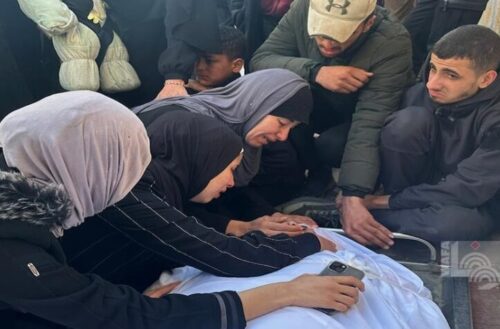
Israeli occupation forces carried out a series of attacks across the Gaza Strip on Tuesday, killing one Palestinian and wounding several others in the northern and central areas of the besieged enclave, as the humanitarian situation continues to deteriorate under the weight of ongoing bombardment and the collapse of essential services.
Medical sources reported that one Palestinian was killed and several others were injured when Israeli forces targeted a group of civilians in the telecommunications area of Jabalia in the northern Gaza Strip.
The strike hit a gathering point near the communications tower, causing casualties and renewed panic among displaced families sheltering nearby.
In a separate incident on Tuesday, two Palestinians were shot and injured by Israeli forces east of Al‑Bureij refugee camp in central Gaza.
Local medical teams said the two men were transferred to a nearby hospital for treatment. However, no further details were immediately available regarding their conditions or the circumstances of the shooting.
The area has been repeatedly targeted by Israeli drones and snipers positioned along the perimeter fence.
🚨 Urgent medical evacuation needed
Yahia survived the Israeli attack, but he is now suffering from a severe eye injury. His condition is worsening every day, and without urgent treatment outside Gaza, he may permanently lose his eye and his vision.
His doctors have confirmed… pic.twitter.com/dnNexYucLu
— حسام شبات (@HossamShabat) March 30, 2026
The Health Ministry also confirmed that two Palestinians died in hospitals on Monday from wounds sustained in earlier attacks, while another injury was recorded during the same period.
Israeli warplanes and drones also carried out several attacks on Monday across the central and northern Gaza Strip, striking residential areas, open spaces used by displaced families, and roads leading to hospitals.
Watch | After two and a half years of forced separation, Gaza’s babies have finally returned home.
After leaving as infants to receive medical treatment abroad at the start of the Israeli genocide, the children arrived back in the Gaza Strip yesterday, where emotional scenes… pic.twitter.com/u7XQhsiWEx
— Quds News Network (@QudsNen) March 31, 2026
Emergency crews reported that their ability to reach targeted areas remains severely limited due to the destruction of infrastructure and the near‑total collapse of civil defense capabilities.
The Gaza Ministry of Health said that since the declared ceasefire framework on October 11, 2025, Israeli forces have killed 705 Palestinians and injured 1,914 others, while 756 bodies have been recovered from beneath the rubble.
The cumulative toll since October 7, 2023, has risen to at least 72,281 Palestinians killed and more than 172,014 injured.
Health officials stressed that these figures do not include thousands of missing people believed to be buried under collapsed buildings or stranded in areas rescue teams cannot reach.
Humanitarian agencies, including the United Nations Office for the Coordination of Humanitarian Affairs (OCHA) and UNRWA, warned that the situation in Gaza continues to worsen as displacement, hunger, and disease spread across the Strip.
UNRWA reported that tens of thousands of displaced Palestinians are sheltering in overcrowded facilities with limited access to clean water, sanitation, or electricity.
The agency noted a sharp rise in respiratory infections, hepatitis A, and diarrheal diseases, particularly among children living in makeshift tents and damaged school buildings.
OCHA added that the near‑total blockade on fuel and medical supplies has forced several hospitals and community kitchens to shut down, leaving thousands without access to food or basic medical care.
Medical evacuations remain suspended due to the closure of border crossings, and UN international staff are still barred from entering Gaza, severely restricting humanitarian coordination.
UNRWA also confirmed that it has lost hundreds of staff members since the beginning of the war, describing the scale of loss as unprecedented in the history of the United Nations.
Across the Strip, residents continue to face the collapse of civilian infrastructure, with water networks, sewage systems, and electricity grids either destroyed or operating at minimal capacity.
Humanitarian officials warn that without immediate and sustained access for aid convoys, Gaza’s population will continue to face life‑threatening shortages of food, clean water, and medical treatment.
The continued attacks, rising number of injuries, and deepening humanitarian crisis underscore the fragility of the ceasefire framework and the ongoing risks faced by civilians across the Gaza Strip, where bombardment, displacement, and the collapse of essential services have become daily realities.
