
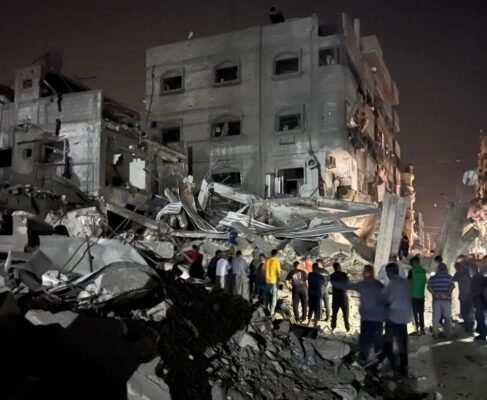
Israeli occupation forces carried out several attacks across the Gaza Strip on Wednesday, in continued violations of the declared ceasefire. Overnight shelling was reported in northern and central Gaza, with explosions heard near Gaza City and in the areas surrounding the Al‑Bureij and Al‑Maghazi refugee camps, in central Gaza.
Civil defense crews said they were unable to reach a number of targeted locations because several access roads had been destroyed and rescue vehicles could not move through the debris. Teams warned that people may still be trapped under collapsed structures in areas they cannot reach.
Hospitals across the Strip continued to report severe shortages. Medical teams at the Shifa Medical Complex in Gaza and the European Gaza Hospital said they were running critically low on anesthesia, antibiotics, blood products, and basic surgical supplies.
Several operations were postponed because hospitals could not maintain sterile conditions or secure the necessary medications.
Breaking: Israeli forces are burning what remains of homes in Jabalia refugee camp and the eastern areas of northern Gaza. pic.twitter.com/kXjZmUbIsQ
— Ramy Abdu| رامي عبده (@RamAbdu) May 20, 2026
UN field teams documented new waves of displacement from northern Gaza toward the central Strip as bombardment intensified.
Families fleeing the shelling said they had no safe destination and were taking shelter in damaged schools, abandoned buildings, or makeshift tents.
Apartheid Israel is building 7-meter high “earth barriers” in Gaza as it prepares to steal 60% of the Strip as part of its ongoing genocide of the Palestinians. pic.twitter.com/QMGhSthKsn
— Zachary Foster (@_ZachFoster) May 20, 2026
Many displaced families lack access to clean water or sanitation, raising concerns about the spread of disease.
Humanitarian agencies reported that several neighborhoods in Gaza City and Khan Younis have gone more than ten days without running water.
With pumping stations unable to operate due to fuel shortages and damaged infrastructure, sewage overflow has been recorded in multiple districts.
Aid workers warned that the combination of contaminated water, overcrowding, and limited medical care could lead to a rapid deterioration in public health.
Fuel shortages continued to affect essential services. The Gaza Electricity Distribution Company said several power lines remain out of service due to damage and the lack of fuel needed to operate backup generators.
Many areas are receiving fewer than four hours of electricity per day, with some neighborhoods experiencing outages lasting more than twenty hours.
Children gather around empty pots at a charity kitchen in Gaza, scraping food remains to bring back to their families amid the Israeli siege and aid restrictions. pic.twitter.com/hfS0dM35KJ
— PALESTINE ONLINE 🇵🇸 (@OnlinePalEng) May 20, 2026
The Gaza Ministry of Health reported that hospitals received one Palestinian killed and sixteen wounded in the past twenty‑four hours as a result of continued Israeli attacks.
Since the “ceasefire” announced on October 11, 2025, the Ministry of Health has recorded 881 Palestinians killed, 2,621 wounded, and 776 bodies recovered from destroyed areas. The cumulative toll since October 7, 2023, has risen to 72,773 Palestinians killed and 172,723 wounded.
Health officials said the actual number of casualties is likely higher, as many victims remain under rubble or in areas that rescue teams cannot access.
Residents and medical workers said the continued bombardment, movement restrictions, and obstruction of rescue efforts show that the ceasefire has not been translated into safety on the ground, as humanitarian conditions continue to deteriorate across the Strip.
