
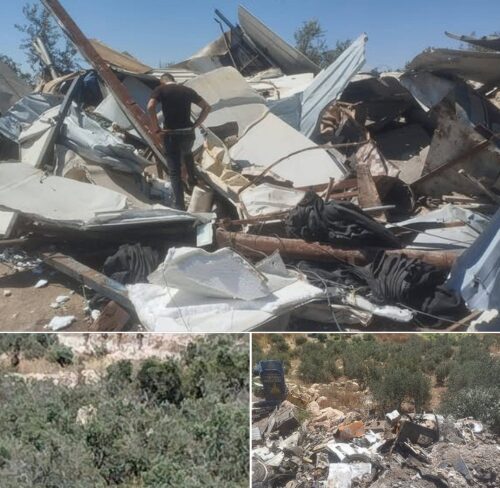
Israeli occupation forces demolished two commercial structures, a farm room, and large areas of agricultural land in the town of Ethna, west of Hebron, on Wednesday, while also bulldozing electricity networks and seizing Palestinian vehicles.
Local sources said the army demolished two commercial facilities belonging to Mohammad Abu Zalata, then bulldozed cultivated land planted with almond trees and other crops.
The soldiers destroyed a small agricultural room, stone terraces, water tanks, and iron gates, and uprooted grapevines belonging to Tayseer Ikhlawi, covering an area of about four dunams.
Bulldozers also tore up sections of the electricity network in several areas west of Ethna, cutting power to parts of the town and causing extensive damage to infrastructure and private property.
In a separate incident, Israeli forces seized the vehicle of Abu Nimer Al‑Ajjouri while he was transporting livestock from his farm to his butcher shop in the center of Beit Ulla, northwest of Hebron.
The army also confiscated another vehicle from the same town; the owner had not yet been identified at the time of reporting.
The demolition in Ethna is part of Israel’s ongoing campaign against Palestinian communities in Area C, which constitutes more than 60% of the occupied West Bank and remains under full Israeli military control.
In these areas, Palestinian homes, agricultural rooms, water networks, solar systems, and commercial structures are routinely demolished under the pretext of lacking Israeli-issued permits—permits that Israel almost never grants—while illegal Israeli colonies continue to expand.
Ethna and the surrounding Hebron district have faced repeated demolitions, land seizures, and infrastructure destruction aimed at restricting Palestinian presence and consolidating Israeli control over strategic agricultural and grazing lands.
Since the beginning of 2026, Israeli occupation forces have demolished more than 1,180 Palestinian structures across the occupied West Bank, according to the Wall & Colonization Resistance Commission and UN OCHA.
The demolitions include 312 homes, 228 agricultural structures, 191 livelihood structures, and 449 additional structures such as water networks, solar systems, fences, and electricity lines. These actions have displaced over 1,950 Palestinians, including more than 900 children, and caused widespread damage to agricultural land, infrastructure, and sources of livelihood.
The majority of demolitions—over 92%—occurred in Area C, which remains under full Israeli military control. In these areas, Palestinians face near‑total denial of building permits, while Israeli colonies continue to expand.
The Hebron district, including towns such as Ethna, Yatta, Masafer Yatta, and Beit Ulla, has recorded some of the highest demolition rates in 2026, alongside the Jerusalem district and the Jordan Valley.
UN OCHA – Demolition & Displacement Dashboard
