
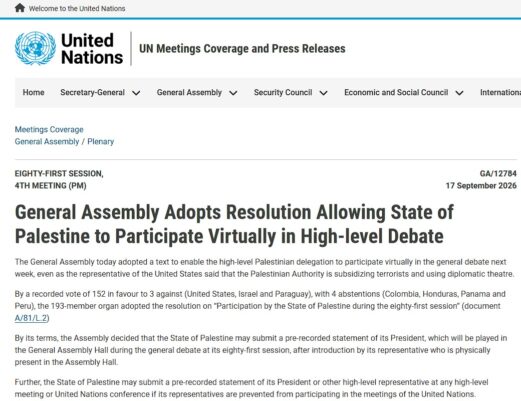
The United Nations General Assembly voted 152-3, with four abstentions, on Thursday to allow Palestinian President Mahmoud Abbas to address its annual high-level gathering by video.
The measure also permits Abbas and other senior Palestinian officials to participate remotely in U.N. meetings or conferences over the following year if U.S. visa restrictions prevent them from traveling to the United States, according to official U.N. meeting coverage and Reuters.
The U.S. State Department said on Wednesday that it would extend visa sanctions against Palestine Liberation Organization members and Palestinian Authority officials. It cited what it described as failures to reform, actions at international organizations that contradict prior commitments and efforts to internationalize the Israeli-Palestinian conflict.
Reuters, citing a Palestinian official, and AFP, citing a source familiar with the matter, reported that Abbas was among those denied a visa. The State Department said it had maintained the standing waiver for personnel notified to the PLO Observer Mission to the United Nations under the Headquarters Agreement.
Under the 1947 Headquarters Agreement between the United Nations and the United States, the host country is generally required to permit foreign representatives to travel to U.N. headquarters. Reuters reported that Washington maintains it may deny visas on security, extremism or foreign-policy grounds. Whether the restrictions comply with the agreement remains disputed.
Palestinian officials said the restrictions violated the Headquarters Agreement. According to the Palestine News & Info Agency (WAFA), the Palestinian Ministry of Foreign Affairs and Expatriates welcomed the resolution and thanked its sponsors and supporters, saying the vote had prevented Palestine from being excluded from the Assembly’s high-level proceedings.
The ministry said Abbas’s address would be delivered by video at the date and time assigned under the General Assembly’s schedule.
The ministry added that Palestinian diplomacy would continue to seek international protection for the Palestinian people and pursue political, legal and diplomatic efforts toward self-determination and an independent Palestinian state with East Jerusalem as its capital, while opposing the occupation, colonial policies and violence by colonizers.
