
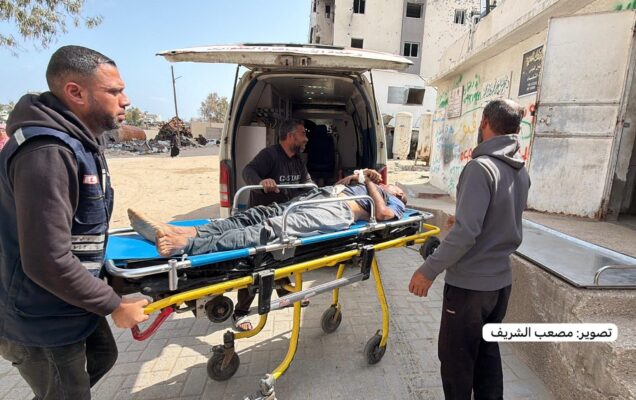
Israeli occupation forces fatally shot a Palestinian man on Sunday morning in Jabalia in the northern Gaza Strip, as continued attacks, the collapse of essential services, and the targeting of humanitarian workers further deepened the crisis across the devastated enclave.
Medical sources said soldiers opened live fire toward Khalil Nasr while he was inside the Halawa displacement camp, striking him in the head. He was transferred to a medical facility, where he later died of his wounds.
The killing came as UNICEF announced the suspension of its operations at a water‑filling site east of Gaza City after two of its contracted workers were killed by Israeli fire.
Palestinian medical sources said the strike targeted the Mansoura Street desalination facility in the Shuja’iyya neighborhood on Friday, killing brothers Eid and Mahmoud Abu Warda, both drivers for the organization, and injuring two others.
UNICEF condemned the attack, stating that the workers were carrying out a routine mission to deliver water to residents and that no changes had been made to their movement routes.
The agency warned that attacks on humanitarian personnel threaten the delivery of essential services and called for an immediate investigation and accountability. It stressed the need to protect aid workers and civilian infrastructure, including water facilities, under international humanitarian law.
The Mansoura water point is currently the only site supplying trucks connected to the Mekorot water line serving Gaza City. UNICEF and its partners rely on it multiple times a day to deliver water to hundreds of thousands of residents, including large numbers of children. The suspension of operations is expected to worsen already severe shortages.
Humanitarian assessments indicate that 1.6 million people—about 77% of Gaza’s population—are facing high levels of acute food insecurity, including more than 100,000 children and 37,000 pregnant and breastfeeding women.
Palestinian medical sources also reported that at least two more Palestinians were killed on Saturday evening by Israeli fire in separate incidents: one near Israeli military deployment north of Rafah in the southern Gaza Strip, and another in an area northwest of Beit Lahia in the north.
One of the victims was transferred to Nasser Hospital in Khan Younis after being left in the open for several hours due to the danger posed to medical teams attempting to reach him.
Earlier on Saturday, the Gaza Ministry of Health said eight bodies had arrived at hospitals within 48 hours, bringing the number of Palestinians killed since October 2023 to more than 72,550.
Across the Gaza Strip, local reporters documented renewed shelling and drone fire overnight in northern and central areas, including around Gaza City and near the Nuseirat and Bureij refugee camps. Emergency crews said destroyed roads and a lack of fuel for ambulances continue to hinder their ability to reach the wounded.
Hospitals in Khan Younis and Rafah reported ongoing shortages of anesthesia, antibiotics, and surgical supplies, forcing medical teams to perform procedures under extreme conditions. Humanitarian organizations reiterated that the health system has collapsed, with thousands of patients lacking access to dialysis, cancer treatment, and trauma care.
On October 24, 2024, Israeli forces killed and wounded 70 Palestinians in a massacre after bombing Al-Nuseirat “Martyrs” School, which shelters hundreds of children in central Gaza. pic.twitter.com/NKzwaHFDrq
— Ramy Abdu| رامي عبده (@RamAbdu) April 19, 2026
Displaced families in Rafah and Deir al‑Balah reported worsening shortages of clean water and food, with aid groups warning that the limited number of trucks entering Gaza remains far below what is needed. Many shelters have not received flour or potable water for days, and cases of dehydration and waterborne illness continue to rise.
Local media also reported continued Israeli military bulldozing and demolitions in parts of northern Gaza, including areas previously designated as “evacuation zones,” preventing residents from returning to their homes or retrieving belongings. Witnesses described ongoing drone surveillance and intermittent gunfire near several displacement sites.
Human rights organizations warned that restricted aid, ongoing bombardment, and the targeting of civilian areas are contributing to what they describe as an engineered humanitarian catastrophe, with families facing starvation, disease, and repeated displacement.
