
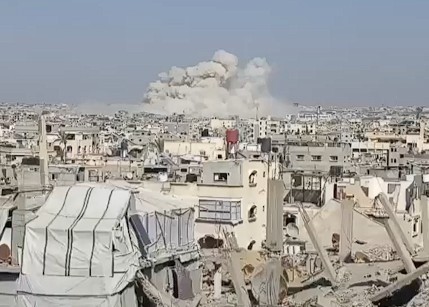
Israeli attacks and siege measures continued across the Gaza Strip on Sunday, deepening an already catastrophic humanitarian crisis and highlighting how little of the “ceasefire” framework announced in late 2025 has been implemented on the ground.
Residents in central Gaza said an Israeli drone struck a residential area early in the morning, killing two Palestinians and injuring several others.
Artillery fire also hit the western edges of Deir al‑Balah, where thousands of displaced families have been living in makeshift tents. Witnesses described people fleeing once again, carrying whatever belongings they could salvage, after Israeli forces issued new evacuation orders.
In Nuseirat and Khan Younis, sporadic shelling left additional injuries and sent families scrambling for cover. Local reporters described the situation as “a ceasefire in name only,” with Israeli attacks continuing at a pace that keeps communities in constant fear.
Inside Gaza City, conditions at the Shifa Hospital have become unbearable. Families gathered outside the main entrance demanding medical evacuation for relatives who can no longer receive treatment inside the Strip.
Patients protest outside Al-Shifa Medical Complex, demanding Israel lift travel restrictions for urgent medical treatment.
Gaza health authorities say more than 20,000 patients and wounded people are awaiting evacuation as Israel restricts Rafah crossings. pic.twitter.com/7JJq6BAehh
— Al Jazeera English (@AJEnglish) July 5, 2026
Doctors say they have no functioning intensive care beds, no dialysis capacity, and almost no surgical supplies. One medical worker said they are forced to prioritize patients based on who has the best chance of surviving without equipment.
Rights groups also warned that detained medical personnel, including hospital directors held by Israeli forces, are in life‑threatening condition.
The health emergency is compounded by a surge in disease. Over the past two weeks, medical relief teams documented thousands of new cases of contagious skin infections—including chickenpox, scabies, and lice—spreading rapidly through overcrowded shelters. Intestinal illnesses linked to contaminated water and food are also rising, with aid workers reporting entire families falling ill at once.
Humanitarian access remains severely restricted. Relief officials say only 150 to 200 trucks are entering Gaza each day, far below the 600 to 1,000 trucks required to meet basic needs.
🚨HEARTBREAKING: Elderly Palestinian Umm Atta Al-Nashash searches the ruins of her destroyed home in central Gaza’s Bureij refugee camp, hoping to recover the remains of her four sons, who were killed when the Israeli army bombed their home two years ago. pic.twitter.com/OEptk33iJE
— Gaza Notifications (@gazanotice) July 5, 2026
Many of the trucks that do enter are designated for private‑sector goods rather than humanitarian supplies, leaving UN agencies and local organizations unable to reach large segments of the population.
WAFA News reported that several aid convoys were blocked at Israeli‑controlled crossings today, delaying deliveries of flour, medicine, and water purification tablets.
Conditions in displacement shelters continue to deteriorate. More than 750 sites across Gaza are hosting families in worn‑out tents infested with insects and rodents. With summer temperatures rising, doctors say skin infections are spreading faster, and children are fainting in food lines due to dehydration and hunger.
UN field teams warn of critical malnutrition, especially in northern Gaza, where families have endured repeated displacement and long periods without regular food distributions. Infant formula and clean water remain scarce.
The physical destruction across Gaza remains overwhelming. Recent assessments cited by Al Jazeera estimate that nearly all buildings in the Strip have been damaged or destroyed, and large areas remain under direct Israeli military control or subject to strict movement restrictions.
New displacement orders in western Deir al‑Balah this week forced families to move yet again, often to areas with no infrastructure or services.
Politically, the “ceasefire” agreement that took effect on October 11, 2025, remains largely unfulfilled. Key provisions—steady aid entry, withdrawal of Israeli forces from designated areas, and a comprehensive detainee exchange—have stalled.
While international mediators continue to discuss a second phase focused on reconstruction and administrative arrangements, Palestinian officials warn that the current trajectory risks cementing long‑term Israeli control rather than enabling genuine recovery.
