
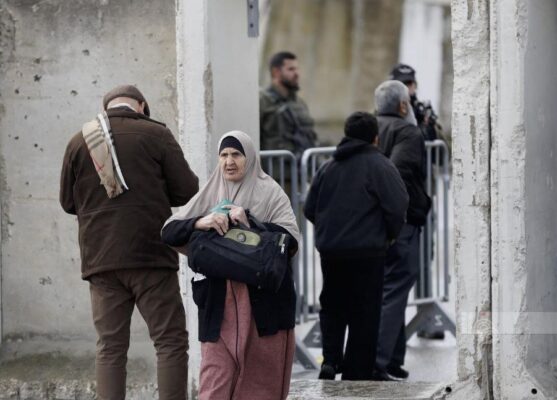
Israeli forces intensified invasions, home break‑ins, abductions, and movement restrictions across the occupied West Bank, including occupied Jerusalem, from Thursday evening through Friday, targeting children, worshippers in Al-Aqsa, and entire communities amid a sharp escalation during the second Friday of Ramadan.
Israeli soldiers stationed at a military roadblock at the entrance to Shuhada Street in Hebron in the southern West Bank abducted 15‑year‑old Hamed Mufid al‑Sharabati as he attempted to pass through the roadblock on his way home to the Tel Romeida neighborhood.
Later that evening, Israeli forces invaded the nearby town of Beit Awwa, west of Hebron, spreading through residential streets, obstructing movement, and firing concussion grenades and tear gas.
Two Palestinian children, aged 14 and 15 and both from the town of Silwad, were shot with live ammunition by Israeli forces near the junction of the village of al‑Mazra’a ash‑Sharqiya, east of Ramallah in the central West Bank.
Local sources said the children were inside a vehicle when Israeli soldiers opened fire. One child was struck in the chest and reported to be in stable condition, while the other sustained moderate injuries.
On Friday morning, Israeli forces invaded the village of Kafr Malek, east of Ramallah, where soldiers used loudspeakers to broadcast Hebrew songs at high volume in an apparent attempt to disturb residents.
Around the same time, troops invaded the town of az‑Zawiya, west of Salfit in the central West Bank, breaking into several homes, interrogating residents, and ransacking property.
 In Bethlehem in the southern West Bank, Israeli forces abducted a man identified as Khaled Issa Tarayra, originally from Bani Na’im near Hebron, after stopping his vehicle in the city of Beit Jala.
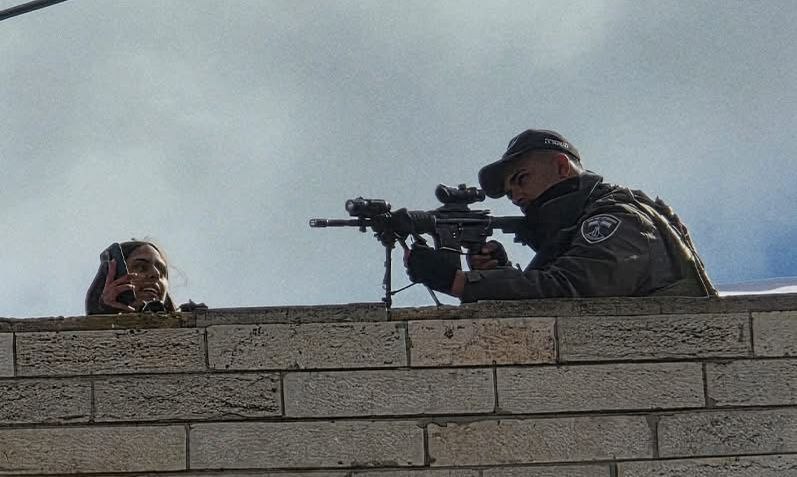
Also in Bethlehem, the army deployed sharpshooters near roadblock #300, in addition to dozens of soldiers in the area to prevent the Palestinian worshipers from entering Jerusalem to reach Al-Aqsa.
In addition, several Israeli military vehicles invaded Beit Fajjar town, south of Bethlehem, and closed several streets.
Before dawn, Israeli forces invaded the town of Deir al‑Ghusoon, north of Tulkarem in the northwestern West Bank, breaking into several homes and abducting six young men: Mohammad Abdel‑Khaleq, Abdel‑Aziz Raja Khalayla, Islam Raed al‑Doqqa, Yousef Hatem al‑Qub, Ibrahim al‑Masoud, and Yahya Nidal Ghanem. Residents reported extensive damage to the interiors of the homes during the invasions.
In occupied Jerusalem, Israeli forces abducted Sheikh Rani Rushdi Abu Sbeih at one of the gates of the Al‑Aqsa Mosque compound and transferred him to the al‑Qishla interrogation center.
The abduction came amid what local authorities described as an unprecedented escalation in Israeli measures across the city during the second Friday of Ramadan.
Israeli forces deployed heavily around the Al‑Aqsa Mosque, installed iron barriers at its main entrances and throughout the Old City, and imposed severe restrictions on Palestinians arriving from the occupied West Bank through the Qalandia military roadblock to the north and the Bethlehem military roadblock to the south, preventing hundreds, particularly elderly worshippers, from reaching the mosque.
Despite the restrictions, approximately 100,000 Palestinians performed Friday prayers at Al‑Aqsa, underscoring the determination of worshippers to reach the mosque despite the intensified measures.
The Jerusalem Governorate reported that Israeli authorities have issued more than 280 expulsion orders barring Palestinians from entering Al‑Aqsa, forcing many of those expelled to pray inside the adjacent Bab al‑Rahma Cemetery, where Israeli forces have also trampled graves and erected tents.
Israeli forces continued to target worshippers inside the mosque compound, including through abductions during the evening and Taraweeh prayers, as well as field interrogations and restrictions on bringing in food for iftar and suhoor.
Authorities also disrupted the work of the medical clinic and prevented the installation of shade structures for worshippers.
Journalists in occupied Jerusalem were subjected to abductions, summonses, interrogations, and restrictions on their ability to report from the area, including expulsion orders and bans on covering events inside the mosque compound.
Local authorities warned that these measures form part of broader efforts to alter the historical and legal status of Al‑Aqsa Mosque by expanding the authority of Israeli police over its internal administration and undermining the role of the Islamic Waqf.
They reaffirmed that Al‑Aqsa Mosque is an exclusively Muslim holy site and held Israeli authorities responsible for the consequences of the ongoing escalation, urging the international community to uphold its legal and moral responsibilities toward developments in occupied Jerusalem.
