
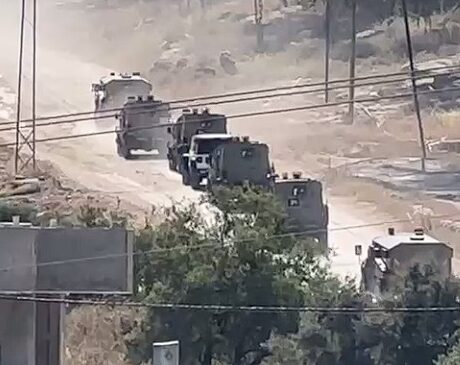
Israeli occupation forces carried out extensive invasions across multiple districts of the occupied West Bank on Monday, storming towns, villages, and refugee camps, violently searching homes, interrogating residents, abducting many Palestinians, and obstructing ambulances, causing a pregnant woman to lose her fetus.
The day’s assaults included a severe medical obstruction incident in which a woman from Qaryut lost her fetus after soldiers blocked the ambulance transporting her, detained the medical team, and forced the vehicle’s engine to be shut off, disabling life‑support equipment.
The invasions were accompanied by widespread road closures, military roadblocks, and the conversion of civilian homes into military posts, further restricting Palestinian movement and access to essential services.
Israeli forces invaded Beit Ummar, Ethna, Doura, and Yatta in the Hebron district in the southern West Bank, searching homes and vehicles, assaulting residents, and subjecting several to field interrogations, including journalist Ehab Al‑Alami.
Soldiers installed multiple military roadblocks at the entrances of Hebron city, its towns, villages, and refugee camps, and closed several main and secondary roads with iron gates, concrete blocks, and earth mounds.
In Aqraba, south of Nablus in the northern West Bank, colonizers assaulted farmer Noah Lutfi Bani Fadel while he worked his land. Israeli forces then invaded the area and abducted Bani Fadel instead of stopping the attack.
Furthermore, a fire erupted near Nissan Park west of Jenin in the northern West Bank after Israeli forces invaded the area and fired live rounds, gas bombs, and concussion grenades.
In Tulkarem, in the northwestern West Bank, Israeli occupation forces continued a large abduction campaign for the second consecutive day, detaining 20 Palestinians, including a woman, from Deir Al‑Ghusoun, Attil, Ar‑Ras, Far’un, Bal’a, and Anabta, after invading and ransacking homes.
In Qalqilia, also in the northwestern West Bank, soldiers abducted former political prisoner and wounded resident Bilal Maskawi after invading his home in the Naqqar neighborhood, along with several other residents from surrounding neighborhoods and villages.
In Qalandia refugee camp, north of occupied Jerusalem, Israeli forces invaded the Qalandia Technical Training Institute, fired tear‑gas canisters, detained teachers and staff inside one hall, and occupied the roof of the Popular Committee building.
Two Palestinians, including a child, were injured. The Palestine Red Crescent Society said soldiers blocked its ambulances from entering the camp.
In Al‑Malha, northwest of Za’tara east of Bethlehem, Israeli forces deployed in several neighborhoods, inspected buildings under the pretext of “license verification,” and issued demolition and stop‑construction notices.
In Turmus Ayya, north of Ramallah in the central West Bank, Israeli occupation forces invaded a Palestinian home, expelled its residents, and converted the property into a military post.
The home’s owner, a Palestinian physician who also holds American citizenship, had returned from the United States just one week earlier.
Protests also erupted in after the army invaded Kafr Malek town, northeast of Ramallah, where soldiers fired tear‑gas canisters at residents.
In the Nablus district, in the northern West Bank, Israeli forces abducted eight Palestinians from Tell, Madama, Asira Al‑Shamaliya, and Burqa, including the father of Ibrahim and Jawad Ramadan, both killed by Israeli paramilitary colonizers and soldiers during Friday’s attack on Tell.
Soldiers also invaded Balata refugee camp, abducting Abdullah Al‑Hotari, Abboud Mustafa, and Mahmoud Qar’an, and blocked a Beita ambulance at the Awrata military roadblock.
In the medical obstruction incident in Qaryut, soldiers blocked the ambulance transporting a pregnant woman in her sixth month, detained the medical team, and forced the ambulance engine to be turned off.
After more than 30 minutes, the ambulance was allowed through, but the woman reached the hospital after losing her fetus. Her life was saved.
A fetus died while its mother survived after Israeli soldiers delayed an ambulance at the Awarta checkpoint, south of Nablus, for more than 45 minutes. pic.twitter.com/omnlkeOjSV
— Eye on Palestine (@EyeonPalestine) July 27, 2026
Medic Bashar Qaryuti said the soldiers deliberately delayed the ambulance, searched the vehicle, and even subjected the six‑month pregnant woman—who was already bleeding—to additional delays despite her condition.
This incident follows the death of Sojoud Fuqaha’ (30) from Sinjil, who suffered a cardiac arrest last week after soldiers blocked ambulance access to the town.
On Sunday, two women were forced to give birth inside private vehicles after soldiers blocked access to hospitals around Nablus. Israeli forces continue obstructing medical teams across the occupied West Bank, delaying ambulances and preventing access to patients.
These are some of the documented Israeli invasions, abductions, and violations carried out across the occupied West Bank; the ongoing and extensive nature of the assaults and restrictions means not all incidents can be fully covered.
